
What size stall does a horse need?
There is a published rule that sizes a stall from your horse instead of from habit: take the height at the withers, multiply by 2 to 2.5, and square it to get the floor area. A 16 hh horse comes out at 144 sq ft, which is a 12 x 12.
Why?
Square for a box stall. A mare and foal get double the length, which is what you get by taking out one wall between two normal stalls.Why?
Your horse's height at the withers, multiplied by 2 to 2.5, then squared. It comes from the one study that watched how horses lie down in different sized boxes.Why?
A second rule, from a different source: 9 sq ft of floor for every 100 lb of horse. It is a floor rather than a target, so it sits below the figure above.Why?
Length times width, so you can compare your own stall with the two rules above.Why?
The usual range for a horse barn. For a tall horse, measure instead — you want about a foot of clear space above its ears with its head up.Why?
The opening the horse walks through, not the frame. The low end is what most door makers sell, the high end is what is recommended.Why?
The stalls plus the aisle between them. Up to three stalls sit in one row, four or more in two facing rows.What the answer means
A 16 hh, 1,150 lb riding horse needs 114 sq ft (11 m²) to 178 sq ft (17 m²) of floor, and the size to build is 12 × 12 ft.
That is the standard American box stall, and the point of this page is that it was not reached by copying the neighbours.
It falls out of a rule that starts from the horse.
Floor area is the square of two to two and a half times the wither height, and it comes from the only study located that measured what box size does to a horse.
Every ranking answer to this question gives you a table instead.
10 × 10 for a pony, 12 × 12 for a horse, 16 × 16 for a draft, with nothing that asks how big your horse actually is.
The table happens to be right for the middle of its range and wrong at both ends, which is exactly where people who go looking are standing.
The formula, and a worked example
Two published rules run side by side here, from unrelated sources and using different inputs. Neither is a fudge of the other.
Rule one — from the horse’s height. Area = (k × wither height)², with k between 2 and 2.5.
For our 16 hh horse: 64 in is 5.33 ft, so 2 × 5.33 = 10.7 ft, squared is 114 sq ft; at 2.5 it is 178.
The middle of that band is 144 sq ft. A 12 × 12 stall is 144.
Watch the form of that equation, because it is where the published wording goes wrong. The multiplier is applied to the height and the result is squared.
The FASS Ag Guide restates the same source as “2 to 2.5 times the height of the horse (at the withers) squared”, which can just as easily be read as two to two and a half times the height squared.
Read it that way and you get 57 sq ft, less than half the floor.
The original paper settles it. Its own boxes were (2.5 × height)² and (1.5 × height)² square metres, and only that reading reproduces the box areas it reports.
Rule two — from body weight. 9 sq ft per 100 lb.
Our 1,150 lb horse comes to 104 sq ft (10 m²), which is well under the height rule and is meant to be: it is a bare minimum for a university or research barn, not a recommendation.
Having two rules disagree in a known direction is more useful than averaging them into one number. If your stall clears the height band you are comfortable; if it fails the weight rule you have a welfare problem rather than a preference.
Is a 10×10 stall big enough for a horse?
Not for a 16 hh horse.
100 sq ft is short of the 114 sq ft at the bottom of the band, and it is under the 104 sq ft the body-weight rule asks for as a minimum.
For a 12.2 hh pony it is right: that pony needs 69–109 sq ft.
Penn State treats 10 ft as the shortest wall worth building for a riding horse whatever the area comes to, and Extension Horses states the same floor as a size — 10 × 10 is the minimum box stall.
The reason it is a wall rule and not an area rule is being cast. A horse that lies down close to a short wall can end up with its legs against it and no way to get them underneath itself again.
What is the average stall size for a horse?
12 × 12 ft, and that is also what is normally meant by a good size stall for a horse.
Extension Horses puts it plainly: the minimum box stall for a riding horse is 10 × 10, more commonly they are 12 × 12, and 16 × 16 or larger is not uncommon.
What the average conceals is that it is only average for an average horse. A 15 hh horse of 1,000 lb needs 100–156 sq ft, so 144 sits comfortably inside it.
A 17.2 hh, 1,900 lb draft needs 136–213 sq ft, and the body-weight rule alone puts its minimum at 171 sq ft. A 12 × 12 fails both.
That is a whole page of its own.
How tall should a horse stall be?
10 to 12 ft is what horse barns are commonly built to, with 8 ft the minimum. The Ag Guide’s band is tighter, 8 to 10 ft.
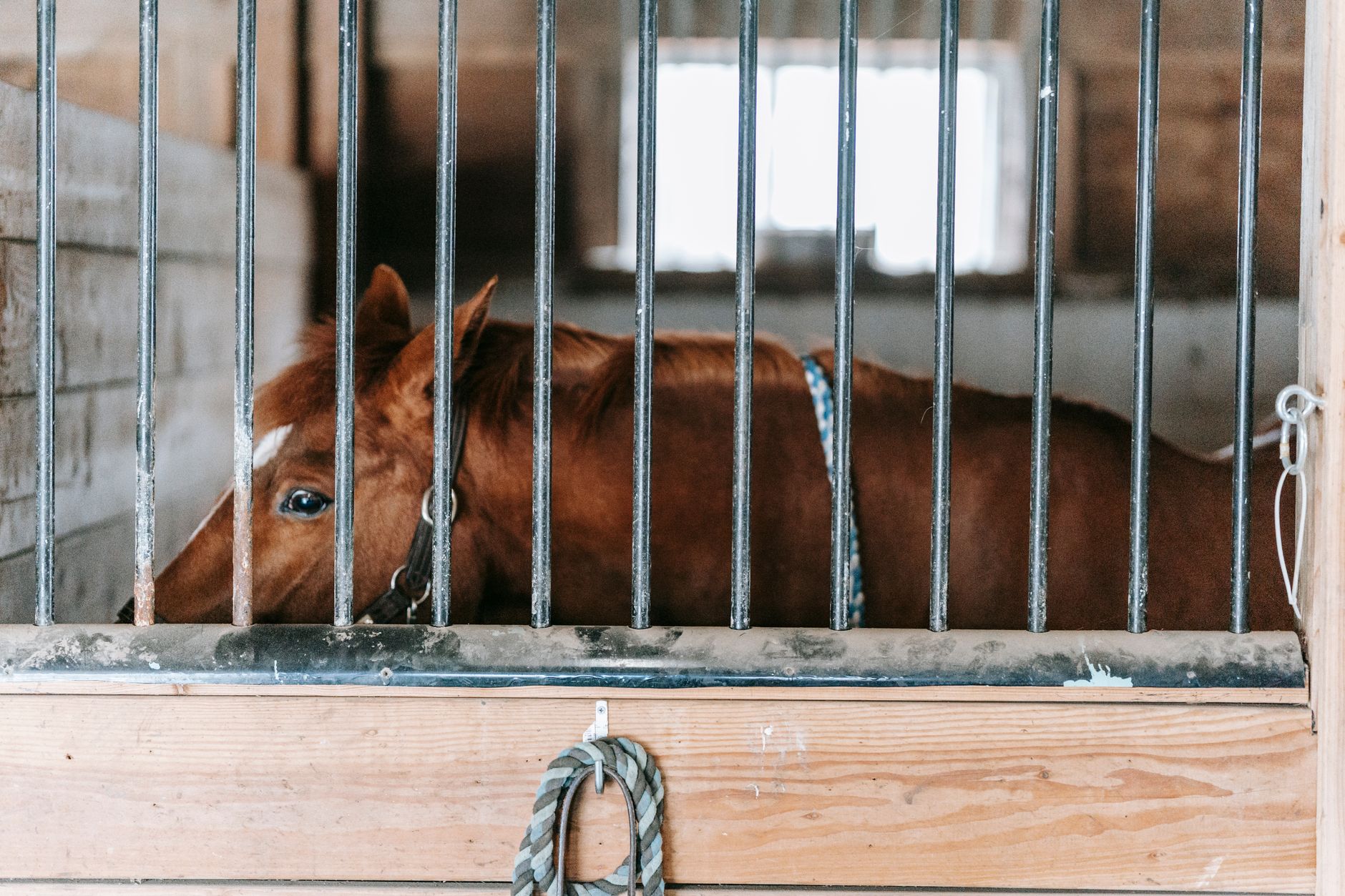
For a tall horse neither band is the test. The rule that governs is at least 1 ft (0.3 m) of clearance above the horse’s ears when its head is held at its highest.
Measure that to the lowest thing a head can strike, not to the ridge.
In a barn with open trusses and no ceiling that is the bottom chord of a truss or a light fitting, and it is often a good deal lower than the roof.
Partitions are a separate figure. 8 ft is standard, 7.5 ft is the minimum Penn State sets, and Extension Horses works to 7 ft.
All three are set by the same thing: most horses can kick as high as 7 ft.
Where each input comes from
Height at the withers. The highest point of the shoulder, straight down to the ground, with the horse standing square on level ground.
In inches rather than hands, because the rule multiplies it — 16 hh is 64 in.
Body weight. Only the second rule uses it, so an estimate is fine.
A tape or the horse weight calculator will get you close enough.
Your stall. Measure inside the walls, not the outside of the frame.
A stall sold as 12 × 12 is often a little under once the boards are in.
Time spent in. Penn State gives the direction without a number: the more time a horse spends in a stall, or the more active it is, the larger the stall that is justified.
So this input picks where in the published band you sit rather than scaling it, and the range you see is always the sourced one.
| Time in the stall | Area needed | Build | Is a 12 × 12 enough? |
|---|---|---|---|
| A few hours a day | 114–144 sq ft | 12 ft square | Yes |
| Overnight, out in the day | 114–178 sq ft | 12 ft square | Yes |
| In most of the day, or on box rest | 144–178 sq ft | 14 ft square | It scrapes in |
What changes the answer
The 1½-times rule, and the trap in it. Penn State also states that the stall wall length is one and a half times the horse’s length.
It does not say which length, and the difference is enormous.
Back-solve it against their own datum of a 12 ft wall for a 1,000 lb horse and it implies a horse 8 ft (2.4 m) long, which is nose to tail.
Feed in the 66 in point-of-shoulder-to-buttock body length a weight tape uses and the rule returns a wall of 8.3 ft (2.5 m) — which the same page rules out two sentences later.
Mare and foal. Two occupants, so the floor doubles: 288 sq ft (27 m²) for our horse, built as 12 × 24 ft.
Extension Horses gives 16 × 20 ft as the useful foaling stall, which is much the same floor arrived at as a square.
The cheap route to the same thing is Penn State’s: take out the divider between two standard stalls. Two 12 × 12 boxes become a 12 × 24 for the cost of an afternoon.
Tie stalls. Sized on 4 sq ft per 100 lb rather than 9, because the horse is not expected to turn round.
Our horse comes to 46 sq ft (4 m²), and the Ag Guide’s worked example is 5 × 12 ft measured from the manger front to the back of the stall.
Turnout. No stall is large enough to be the whole answer.
The published standard is 30 minutes of turnout or 15 minutes of controlled exercise a day for a horse in a box stall, and the source is candid that no study has established the right figure.
The small dimensions nobody checks.
At least 4 sq ft of window per stall for natural light, and less than 3 in of clearance under a full-length door so a hoof cannot get stuck.
Horse stall size chart
Generated by the calculator above rather than typed, so the chart and the tool cannot drift apart. Read across for your horse; the last column is the size to build.
| Type | Height | Weight | Area needed | By body weight | Build |
|---|---|---|---|---|---|
| Miniature | 8.2 hh (34 in) | 250 lb | 32–50 sq ft | 23 sq ft | 8 × 8 ft |
| Small pony | 11 hh (44 in) | 400 lb | 54–84 sq ft | 36 sq ft | 10 × 10 ft |
| Welsh pony | 12.2 hh (50 in) | 500 lb | 69–109 sq ft | 45 sq ft | 10 × 10 ft |
| Large pony | 14 hh (56 in) | 700 lb | 87–136 sq ft | 63 sq ft | 12 × 12 ft |
| Small horse | 15 hh (60 in) | 1,000 lb | 100–156 sq ft | 90 sq ft | 12 × 12 ft |
| Riding horse | 16 hh (64 in) | 1,150 lb | 114–178 sq ft | 104 sq ft | 12 × 12 ft |
| Warmblood | 16.3 hh (67 in) | 1,350 lb | 125–195 sq ft | 122 sq ft | 14 × 14 ft |
| Light draft | 17.2 hh (70 in) | 1,900 lb | 136–213 sq ft | 171 sq ft | 14 × 14 ft |
| Heavy draft | 18 hh (72 in) | 2,100 lb | 144–225 sq ft | 189 sq ft | 14 × 14 ft |
Horse stable dimensions in meters
The same rows in metric, since the rule the whole page rests on was published in square metres in the first place.
| Type | Height | Weight | Area needed | Build |
|---|---|---|---|---|
| Miniature | 0.86 m | 113 kg | 3–4.7 m² | 2.4 × 2.4 m |
| Small pony | 1.12 m | 181 kg | 5–7.8 m² | 3 × 3 m |
| Welsh pony | 1.27 m | 227 kg | 6.5–10.1 m² | 3 × 3 m |
| Large pony | 1.42 m | 318 kg | 8.1–12.6 m² | 3.7 × 3.7 m |
| Small horse | 1.52 m | 454 kg | 9.3–14.5 m² | 3.7 × 3.7 m |
| Riding horse | 1.63 m | 522 kg | 10.6–16.5 m² | 3.7 × 3.7 m |
| Warmblood | 1.7 m | 612 kg | 11.6–18.1 m² | 4.3 × 4.3 m |
| Light draft | 1.78 m | 862 kg | 12.6–19.8 m² | 4.3 × 4.3 m |
| Heavy draft | 1.83 m | 953 kg | 13.4–20.9 m² | 4.3 × 4.3 m |
Common questions about horse stall size
Is a 10×10 stall big enough for a horse?
For a 16 hh riding horse, no. The published area band for that horse is 114–178 sq ft and a 10 × 10 is 100.
It is enough for a pony: a 12.2 hh pony needs 69–109 sq ft, and 10 ft is the shortest wall Penn State will recommend for anything horse-sized anyway.
What is a normal size for a horse stall?
12 × 12 ft, 144 sq ft, and it is normal for a good reason rather than an arbitrary one. Run a 16 hh horse through the wither-height rule and it returns 144 sq ft at the middle of the band.
The American convention and a Danish behavioural study land on the same number.
How tall should a horse stall be?
10–12 ft to the ceiling, with 8 ft the minimum, and partitions 7–8 ft high.
For a big horse the real test is different: at least 1 ft of clearance above its ears with its head up, measured to the lowest light fitting or truss rather than to the roof.
What is the minimum horse stall height?
8 ft of headroom, and a partition of 7 ft at the very least.
Most horses can kick as high as 7 ft, which is why the partition figure is what it is, and Penn State asks for 7.5 ft to stop a horse getting a leg over the wall.
How much does it cost to build a 12×12 horse stall?
We do not publish a price.
A stall’s cost turns on what your local builder charges and on whether you are framing a new bay or fitting a front into an existing one, and any figure here would be stale within a season.
What this page can tell you is whether 12 × 12 is the size you should be pricing.
Do horses prefer to be stabled at night?
What has been measured is narrower than preference.
Horses in a box of (2.5 × wither height)² m² spent significantly longer lying on their chests with their legs tucked under them than the same horses in a box of (1.5 × height)².
That is the posture in which a horse can reach REM sleep, so box size affects how a horse rests. Whether it would rather be in or out is not what that study asked.
How big should a stall be for two horses?
Two horses do not share a box stall.
A mare and foal count as one occupant and a half in practice, and the published answer is a 16 × 20 ft foaling stall or, more cheaply, the divider taken out between two standard stalls to give 12 × 24 ft.
How wide should a barn aisle be?
8–14 ft between two rows of stalls, 12 ft being the usual working figure.
It matters more than it sounds: a 10-stall barn built two rows deep needs 2,160 sq ft (201 m²) of floor, and the aisle is about 33% of it.
Read next
- What size stall for a draft horse? — where a 12 × 12 stops being enough, and what the two rules say instead.
- What size stall for a mini horse? — both published rules are written for light breeds, and neither has a miniature in it.
- How big should a wash stall be? — the one stall sized around the handler rather than the horse.
- How many bags of shavings for a horse stall? — now you know the size, what it takes to bed it.
- How much does a horse weigh? — the second rule on this page needs a body weight.
- All horse calculators — the rest of the tools in this section.
Where these figures come from
Every coefficient behind this calculator is published and cited, and where two published sources disagree we say so rather than quietly pick one. Two such disagreements sit on this page.
The first is the wording of the area rule itself, which the Ag Guide restates in a form that can be read two ways; the paper it cites settles it.
The second is that the same Ag Guide’s own worked examples — 12 × 12 for a box, 5 × 12 for a tie stall — are more generous than the per-weight rules printed beside them.
- Equine Facilities: Stall Dimensions — Extension Horses (eXtension)
- Guide for the Care and Use of Agricultural Animals in Research and Teaching, 3rd ed., Chapter 8: Horses — Federation of Animal Science Societies (FASS)
- Horse Stall Design (Horse Facilities #4) — Penn State Extension
- Lying behavior in horses in relation to box size — Journal of Equine Veterinary Science 26(1):11-17, 2006
- Operation: Wash-stall Design — Stable Management, 2 October 2012