
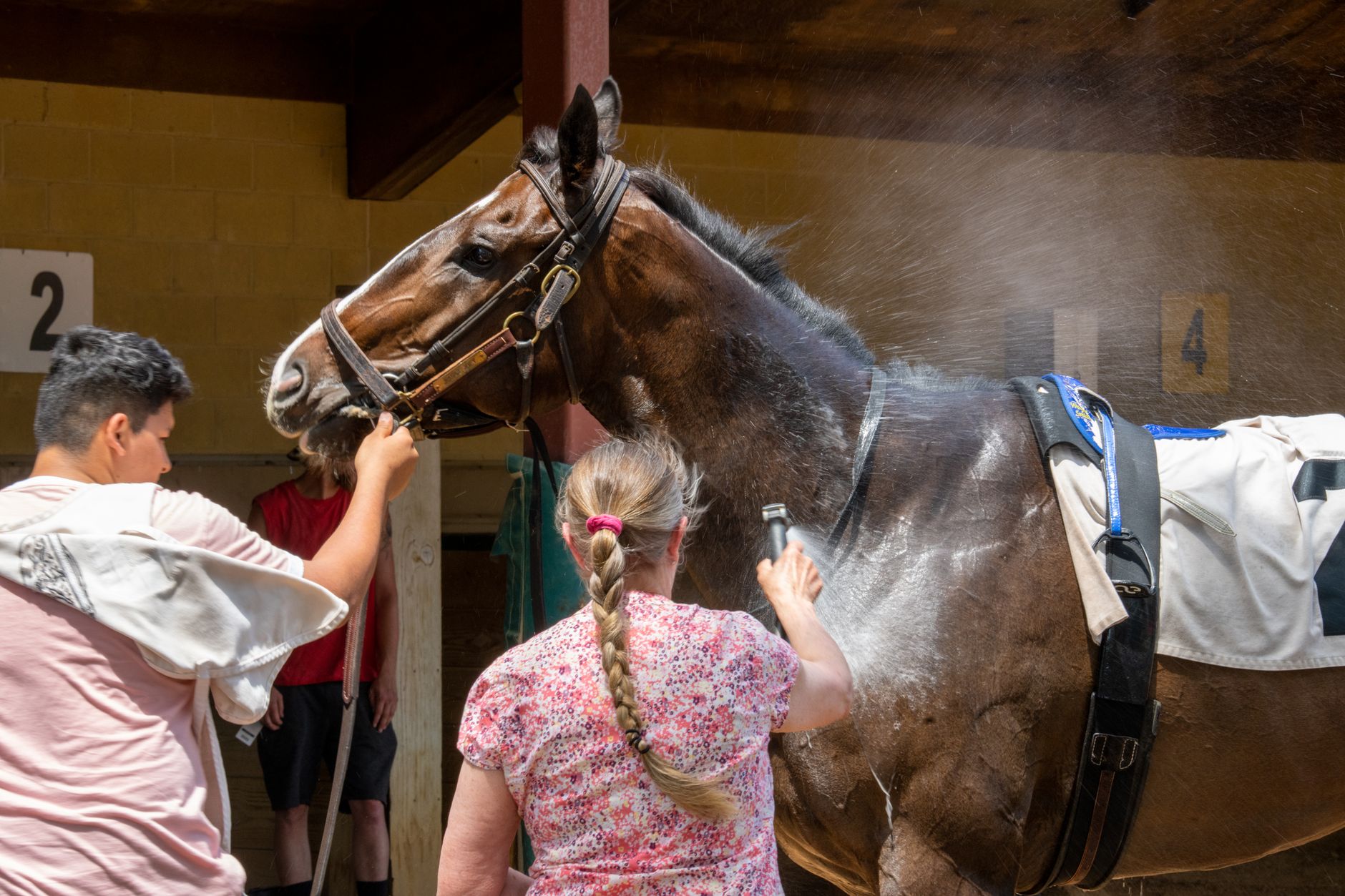
How big should a wash stall be?
10 ft (3 m) wide and 12 ft (3.7 m) deep is the published minimum, and it is what an architect who designs equine buildings works to. That is 120 sq ft (11 m²) of floor.
Notice which way round those numbers go.
The 10 is across the horse and the 12 is along it, which is the reverse of how a box stall is normally quoted, and the reason is the whole point of this page.
A box stall is sized around the horse. A wash stall is sized around the person, the hose and the room to get out of the way.
So the rules that size a box stall — the ones behind our stall size calculator — do not apply here, and it would be dishonest to run them.
A horse in a wash stall is tied, standing, and not lying down or turning round.
| Size | Metric | Floor | What it buys | |
|---|---|---|---|---|
| Published minimum | 10 × 12 ft | 3 × 3.7 m | 120 sq ft | Room to work either side of the horse. The figure an equine architect designs to. |
| A standard bay | 12 × 12 ft | 3.7 × 3.7 m | 144 sq ft | Fits a 12 ft stall opening, so it drops into a barn without special framing. |
| Comfortable | 12 × 14 ft | 3.7 × 4.3 m | 168 sq ft | Somewhere to stand at the head and still get a hose past the quarters. |
| Draft or clipping | 14 × 14 ft | 4.3 × 4.3 m | 196 sq ft | A big horse plus a person plus clippers on a lead, without anyone reversing into a wall. |
Why the width matters more than the depth
The horse’s length is fixed and roughly known. What varies is how much room you have beside it, and that is where the work happens.
At 10 ft (3 m) across you have about 3.8 ft (1.1 m) either side of a horse standing in the middle. That is enough to stand square to it with a hose or a sweat scraper and not be pinned if it moves over.
Take it to 8 ft (2.4 m) to save space and you have lost that. The horse only has to shift its weight to put you against the wall, and a wet horse in a confined space is exactly when that happens.
Going the other way has a cost too.
A wide wash stall lets a horse swing away from the hose rather than stand and take it, which is why the builders who quote 14 ft (4.3 m) of width are quoting it for clipping and veterinary work rather than for washing.
The drainage is the part that goes wrong
The slope decides whether the wash stall drains or floods your aisle, and it has an extension figure behind it: one inch of fall per 6 ft (1.8 m), which is a slope of 1.4%.
That is enough to move water and not so much that it stresses a horse’s tendons standing on it, which is the reason the figure is what it is rather than steeper.
With the drain at the rear wall, the fall runs along the depth of the stall: 2 in (5.1 cm) over 12 ft (3.7 m). Slope it sideways to a wall trench instead and it is 1.7 in (4.3 cm) across 10 ft (3 m).
Either way it is a fall you cannot see and a horse cannot feel, which is the intention. If the finished floor looks level, you have probably got it right.
The quarter-inch-per-foot rule you will read elsewhere is not a horse figure. It is 2.1%, half as steep again, and it comes from general concrete flatwork rather than from anyone thinking about standing an animal on it.
For the drain itself, a 4 in (10.2 cm) trench set 2 ft (0.6 m) from the rear wall with a non-slip removable grate keeps it behind the horse and out of the way.
Horses spook far less at a trench along the back wall than at a round grate in the middle of the floor.
Put a sediment trap in the line and clean it. Hair, sand and shavings will find the drain, and a wash stall that backs up is worse than no wash stall.
Height, doors and the things around it
Ceiling height follows the same rule as any stall: 10–12 ft is what barns are built to, 8 ft is the quoted minimum, and for a tall horse the test is 1 ft (0.3 m) of clearance above its ears with its head up.
A wash stall makes the head-up case more likely rather than less. A horse that dislikes water goes up before it goes anywhere else, so measure the clearance to the lowest light fitting and use a sealed, waterproof one.
The opening wants to be generous.
4 ft (1.2 m) of clear width is the recommendation for a box stall and it is the floor here, because a horse comes out of a wash stall wet, cold and keen.
Watch the aisle in front of it. The published range between two rows of stalls is 8–14 ft, and a wash stall wants the wide end.
It is the one place in a barn where a horse stands still for twenty minutes while everyone else needs to get past it. Putting it opposite the tack room and away from the arena door is worth more than any dimension on this page.
Walls, floor and water
The walls have to be waterproof and washable. Sealed concrete block or fibreglass-reinforced panel, not timber, which will not survive being wetted daily.
Steel panels are worth avoiding for three reasons at once: they rust, they stay cold, and they are noisy when water hits them.
The floor should not be plain concrete. It is slippery wet, which is the single most likely way anyone gets hurt in a wash stall.
Rubber mats trap water and organic matter underneath, so poured seamless rubber with a non-slip finish is the answer if the budget reaches it and textured or broom-finished concrete if it does not.
The water does not need to be hot. 80–90 °F (27–32 °C) is warm enough for a horse and costs a great deal less to keep than domestic hot water.
Does it have to be indoors?
No, and an outdoor wash rack solves most of the drainage problem by not having a barn to flood. What you give up is the ability to use it in February.
The sizes are the same either way, because they are set by the horse and the handler rather than by the roof. What changes is that outdoors you can slope the whole pad to one side and let it run to grass.
If you are only ever going to hose legs off after a ride, an outdoor rack on a well-drained pad does the job for a fraction of the cost.
The indoor wash stall earns its keep for clipping, for treating wounds and for getting a horse clean in winter.
A note on the sources
The size figures here come from an equine architect quoted in a trade publication, not from extension. No extension or peer-reviewed publication located for this page sets a wash stall size, and that is worth saying plainly.
The drainage slope is the exception and it is the more important number: that one is Penn State’s, quoted in the same article, and it is the only figure on this page with a tendon-related reason attached to it.
Common questions about wash stall size
How big should a wash stall be?
10 ft (3 m) wide and 12 ft (3.7 m) deep as a minimum — 120 sq ft (11 m²) — which is what an equine architect designs to for room to work safely around the horse.
12 × 12 is the common built size because it drops into a standard stall bay, and 12 × 14 or 14 × 14 is worth it if you clip or if you keep drafts.
Is a 10×12 wash stall big enough?
Yes, that is the published minimum and it is a working size.
It gives roughly 3.8 ft (1.1 m) either side of a horse standing in the middle, which is enough to stand square to it and not be pinned if it moves over.
Below that width you are the one who gets squashed.
What is the best slope for a wash stall floor?
One inch of fall per 6 ft (1.8 m), which is 1.4% — enough to move water without stressing a horse’s tendons as it stands there. Running back to a rear trench that is 2 in (5.1 cm) over 12 ft (3.7 m).
The quarter-inch-per-foot figure quoted elsewhere is 2.1%, and it comes from general concrete work rather than from horses.
Where should the drain go in a wash stall?
A 4 in (10.2 cm) trench drain set 2 ft (0.6 m) from the rear wall, with a non-slip removable grate. Horses spook at a round grate in the middle of the floor far more than at a trench behind them.
Put a sediment trap in the line, because hair, sand and bedding will all find their way down it.
How wide should a wash stall door be?
At least the 4 ft (1.2 m) of clear opening recommended for a box stall, and wider if you can. A horse leaves a wash stall wet and often in a hurry, which is a different proposition from walking calmly into a stall it lives in.
Can you use a horse stall as a wash stall?
You can convert one, and the size works — a 12 × 12 box is comfortably inside the range.
The work is all in the floor and the walls: you need a fall to a drain, a waterproof wall surface and a non-slip floor, none of which a box stall has.
It is a floor-and-drainage job rather than a framing job.
How hot should wash stall water be?
80–90 °F (27–32 °C) is plenty. Scalding water is unnecessary for a horse and expensive to keep standing, and turning the barn heater down is one of the easier savings in a stable.
Related calculators and guides
- What size stall does a horse need? — the box stall the same barn needs, sized from the horse rather than the handler
- What size stall for a draft horse? — the wash stall grows with the horse too, and the door is the part that fails
- How many bags of shavings for a horse stall? — the box stalls either side of it, and what they cost to keep up
- All horse calculators — the rest of the tools in this section
Where these figures come from
Every figure on this page is published and cited. Where sources disagree we take the more conservative one and say so.
Our full approach is set out in how we source our numbers.
- Equine Facilities: Stall Dimensions — Extension Horses (eXtension)
- Guide for the Care and Use of Agricultural Animals in Research and Teaching, 3rd ed., Chapter 8: Horses — Federation of Animal Science Societies (FASS)
- Horse Stall Design (Horse Facilities #4) — Penn State Extension
- Lying behavior in horses in relation to box size — Journal of Equine Veterinary Science 26(1):11-17, 2006
- Operation: Wash-stall Design — Stable Management, 2 October 2012