
How much hay does a horse need per day?
Enter your horse's weight and how it is kept. Every answer is a range, because every published figure behind it is a range.
How much hay does a horse eat a day?
How much hay does a horse need a day? Between 1.5% and 2.5% of its body weight in dry forage, with about 2% as the everyday working figure. That single sentence is most of the science. Everything else on this page is the arithmetic around it, and the reasons your horse might sit at one end of that range rather than the middle.
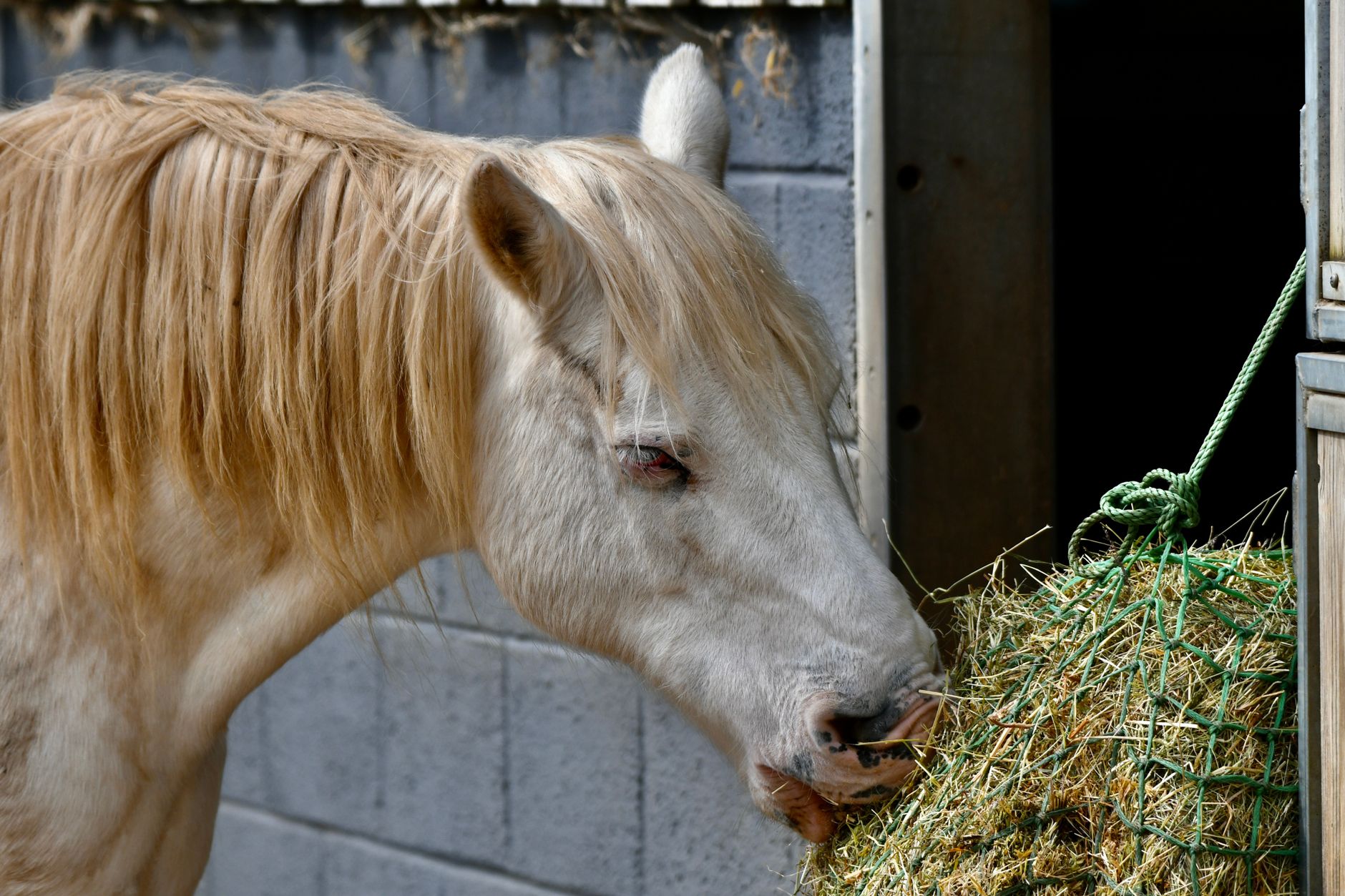
For a 1,100 lb (499 kg) horse doing no work, kept on hay alone and fed from a rack, that comes out at 25.7 lb (11.7 kg) a day. Over a month it is 772 lb (350 kg), or 16 bales of 50 lb small squares.
The range matters more than the middle number. An easy keeper — the horse that holds condition on air — sits near the bottom. A hard keeper, an older horse, or one that has just come through a hard winter sits near the top. Nobody can tell you which yours is from a form. Your horse’s ribs can.
The honest way to use this figure is as a starting point you then correct. Feed it for two weeks, run a hand along the ribs, and adjust. If you can see ribs, feed more. If you cannot feel them without pressing, feed less.
The formula, spelled out
Four steps, in this order. Every calculator that gets this wrong skips one of them.
Step 1 — the dry matter requirement. Body weight × 2%. For our 1,100 lb horse: 1,100 × 0.02 = 22 lb of dry matter a day.
Step 2 — adjust for work and cold. At maintenance in mild weather there is no adjustment. Work and cold both raise the energy requirement, and where hay is the only feed, that energy has to arrive as more hay. Our horse is at maintenance in summer, so this step multiplies by one and we move on.
Step 3 — convert dry matter to hay you can weigh. Hay is not dry. Cured hay runs about 90% dry matter, so the remaining 10% is water that still has to go on the scale. 22 ÷ 0.90 = 24.4 lb of actual hay.
This step is the most commonly skipped one on the internet, and skipping it under-feeds by about 10%. If a calculator tells you a 1,100 lb horse needs 22 lb of hay, it has quietly handed you a dry matter figure and called it hay.
Step 4 — add what gets wasted. Hay dropped, trampled or bedded on is hay you paid for. Fed from a rack, about 5% is lost, so 24.4 ÷ 0.95 = 25.7 lb (11.7 kg). That is the figure to buy against.
Fed on the ground outdoors instead, small square waste runs about 13%. With round bales and no feeder at all it reaches 57% — more than half the bale gone.
Where each input comes from, and how to measure it
Body weight. The hardest input to get right, and the one everything scales from. A weight tape is close enough for feeding decisions, but it reads low on stocky, heavily muscled horses — by around 15% in one study. Guessing from breed is worse than taping. If you want a better figure than a tape gives, a girth and length measurement with a formula beats both.
Workload. Be honest and be conservative. Most horses described as “in light work” are in maintenance with occasional exercise. Light work means one to three hours a week of actual work, not turnout.
Bale weight. Weigh one. This is the single most valuable five minutes on this page. Stand on a bathroom scale holding a bale, subtract your own weight, done. Small squares sold as “fifty pound bales” range from about 35 lb to 80 lb, and every figure on this page scales directly with that number.
Flakes per bale. Count them on your own bales. It varies by baler setting and by cutting, and it is the only way to turn a weight into the unit you actually feed with.
Temperature. Use the overnight low, not the daytime high. The horse spends the coldest hours standing in it.
What changes the answer
How much hay does a horse eat in the winter?
Below a certain temperature a horse starts burning energy simply to stay warm. That threshold is the lower critical temperature, and it is not a fixed number — it depends on the coat. A horse with a heavy winter coat, dry and out of the wind, sits at about 30 °F. A moderate coat, about 50 °F. Wet, clipped or short-coated, about 60 °F.
Below that threshold the requirement climbs steadily. Our 1,100 lb horse with a moderate coat needs 25.7 lb (11.7 kg) in mild weather, 36.3 lb (16.5 kg) at 20 °F, and 38.6 lb (17.5 kg) at 0 °F.
You will often see this quoted as “one percent more feed per degree below critical temperature”. That rule is published by more than one extension service and it is a reasonable pocket estimate, but it rounds down. Working from the underlying figure in the NRC tables gives closer to 1.4% per degree, and that is what this calculator uses. We would rather explain the difference than quietly pick the smaller number.
A wet horse is a different animal entirely. Rain flattens the coat and destroys its insulation, which is why the wet or clipped threshold sits so much higher. Shelter and a rug do more for a cold horse than extra hay does.
How much hay does a horse need with pasture access?
Grazing is not hay by another name, and turnout time does not convert into intake in a straight line. A horse with only three hours on grass eats at more than three times the hourly rate of one turned out around the clock. Short access does not produce a small meal; it produces a fast one.
That has a practical consequence, and it runs the opposite way to most people’s intuition. If grazing simply scaled with time on grass, six hours of turnout would leave our 1,100 lb horse still needing about 21.3 lb of hay a day. In practice it needs 14 lb (6.3 kg), because it takes far more grass in those six hours than a quarter of a full day’s worth.
So cutting turnout is a much weaker weight-management tool than it looks. Halving the hours does not halve the grass. It is also why grazing intake is the least certain figure on this page — treat hay as the part you adjust, and watch the horse rather than the arithmetic.
How much hay is too much? The intake ceiling
A horse cannot eat its way out of an unlimited energy requirement. Voluntary forage intake tops out around 3% of body weight. Past that, the answer is not more hay — it is that hay alone cannot do the job and the balance has to come from concentrates.
Run our 1,100 lb horse at heavy work and the raw arithmetic asks for about 41.2 lb of hay a day — 3.7% of its body weight. No horse will eat that, and a calculator that prints it has stopped describing anything real. When the figures go past the ceiling, this one caps them and tells you why.
How much hay is wasted, and what that costs you
Over a 120-day winter, one horse on 900 lb round bales needs 8 bales with no feeder and 4 bales with a restrictive one. Every feeder design tested paid for itself within twenty months, and most within a year.
How much hay per day: charts by weight, temperature and bale type
These tables are generated by the same code the calculator runs, so they cannot drift apart from it.
| Body weight | Maintenance | Light work | Moderate work | Heavy work |
|---|---|---|---|---|
| 500 lb (227 kg) | 11.7 lb (5.31 kg) | 14 lb (6.4 kg) | 16.4 lb (7.43 kg) | 17.5 lb (7.96 kg) |
| 800 lb (363 kg) | 18.7 lb (8.49 kg) | 22.5 lb (10.2 kg) | 26.2 lb (11.9 kg) | 28.1 lb (12.7 kg) |
| 1,000 lb (454 kg) | 23.4 lb (10.6 kg) | 28.1 lb (12.7 kg) | 32.7 lb (14.9 kg) | 35.1 lb (15.9 kg) |
| 1,100 lb (499 kg) | 25.7 lb (11.7 kg) | 30.9 lb (14 kg) | 36 lb (16 kg) | 38.6 lb (17.5 kg) |
| 1,200 lb (544 kg) | 28.1 lb (12.7 kg) | 33.7 lb (15.3 kg) | 39.3 lb (17.8 kg) | 42.1 lb (19.1 kg) |
| 1,400 lb (635 kg) | 32.7 lb (14.9 kg) | 39.3 lb (17.8 kg) | 45.8 lb (20.8 kg) | 49.1 lb (22.3 kg) |
| 1,600 lb (726 kg) | 37.4 lb (17 kg) | 44.9 lb (20.4 kg) | 52.4 lb (23.8 kg) | 56.1 lb (25.5 kg) |
| Overnight low | Heavy winter coat | Moderate coat | Wet or clipped |
|---|---|---|---|
| 40 °F (4 °C) | 25.7 lb (11.7 kg) | 29.3 lb (13.3 kg) | 32.8 lb (14.9 kg) |
| 30 °F (-1 °C) | 25.7 lb (11.7 kg) | 32.8 lb (14.9 kg) | 36.3 lb (16.5 kg) |
| 20 °F (-7 °C) | 29.3 lb (13.3 kg) | 36.3 lb (16.5 kg) | 38.6 lb (17.5 kg) |
| 10 °F (-12 °C) | 32.8 lb (14.9 kg) | 38.6 lb (17.5 kg) | 38.6 lb (17.5 kg) |
| 0 °F (-18 °C) | 36.3 lb (16.5 kg) | 38.6 lb (17.5 kg) | 38.6 lb (17.5 kg) |
| -10 °F (-23 °C) | 38.6 lb (17.5 kg) | 38.6 lb (17.5 kg) | 38.6 lb (17.5 kg) |
| How the bale is fed | 4×5 bale (900 lb) | 5×6 bale (1,500 lb) |
|---|---|---|
| No feeder at all | 8 bales | 5 bales |
| Hay sleigh | 5 bales | 3 bales |
| Ring, cone or tombstone | 5 bales | 3 bales |
| Tombstone saver | 4 bales | 3 bales |
| Covered cradle | 4 bales | 3 bales |
| HayHut | 4 bales | 3 bales |
| Cinch Net | 4 bales | 3 bales |
| Waste Less | 4 bales | 3 bales |
Common questions about feeding hay to horses
How much hay should a 1,000 lb horse eat per day?
About 23.4 lb (10.6 kg) of grass hay at maintenance, fed from a rack. Fed on the ground outdoors, buy closer to 25.5 lb (11.6 kg) to cover what gets trampled and soiled.
How much hay does a 1,200 lb horse need per day?
About 28.1 lb (12.7 kg) at maintenance in mild weather, rising to 39.6 lb (18 kg) at 20 °F with a moderate coat.
How much hay should a 500 kg horse eat?
A 500 kg horse is a 1,102 lb horse, so about 25.8 lb (11.7 kg) a day at maintenance.
How much hay does a horse eat in a week?
About 180 lb (81.7 kg) for an 1,100 lb horse at maintenance — a little over 3 small square bales at 50 lb each.
How much hay does a horse eat per month?
About 772 lb (350 kg) a month for an 1,100 lb horse at maintenance, which is roughly 16 bales of 50 lb small squares. Weigh your own bales before trusting that — the answer moves with bale weight more than with anything else.
How much more hay does a horse need in cold weather?
More than most people budget for. An 1,100 lb horse with a moderate coat goes from 25.7 lb (11.7 kg) a day in mild weather to 36.3 lb (16.5 kg) at 20 °F and 38.6 lb (17.5 kg) at 0 °F. Over a 120-day winter that difference is hundreds of pounds of hay.
How many flakes of hay per horse per day?
About 3 flakes per feeding, twice a day, for an 1,100 lb horse on 50 lb bales that break into 12 flakes. Treat it as a starting point rather than a measurement, for the reason below.
How many flakes of hay are in a bale?
Usually 10 to 14 in a small square bale, but it depends entirely on the baler setting and the cutting. Count them on your own bales — it is the only way to turn a bale weight into the unit you actually feed with.
What is a flake of hay, and how much does one weigh?
A flake is the slice a small square bale falls into when you cut the strings. It is not a unit of weight and never has been. Penn State weighed three flakes from a single bale at 4.57 lb, 3.21 lb and 4.54 lb — a 42% spread inside one bale. Divide your bale weight by the number of flakes in it and you have a usable average for your hay; anyone quoting a universal flake weight is guessing.
Is two flakes of hay enough for a horse?
For most horses, no. On the Penn State flakes, two would come to somewhere between 6 and 9 lb — well under half of what an 1,100 lb horse needs in a day.
How many flakes of hay for a mini horse?
A 300 lb miniature needs roughly 7.02 lb (3.18 kg) a day, which is around 1 flake per feeding on typical 50 lb bales. Minis and ponies are the group most likely to founder on rich forage, so what the hay is matters more for them than how much it weighs.
Can you overfeed hay to a horse?
Yes, though it is far less common and far less dangerous than overfeeding grain. Easy keepers on unlimited good hay do gain weight. The usual answer is not less forage but lower-energy forage, or a slow feeder that stretches the same weight over more hours.
Do horses need to eat hay all day?
Close to it. A horse’s stomach secretes acid continuously, so long gaps without forage are a genuine ulcer risk. Below about 1.5% of body weight in forage, gut health starts to suffer regardless of whether the energy adds up.
How long will a bale of hay last one horse?
A 50 lb small square lasts an 1,100 lb horse about two days at maintenance. A 900 lb round bale fed with a good feeder lasts roughly 35 days — but with no feeder at all, closer to 16, because more than half of it never gets eaten.
Read next
- How much hay does a horse eat in the winter? — the cold-weather uplift in full, and the point at which hay alone stops being the answer.
- How many flakes of hay per horse per day? — why a flake is not a unit of weight, and how to get a count that is actually yours.
- How many flakes of hay are in a bale? — what a flake is, what one weighs and what it costs.
- How much hay does a horse eat per month? — the same figures by week, month and year, with the money.
- How much hay do I need for winter? — buying a whole season, and what the stack loses in storage before you feed it.
- How much hay does a mini horse need? — where the percentage rule holds but the measuring stops working.
- How much grain should I feed my horse daily? — what to do about the gap hay leaves, once you have the forage settled.
- All horse calculators — the rest of the tools in this section.
Where these figures come from
Every coefficient behind this calculator is published and cited. Where sources disagree — and on lower critical temperature they disagree considerably — we take the more conservative figure and say so rather than picking the flattering one. Our full approach is set out in how we source our numbers.
- Caring for Horses in Cold Weather — Utah State University Extension
- Effect of Restricted Pasture Access on Pasture Dry Matter Intake Rate, Dietary Energy Intake, and Fecal pH in Horses — Journal of Equine Veterinary Science (2013)
- Estimation of Actual and Ideal Bodyweight Using Morphometric Measurements and Owner Guessed Bodyweight of Adult Draft and Warmblood Horses — Journal of Equine Veterinary Science (2016)
- Estimation of Actual and Ideal Bodyweight Using Morphometric Measurements of Miniature, Saddle-Type, and Thoroughbred Horses — Journal of Equine Veterinary Science (2019)
- Estimation of body weight and development of a body weight score for adult equids using morphometric measurements — Journal of Animal Science 92(5):2230-2238 (2014)
- Evaluation of the accuracy of horse body weight estimation methods — Animals (2023)
- Feeding horses with a round-bale feeder — University of Minnesota Extension
- Hay Storage: Dry Matter Losses and Quality Changes — Mississippi State University Extension
- Horse Owner’s Guide to Buying Hay (EC 1249) — Oregon State University Extension Service
- How Much Does That Round Bale Weigh? — Kansas State University Research and Extension, Greenwood County
- Implications of Round Bale Dimensions on Hay Use (AN326) — University of Florida IFAS Extension (EDIS)
- Nutrient Requirements of Horses, Sixth Revised Edition — National Research Council / National Academies Press (2007)
- Nutritional Requirements of Horses and Other Equids — Merck Veterinary Manual
- Properly curing hay is crucial for forage quality — North Dakota State University Extension (2024)
- Round-bale feeder design affects hay waste and economics during horse feeding — Journal of Animal Science 90(3):1047 (2012)
- Selecting a small square-bale feeder — University of Minnesota Extension
- Selecting and storing horse hay — University of Minnesota Extension
- Ten ways to stretch your horse’s hay supply — University of Minnesota Extension
- The effect of small square-bale feeder design on hay waste and economics during outdoor feeding of adult horses — Journal of Equine Veterinary Science (2014)
- The energy requirements of performance horses in training (2020)
- The Importance of Weighing Horse Feed — Penn State Extension
- Winter Care for Horses (G1873) — University of Nebraska-Lincoln Extension (2008)
- Winter Feeding for Horses, Fact Sheet #1143 — Rutgers University, Department of Animal Sciences (2011)