
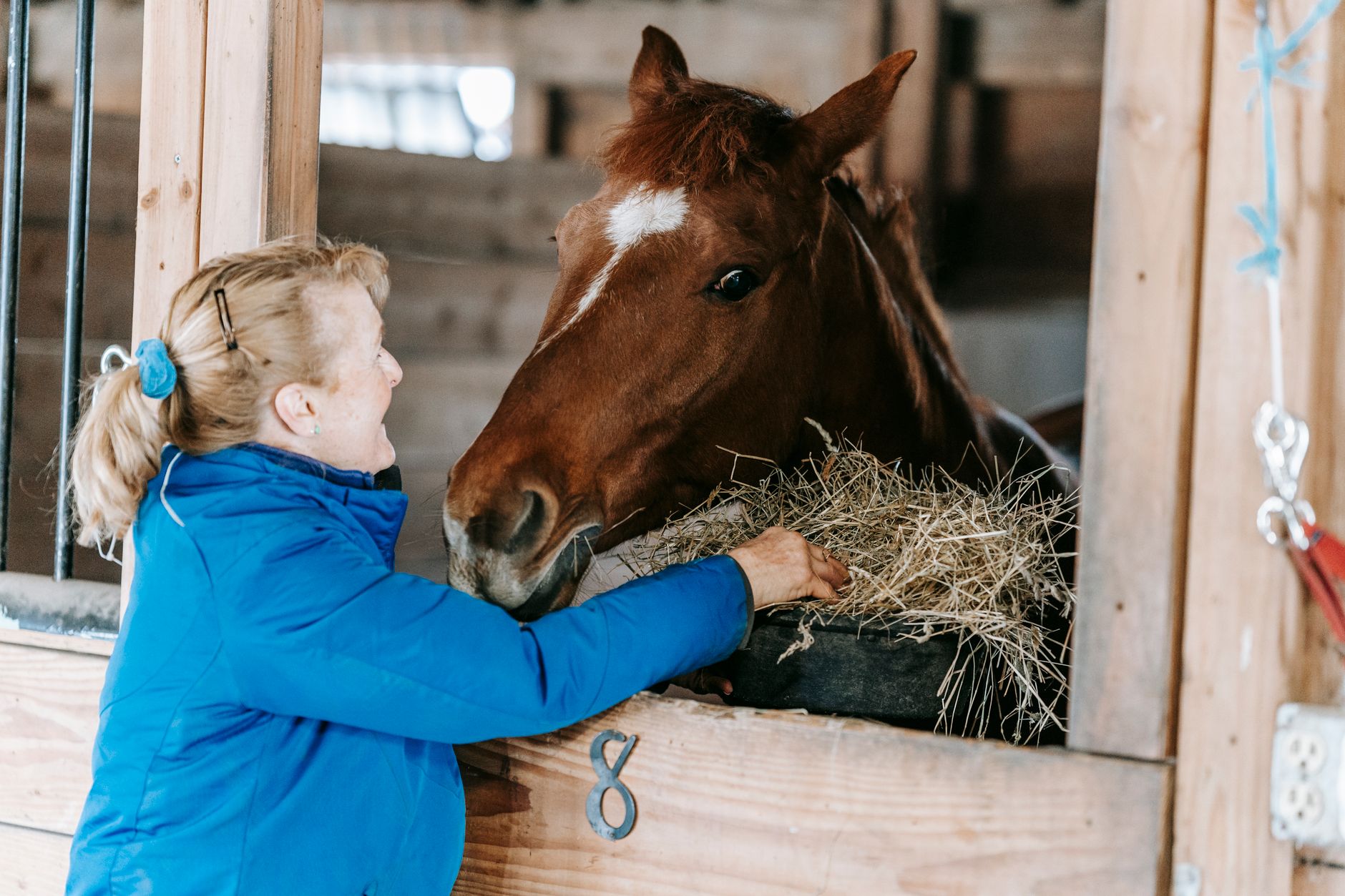
How many flakes of hay per horse per day?
The short answer: about 6 flakes a day for an 1,100 lb horse, split into two feedings, on 50 lb bales that break into 12 flakes.
The longer answer is that the question cannot be answered properly, and everyone answering it confidently is guessing. A flake is not a unit of weight. It is however thick the baler happened to slice, and it varies enough to change your horse’s ration by half.
Here is what that looks like in practice, and how to get a number you can actually trust for your own hay.
How many flakes to feed a horse a day?
Start from weight, then convert. A horse at maintenance eats around 2% of its body weight a day in dry matter, which on the scale is more hay than it sounds because hay is only about 90% dry matter.
| Body weight | Hay per day | Flakes per day | Flakes per feeding, twice a day |
|---|---|---|---|
| Pony, 500 lb | 11.7 lb (5.31 kg) | 3 | 1.5 flakes |
| Small horse, 800 lb | 18.7 lb (8.49 kg) | 4 | 2 flakes |
| 1,000 lb | 23.4 lb (10.6 kg) | 6 | 3 flakes |
| 1,100 lb — the average riding horse | 25.7 lb (11.7 kg) | 6 | 3 flakes |
| 1,200 lb | 28.1 lb (12.7 kg) | 7 | 3.5 flakes |
| Draft cross, 1,400 lb | 32.7 lb (14.9 kg) | 8 | 4 flakes |
Those flake counts are only true for a 50 lb bale cut into 12. Change either and the count changes with it.
Why flakes are not a unit of weight
Penn State weighed three flakes taken from a single bale. They came out at 4.57 lb, 3.21 lb, 4.54 lb — a 42% spread inside one bale, never mind between farms.
It gets wider than that across regions. A typical east-coast 50 lb bale broken into 13 gives flakes of about 3.8 lb. A western three-string bale at 110 lb cut into 16 gives 6.9 lb flakes — nearly double. “Two flakes” means two different rations depending on which side of the country you buy hay.
There is no published study of flake weight to appeal to, because there is nothing stable to study. Any page quoting a universal flake weight made it up.
Is 2 flakes of hay enough for a horse?
Not for a day. Taking the Penn State flakes, two of them weigh between 6.4 lb and 9.1 lb. An 1,100 lb horse needs 25.7 lb (11.7 kg), so two flakes is roughly 30% of a day’s ration.
Two flakes is a reasonable feeding for a smaller horse. As a day’s hay it is a horse losing weight, and the reason the internet is full of people insisting their horse “just doesn’t eat much” is often that nobody ever put the flakes on a scale.
How many flakes of hay per horse per day, by weight
This is the same 1,100 lb horse in every cell. The only thing changing is the hay.
| Bale weight | 10 flakes/bale | 12 flakes/bale | 14 flakes/bale | 16 flakes/bale |
|---|---|---|---|---|
| 40 lb | 6 flakes (4.0 lb each) | 8 flakes (3.3 lb each) | 9 flakes (2.9 lb each) | 10 flakes (2.5 lb each) |
| 50 lb | 5 flakes (5.0 lb each) | 6 flakes (4.2 lb each) | 7 flakes (3.6 lb each) | 8 flakes (3.1 lb each) |
| 60 lb | 4 flakes (6.0 lb each) | 5 flakes (5.0 lb each) | 6 flakes (4.3 lb each) | 7 flakes (3.8 lb each) |
| 80 lb | 3 flakes (8.0 lb each) | 4 flakes (6.7 lb each) | 5 flakes (5.7 lb each) | 5 flakes (5.0 lb each) |
Same horse, same requirement, and the answer ranges from 3 flakes to 10 flakes. That is the entire case against the question.
How to work it out for your own hay
Five minutes, once per load of hay, and then the flake count is genuinely yours:
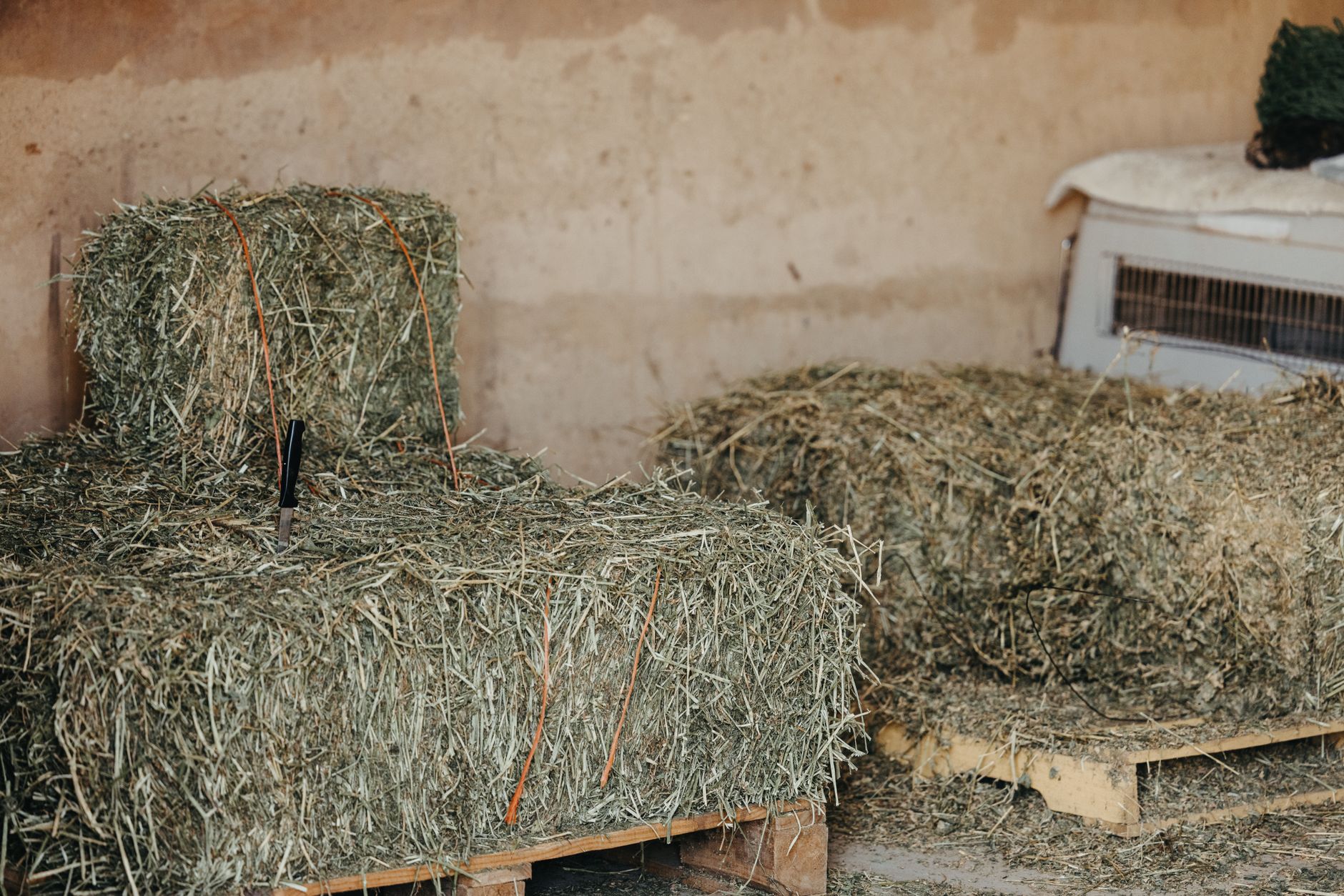
- Weigh a bale. Stand on a bathroom scale holding one, subtract your own weight. Small squares sold as fifty-pound bales run from about 40 lb to 80 lb.
- Count the flakes in it as you feed it out.
- Divide. Bale weight ÷ flake count = your flake weight.
- Divide again. Your horse’s daily hay ÷ flake weight = flakes a day.
Do it once and you can go back to counting flakes at the barn, which is what everybody actually wants to do. The point is not to feed by weight forever — it is to know what your flakes weigh so the counting means something.
Feeding twice a day or three times
The daily total does not change; how it lands does. Our 1,100 lb horse on two feedings gets 3 flakes at a time. On three, 2 flakes.
Three smaller feedings, or a slow feeder, keeps forage in front of the horse for more of the day, which is closer to how a horse is built to eat. It does not change what you buy.
One more thing the flake count hides
Hay you put out is not all hay the horse eats. Fed from a rack outdoors, about 5% is dropped, trampled or soiled; on the ground with no feeder, about 13%. Every figure on this page already includes that, which is why they run slightly higher than a bare percentage-of-body-weight calculation would give you.
Common questions about feeding hay by the flake
How many flakes are in a 50 lb bale?
Usually 10 to 14, and it is set by the baler, not by any standard. That is why the same “50 lb bale” gives one person 5.0 lb flakes and another 3.6 lb flakes. Count the flakes in your own bales once and the number holds for that load.
How much hay should a 1000 lb horse eat per day?
23.4 lb (10.6 kg) of grass hay at maintenance, fed from a rack. That is the figure to work from; the flake count is just a way of measuring it out.
How much is one flake of hay?
Divide your bale weight by the number of flakes in it — that is the only honest answer, because no published study establishes a standard flake weight. Real measured examples run from 3.8 lb on a 50 lb east-coast bale to 6.9 lb on a 110 lb western three-string.
How many flakes of hay per horse per day in winter?
More, and by a lot. The same 1,100 lb horse needs 36.3 lb (16.5 kg) once overnight lows reach 20 °F, which is about 9 flakes a day rather than 6.
How many bales of hay per horse per month?
About 16 bales of 50 lb small squares for an 1,100 lb horse at maintenance — 772 lb (350 kg) of hay. Weigh your own bales before ordering against that number.
Do horses need to eat hay all day?
Close to it. A horse’s stomach produces acid continuously, so long gaps without forage are a real ulcer risk. If your flake count leaves the horse empty for half the night, the answer is usually a slow feeder or a third feeding rather than more hay.
Related calculators and guides
- Horse hay calculator — put your own bale weight and flake count in and it does this arithmetic for you, in pounds and in flakes
- How much hay does a horse eat in the winter? — the same figures once cold weather raises the requirement
- All horse calculators — the rest of the tools in this section
Where these figures come from
Every figure on this page is published and cited. Where sources disagree we take the more conservative one and say so. Our full approach is set out in how we source our numbers.
- Caring for Horses in Cold Weather — Utah State University Extension
- Hay Storage: Dry Matter Losses and Quality Changes — Mississippi State University Extension
- Horse Owner’s Guide to Buying Hay (EC 1249) — Oregon State University Extension Service
- How Much Does That Round Bale Weigh? — Kansas State University Research and Extension, Greenwood County
- Implications of Round Bale Dimensions on Hay Use (AN326) — University of Florida IFAS Extension (EDIS)
- Nutrient Requirements of Horses, Sixth Revised Edition — National Research Council / National Academies Press
- Nutritional Requirements of Horses and Other Equids — Merck Veterinary Manual
- Properly curing hay is crucial for forage quality — North Dakota State University Extension
- Selecting a small square-bale feeder — University of Minnesota Extension
- Selecting and storing horse hay — University of Minnesota Extension
- Ten ways to stretch your horse’s hay supply — University of Minnesota Extension
- The effect of small square-bale feeder design on hay waste and economics during outdoor feeding of adult horses — Journal of Equine Veterinary Science
- The energy requirements of performance horses in training
- The Importance of Weighing Horse Feed — Penn State Extension
- Winter Care for Horses (G1873) — University of Nebraska-Lincoln Extension
- Winter Feeding for Horses, Fact Sheet #1143 — Rutgers University, Department of Animal Sciences