
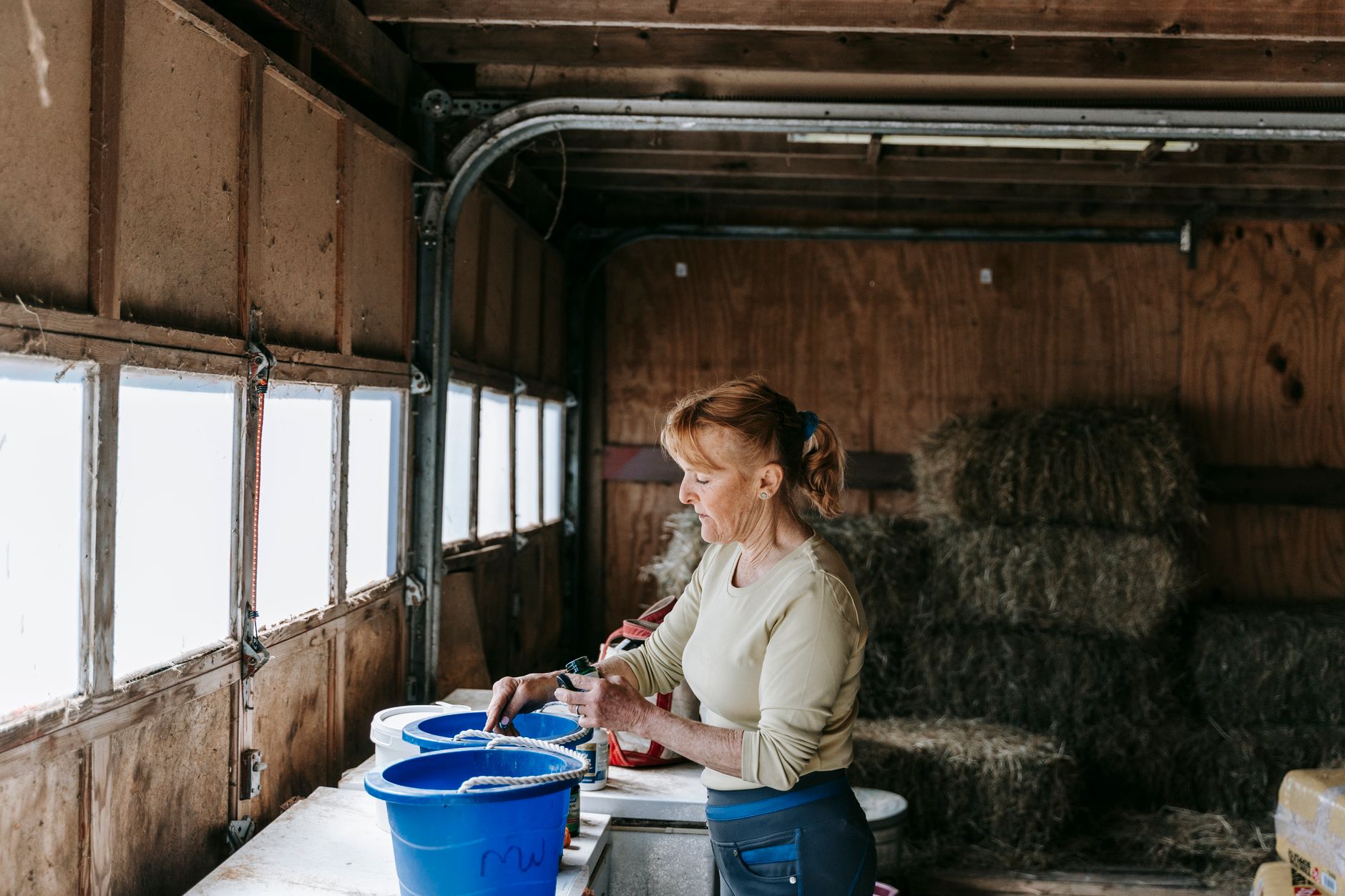
How many scoops of grain should I feed my horse?
How many scoops of grain should I feed my horse? There is no number of scoops. That is the honest answer, and it is the one nobody gives.
A scoop is a measure of volume. Feed is sold and dosed by weight. Asking how many scoops of feed a horse needs is like asking how many cupfuls of flour make a pound — it depends entirely on the flour.
And feeds vary far more than flours do. The two only line up if you know what your particular feed weighs, and across 49 products from two manufacturers a quart of horse feed weighs anywhere from 0.89 lb to 1.53 lb — the heaviest is 72% heavier than the lightest.
So the same 3-quart scoop delivers 2.7 lb of one feed and 4.6 lb of another. Anyone who tells you “two scoops twice a day” without asking what is in the scoop is guessing, and the guess can be out by nearly half.
Work out the pounds first, then convert
Grain is the remainder — what your forage does not already supply. Get that number in pounds, and the scoop count follows in one division.
For an 1,100 lb horse eating 20 lb of average grass hay a day: at maintenance the answer is 0 lb (0 kg). In light work, 2.38 lb (1.08 kg). In moderate work, 4.72 lb (2.14 kg). In heavy work on 22 lb of hay, 5.89 lb (2.67 kg).
Now divide by what your scoop holds. A 3-quart scoop of pelleted feed weighs about 4 lb, so that moderate-work horse takes 1.25 scoops a day. The same scoop of textured feed weighs about 3.4 lb, so the same horse on the same ration takes 1.5 scoops.
| Workload | Grain per day | Pelleted feed | Textured feed |
|---|---|---|---|
| No work | 0 lb (0 kg) | 0 scoops | 0 scoops |
| Light work | 2.38 lb (1.08 kg) | 0.5 scoops | 0.75 scoops |
| Moderate work | 4.72 lb (2.14 kg) | 1.25 scoops | 1.5 scoops |
| Heavy work | 5.89 lb (2.67 kg) | 1.5 scoops | 1.75 scoops |
Why the scoop trap is worse than it looks
Two things move in opposite directions, and that is what catches people out.
Pellets and textured feed made to the same formula carry the same energy per pound. Pressing a mix into pellets changes how densely it packs, not how many calories are in it. But a quart of pellets weighs about 18% more than a quart of sweet feed.
So switching your horse from a textured feed to a pelleted one, keeping the same scoop and the same number of scoops, quietly increases the ration by about a fifth. Nothing about the horse changed. Nothing on the bag changed. Only the density did, and nobody weighed it.
| Feed form | 1-quart scoop | 2-quart scoop | 3-quart scoop |
|---|---|---|---|
| Textured / sweet feed | 0.9–1.2 lb | 1.9–2.4 lb | 2.8–3.6 lb |
| Pelleted feed | 1.2–1.4 lb | 2.5–2.8 lb | 3.7–4.2 lb |
| High-fat performance feed | 1.2–1.4 lb | 2.4–2.7 lb | 3.6–4.1 lb |
| Senior or complete feed | 0.9–1.3 lb | 1.8–2.6 lb | 2.7–3.8 lb |
| Ration balancer | 1.3–1.5 lb | 2.6–3.1 lb | 3.9–4.6 lb |
How to make your scoop exact
Five minutes, once, and every scoop figure stops being an estimate.
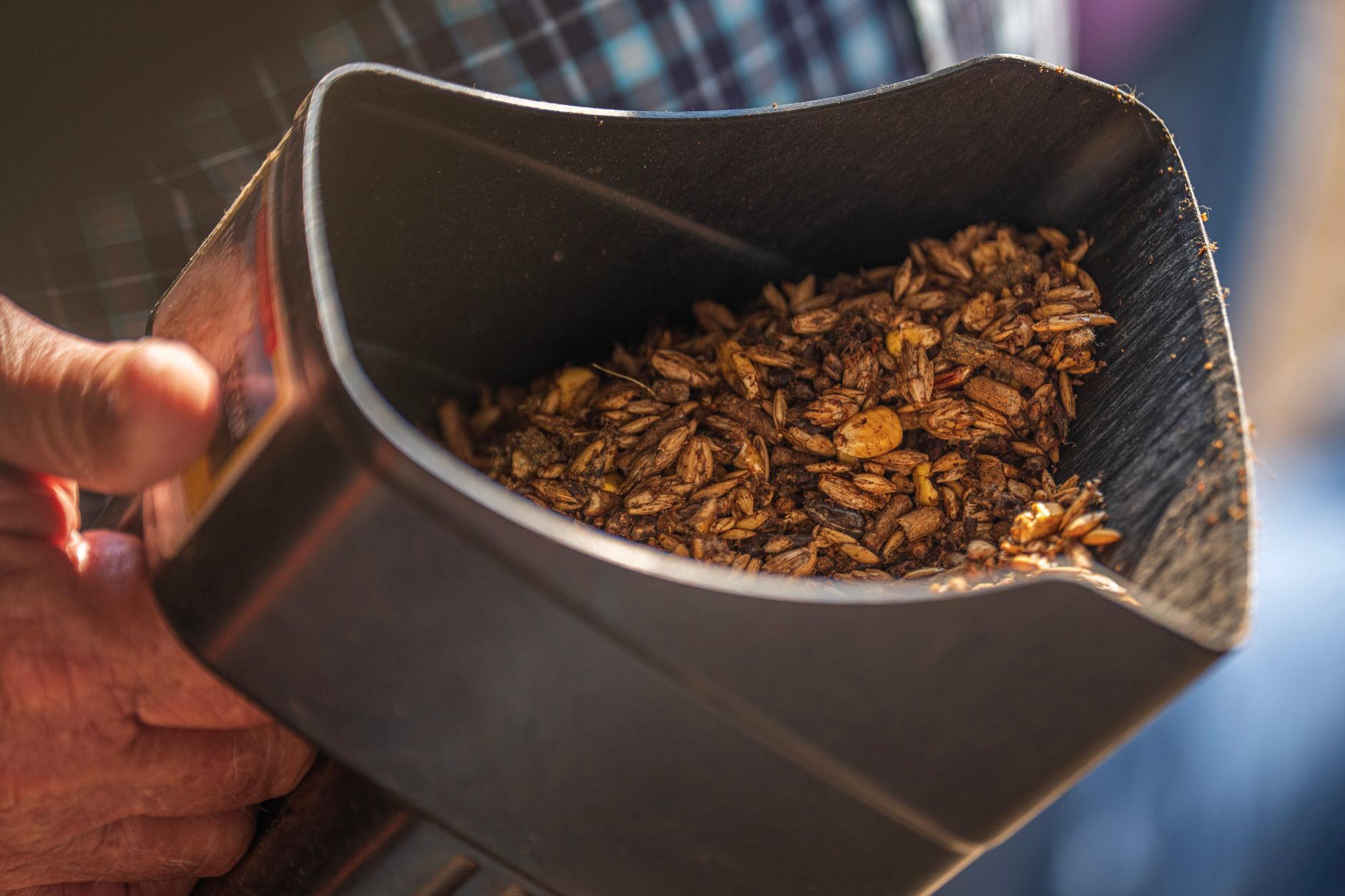
Weigh a level quart. Put a container on a kitchen scale, zero it, tip in one level quart of your feed, read the number. That is your feed’s quart weight, and it will not change until you change feeds.
Or weigh a whole scoop. Simpler and just as good: weigh the empty scoop, fill it the way you actually fill it, weigh it again. The difference is what your horse gets per scoop, including your particular habit of heaping or levelling.
Then mark the scoop. If the answer is “feed 2.5 lb”, find where that comes to on the scoop and put a line on it with a permanent marker. Now anyone can feed the horse correctly, including the person covering for you at short notice.
Watch the meal, not just the day
There is a limit on how much grain can go into one meal, and you cannot see it in a daily total. More than 0.5% of body weight of grain-based feed at a sitting — 5.5 lb for an 1,100 lb horse — sends starch the small intestine cannot absorb into the hindgut, where it ferments. That is the route to grain-associated colic and laminitis.
In scoops, that ceiling is about 1.4 three-quart scoops of pelleted feed, or 1.6 of textured. Very few horses should be anywhere near it. If yours needs more than that in a day, the answer is more meals — at least 4 hours apart — not bigger ones.
If the answer comes out at nothing
It often does, and that is not a fault in the arithmetic. A mature horse in no work, on reasonable hay, meets its energy requirement from forage alone. Our 1,100 lb example at maintenance needs 0 lb (0 kg) of grain.
What a horse in that position is usually short of is protein, minerals and vitamins, not calories. That is what a ration balancer is for — a pound or two a day, fed to a label rate, with almost no energy attached. It is a scoop of something, but it is not grain, and it is not filling an energy gap.
Common questions about feeding grain by the scoop
How much grain should a 1000 lb horse eat?
In light work, on 20 lb of average grass hay, about 1.1 lb (0.5 kg) a day — roughly 0.25 scoops of a 3-quart scoop of pelleted feed. At maintenance on the same hay, none at all. Body weight on its own cannot answer this: what the horse does and what its hay is worth decide it.
How much is one scoop of horse feed?
Between 0.89 and 1.53 lb per quart, depending entirely on the feed. A 3-quart scoop therefore holds anywhere from 2.7 lb to 4.6 lb. Ration balancers are the densest and textured mixes among the lightest.
How many pounds is a 3-quart feed scoop?
About 4 lb of pelleted feed and about 3.4 lb of textured feed. The moulded number on a feed-store scoop is its volume in quarts, never its weight — the weight depends on what you put in it.
How many scoops are in a 50 lb bag of horse feed?
Using a 3-quart scoop, roughly 12 to 13 scoops of pelleted feed, and 14 to 18 of a textured mix. Counting scoops out of a bag is actually a decent way to check your scoop weight: divide 50 lb by the number of scoops it took to empty it.
Can you feed a horse too much grain?
Yes, and the limit that matters is on the meal rather than the day. Above 0.5% of body weight in one feeding — 5.5 lb for an 1,100 lb horse — undigested starch reaches the hindgut and ferments, which is the mechanism behind grain-associated colic and laminitis. A horse needing more than that in a day needs it split across more meals, at least 4 hours apart.
Do horses need to eat grain every day?
Most do not need it at all. A mature horse in no work or light work, on decent forage, meets its energy requirement from hay and grass alone. Grain earns its place when work, cold, age or poor forage opens a gap that hay cannot close.
Should I feed by weight or by volume?
By weight, always. Volume is a proxy that only works once you have measured the weight behind it. Weighing a level quart of your feed takes a minute and turns every scoop figure on this page from typical into exact.
Related calculators and guides
- Horse grain calculator — put your own hay, scoop size and feed in and it does this arithmetic for you, in pounds and in scoops
- Horse hay calculator — settle the forage side first — it decides how much grain there is left to feed
- All horse calculators — the rest of the tools in this section
Where these figures come from
Every figure on this page is published and cited. Where sources disagree we take the more conservative one and say so. Our full approach is set out in how we source our numbers.
- Basics of Feeding Horses: Feeding Management (G1781) — University of Nebraska-Lincoln Extension
- Equine Nutrition: Concentrates — Utah State University Extension
- Equine Senior Horse Feed – feeding directions — Purina Animal Nutrition LLC
- Feeding and Nutrition for the Senior Horse (UT Horse, Vol. 2 Issue 4) — University of Tennessee Institute of Agriculture Extension
- Forage for Horses (Idaho Forage Handbook, 3rd Edition, Chapter 17) — University of Idaho Extension
- Hay Storage: Dry Matter Losses and Quality Changes — Mississippi State University Extension
- Integrity Feed Weight Chart — Star Milling Co.
- Measuring the Digestible Energy Content of Horse Feeds — Kentucky Equine Research, Inc.
- Nutrient Requirements of Horses, Sixth Revised Edition — National Research Council / National Academies Press
- Nutritional Requirements of Horses and Other Equids — Merck Veterinary Manual
- Properly curing hay is crucial for forage quality — North Dakota State University Extension
- Purina Horse Feed Quart Weights (conversion chart) — Purina Animal Nutrition LLC
- Selecting and storing horse hay — University of Minnesota Extension
- The energy requirements of performance horses in training
- Winter Feeding for Horses, Fact Sheet #1143 — Rutgers University, Department of Animal Sciences