
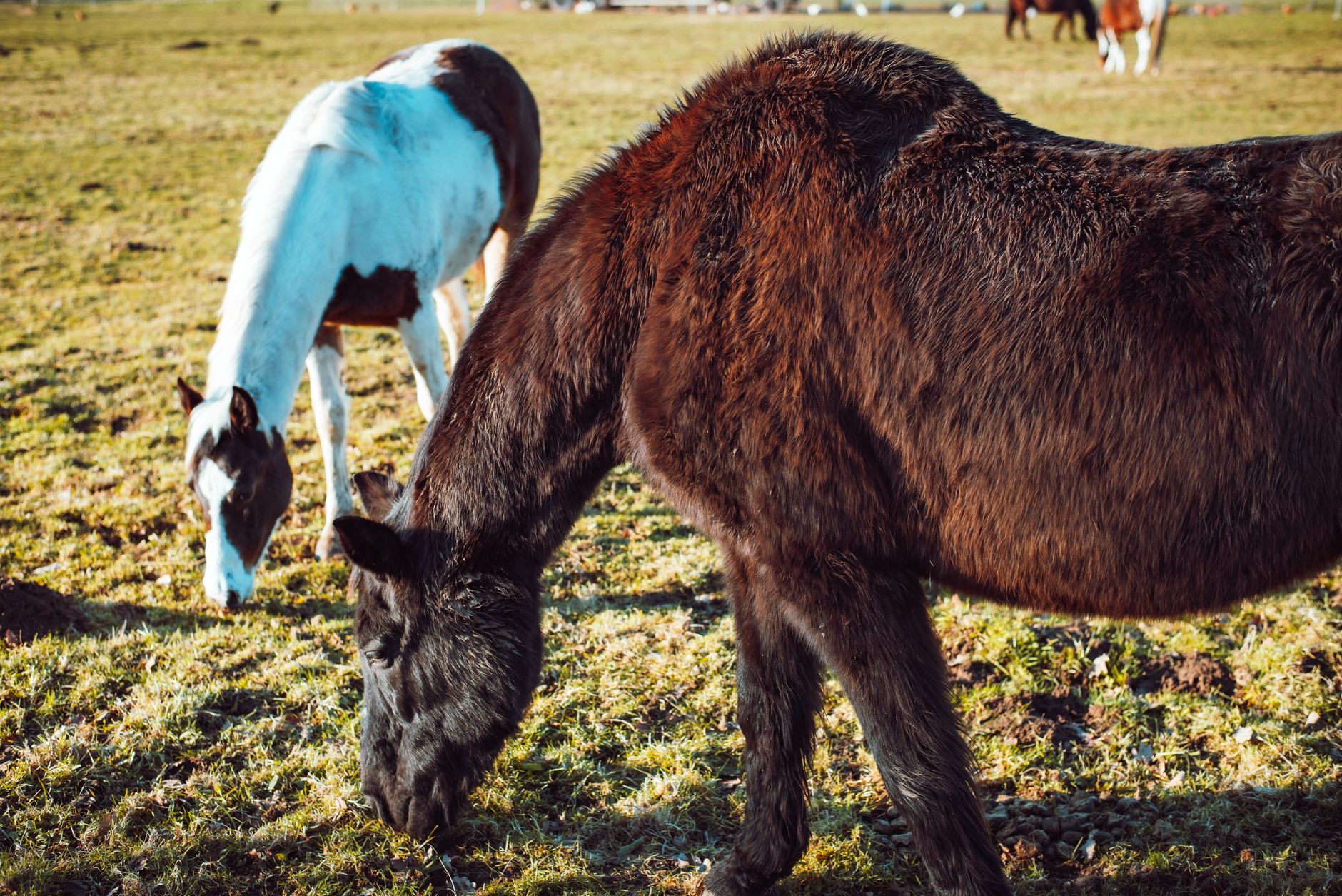
Do horses need grain every day?
Do horses need grain every day? Most horses do not need grain at all, on any day. That is not a contrarian position — it is what the arithmetic returns for a mature horse in light work on reasonable forage, and it is the answer a feed company’s calculator will never give you.
Grain is a remainder, not a food group
A horse’s energy requirement is met by forage first. Grain exists to fill whatever is left over, and on decent hay there is frequently nothing left over.
An 1,100 lb horse eating 20 lb of average grass hay a day needs 0 lb (0 kg) of grain at maintenance. In light work, 2.38 lb (1.08 kg). It is only at moderate work that a real gap opens — 4.72 lb (2.14 kg) — and moderate work means three to five hours a week of genuine work, not turnout and a hack at the weekend.
Feed the same horse better hay and the gap closes further. On early-bloom grass hay in light work it needs 1.75 lb (0.79 kg); on early-bloom alfalfa, 0 lb (0 kg).
| Hay | No work | Light work | Moderate work | Heavy work |
|---|---|---|---|---|
| Mature, stemmy grass hay | 1.56 lb (0.71 kg) | 3.9 lb (1.8 kg) | 6.24 lb (2.83 kg) | 8.58 lb (3.89 kg) |
| Average grass hay | 0 lb (0 kg) | 2.38 lb (1.08 kg) | 4.72 lb (2.14 kg) | 7.06 lb (3.2 kg) |
| Early-bloom grass hay | 0 lb (0 kg) | 1.75 lb (0.79 kg) | 4.09 lb (1.85 kg) | 6.43 lb (2.91 kg) |
| Mixed grass and legume | 0 lb (0 kg) | 2 lb (0.91 kg) | 4.34 lb (1.97 kg) | 6.68 lb (3.03 kg) |
| Alfalfa, mid to full bloom | 0 lb (0 kg) | 1.24 lb (0.56 kg) | 3.58 lb (1.62 kg) | 5.92 lb (2.68 kg) |
| Alfalfa, early bloom | 0 lb (0 kg) | 0 lb (0 kg) | 2.69 lb (1.22 kg) | 5.03 lb (2.28 kg) |
Most of that table is zero, and the horses it describes are the majority of horses in the country.
Why so many horses get grain anyway
It looks like care. A bucket is the visible, satisfying part of horse keeping. Hay is a chore; feeding is a moment. Nobody has ever felt like a good owner for putting out slightly more hay.
It is how the yard has always done it. Feed routines are inherited rather than calculated, and a routine built around a hard-working horse in the 1980s outlives the horse by decades.
Nobody counts the hay. The energy in 20 lb of hay is invisible in a way that the energy in a scoop is not. Hay quality alone moves the requirement by more than most people’s entire grain ration — the difference between stemmy and early-bloom grass hay is around 18% of the energy in every pound.
And it is sold that way. The tools that rank for these questions belong to feed companies. None of them is going to return zero.
The horses that do need it
There are real cases, and they are worth naming so this does not read as a blanket rule.
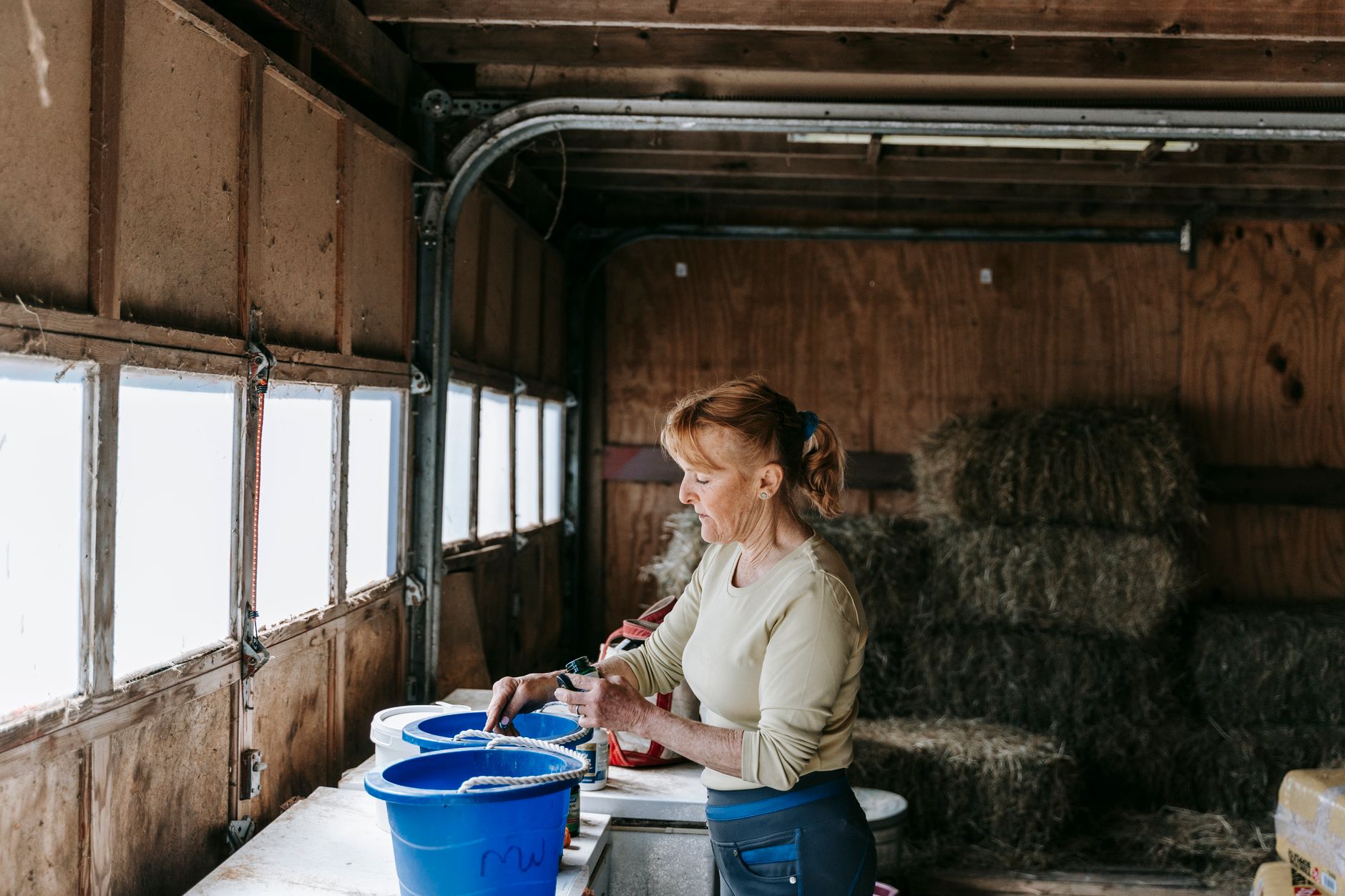
Horses in genuine work. Moderate work upward, consistently, not occasionally.
Hard keepers. Some horses hold condition badly on forage alone, and there is no shame in the bucket for them. Rule out teeth, ulcers and worms first — all three look like a feeding problem and none of them is.
Poor forage. On stemmy, late-cut hay even a horse at maintenance opens a gap: 1.56 lb (0.71 kg) a day for our example. Buying better hay is almost always cheaper than making up the difference in bags.
Growing horses, and mares in late pregnancy or lactation. Their requirements sit far above maintenance and forage often genuinely cannot meet them.
Old horses that can no longer chew hay. A different problem with a different answer — the feed is replacing forage rather than topping it up.
What a horse with no energy gap is actually short of
Here is the part that gets lost when the answer is presented as simply “your horse does not need grain”.
Forage reliably meets a horse’s energy needs. It does not reliably meet its protein, mineral and vitamin needs — hay grown on a given soil carries what that soil had, and cured hay has lost most of its vitamin E and beta-carotene along the way. A horse doing fine on hay alone can still be short of things you cannot see.
The answer to that is not a small amount of a regular feed. Commercial feeds are formulated on the assumption that you feed the full label amount, so half a scoop does not give you half a balanced diet; it gives you an unbalanced one.
It is a ration balancer: protein, minerals and vitamins concentrated into 0.1–0.18% of body weight a day, roughly 1.54 lb (0.7 kg) for an 1,100 lb horse, with almost no calories attached. It is the correct answer for the horse this whole page is about.
Turning grain off
If the arithmetic says your horse does not need what it is getting, change it gradually. Gut bacteria adapt to a diet over one to two weeks and an abrupt change is itself a colic risk.
Reduce over ten days or so, add the equivalent hay as you go, and keep forage above 1.5% of body weight throughout — the floor matters more than the grain ever did. Then watch the ribs rather than the bucket: run a hand along them every couple of weeks, and if you start to see them, put some back.
Most people find nothing happens, except that the horse is calmer and the feed bill is smaller.
Common questions about whether horses need grain
Do horses need to eat grain everyday?
Most do not need grain on any day. A mature horse in no work or light work on reasonable hay meets its energy requirement from forage alone — 0 lb (0 kg) of grain for an 1,100 lb horse on 20 lb of average grass hay. Grain earns its place when work, poor forage, age or a genuine hard keeper opens a gap.
Can a horse live on hay alone?
On energy, yes, and most do. On everything else, not reliably: hay carries whatever the soil it grew on carried, and loses most of its vitamin E and beta-carotene in curing. A horse on forage alone is usually short of minerals and vitamins rather than calories, which is what a ration balancer is for.
What happens if I stop feeding my horse grain?
Usually nothing, if the horse did not need it. Reduce it over about ten days rather than stopping suddenly — gut bacteria take one to two weeks to adapt and an abrupt change is a colic risk in itself. Replace the calories with hay, keep forage above 1.5% of body weight, and check the ribs by hand every couple of weeks.
How do I know if my horse needs grain?
Work out the gap. Take the energy the horse needs for its weight and workload, subtract what its forage supplies, and see whether anything is left. Then check the result against the horse: if you can see ribs, it needs more; if you cannot feel them without pressing, it needs less. Teeth, ulcers and worms all mimic a feeding shortfall and should be ruled out before you reach for a bag.
Is it bad to feed a horse grain?
Not in itself, in the right amount. It becomes a problem when a meal exceeds 0.5% of body weight, when concentrate passes 50% of the total ration, or when it displaces forage below 1.5% of body weight. Horses fed grain they do not need also tend to be fatter and sharper than their owners would like.
How much should a horse eat per day in total?
Hay and grain together, 1.5–2% of body weight at maintenance, rising to 2–3% in hard work. Forage should be the large majority of it and never less than 1.5% of body weight.
Do horses on good pasture need grain?
Rarely, while the grass is actually growing. Our 1,100 lb example on 8 lb of hay plus nine hours a day at grass needs 1.26 lb (0.57 kg) in light work. Pasture is forage and it counts — the mistake is treating turnout as exercise and hay as the only food.
Related calculators and guides
- Horse grain calculator — put your own horse and hay in and see whether the gap is real
- What kind of grain should I feed my horse? — if there is a gap, which feed closes it with the least starch
- All horse calculators — the rest of the tools in this section
Where these figures come from
Every figure on this page is published and cited. Where sources disagree we take the more conservative one and say so. Our full approach is set out in how we source our numbers.
- Basics of Feeding Horses: Feeding Management (G1781) — University of Nebraska-Lincoln Extension
- Effect of Restricted Pasture Access on Pasture Dry Matter Intake Rate, Dietary Energy Intake, and Fecal pH in Horses — Journal of Equine Veterinary Science
- Equine Nutrition: Concentrates — Utah State University Extension
- Equine Senior Horse Feed – feeding directions — Purina Animal Nutrition LLC
- Feeding and Nutrition for the Senior Horse (UT Horse, Vol. 2 Issue 4) — University of Tennessee Institute of Agriculture Extension
- Forage for Horses (Idaho Forage Handbook, 3rd Edition, Chapter 17) — University of Idaho Extension
- Hay Storage: Dry Matter Losses and Quality Changes — Mississippi State University Extension
- Integrity Feed Weight Chart — Star Milling Co.
- Measuring the Digestible Energy Content of Horse Feeds — Kentucky Equine Research, Inc.
- Nutrient Requirements of Horses, Sixth Revised Edition — National Research Council / National Academies Press
- Nutritional Requirements of Horses and Other Equids — Merck Veterinary Manual
- Properly curing hay is crucial for forage quality — North Dakota State University Extension
- Purina Horse Feed Quart Weights (conversion chart) — Purina Animal Nutrition LLC
- Selecting and storing horse hay — University of Minnesota Extension
- The energy requirements of performance horses in training
- Winter Feeding for Horses, Fact Sheet #1143 — Rutgers University, Department of Animal Sciences