
What kind of grain should I feed my horse?
What kind of grain should I feed my horse? For most horses, the honest answer is none — a mature horse in light work on decent forage does not need grain at all. But when there is a genuine energy gap to close, the choice matters more than the way people usually talk about it suggests.
The cereals are not interchangeable
These figures come from digestion trials — horses actually fed the stuff, with what came out the other end measured — rather than from book estimates.
| Feed | Mcal per lb, as fed | Against oats | What it is for |
|---|---|---|---|
| Corn | 1.54 | +18% | The densest common cereal. That is exactly why it is easy to overfeed by volume: a scoop of corn carries far more energy than the same scoop of oats. |
| Oats | 1.30 | — | The traditional horse grain, and the safest of the cereals to eyeball, because it is the least energy-dense of them. |
| Wheat middlings | 1.38 | +6% | A milling by-product, common as a binder in pelleted feeds. Book tables understate it. |
| Molasses | 1.18 | −9% | What makes a textured feed textured. Palatable, and a real energy contribution rather than just a coating. |
| Rice bran | 1.19 | −8% | A fat source. Its energy comes from oil rather than starch, which is the point of feeding it. |
| Beet pulp, dry | 1.06 | −18% | Fibre a horse can actually digest. Soaks into a mash, useful for old mouths and for adding calories without starch. |
| Alfalfa hay | 0.94 | −28% | Included for scale: good legume hay is not far behind the weaker concentrates. |
| Timothy hay | 0.80 | −38% | And ordinary grass hay carries about half the energy of corn, pound for pound. |
| Soybean hulls | 0.77 | −41% | Another highly digestible fibre. Tables understate this one badly too. |
| Oat hulls | 0.65 | −50% | Filler. Barely digestible, and the ingredient most likely to be padding out a cheap feed. |
Corn carries 18% more energy per pound than oats. Fed by weight that is simply a fact to account for. Fed by the scoop it is a trap, because corn is also denser, so a scoop of corn delivers considerably more energy than a scoop of oats twice over.
That is the whole historical reason oats got their reputation as the safe traditional horse grain. They are not more nutritious. They are more forgiving of being measured badly.
Two things the tables get wrong
The same research compared direct measurement against the standard published estimates, and found them close for cereals and hays but well out on three ingredients.
Beet pulp and soybean hulls are far more digestible than they look. Their fibre behaves nothing like the fibre in forage — a horse extracts much more from it than a table predicts. Both are genuinely useful for putting weight on a horse without loading it with starch.
Oat hulls are far less digestible than they look — the standard estimate runs about 22% high. This is the one to watch on an ingredient list, because oat hulls are cheap and they are what a low-grade feed is bulked out with. A guaranteed analysis will not tell you; the ingredient list will.
Straight grain or a bagged feed?
Straight cereals are cheap and simple, and they leave the mineral and protein side of the diet unbalanced. Oats alone do not supply what a growing, working or breeding horse needs, and correcting that by hand means buying and mixing supplements accurately every day.
A commercial feed exists to solve exactly that, and it only does so if you feed it at the rate on the bag. Feeding half the label amount of a balanced feed does not give you half a balanced diet — it gives you an unbalanced one, because the vitamins and minerals were formulated on the assumption you would feed the full amount.
That is the single most common mistake in this whole subject: a horse that only needs a small amount of energy being given a small amount of a feed designed to be fed in quantity.
| Form | Mcal per lb | lb per quart | What it is for |
|---|---|---|---|
| Textured / sweet feed | 1.40–1.45 | 0.94–1.19 | Whole and processed grains held together with molasses. Palatable, easy to see what is in it, hardest to chew. |
| Pelleted feed | 1.40–1.45 | 1.24–1.40 | The same formula pressed. Same energy per pound, more weight per scoop, no sorting out the bits it likes. |
| High-fat performance feed | 1.55–1.62 | 1.21–1.36 | Energy from oil rather than starch, so the same calories arrive in a smaller, safer meal. |
| Senior or complete feed | 1.17–1.36 | 0.89–1.28 | Carries enough fibre to stand in for hay, so it is fed at much larger quantities. |
| Ration balancer | 1.40–1.45 | 1.29–1.53 | Protein, minerals and vitamins with almost no calories. Fed by the label, not by an energy gap. |
Pellets, textured or extruded
They are not different diets. The same formula pressed into pellets carries the same energy per pound as the loose mix. What changes is density — a quart of pellets weighs about 18% more than a quart of sweet feed — and behaviour.
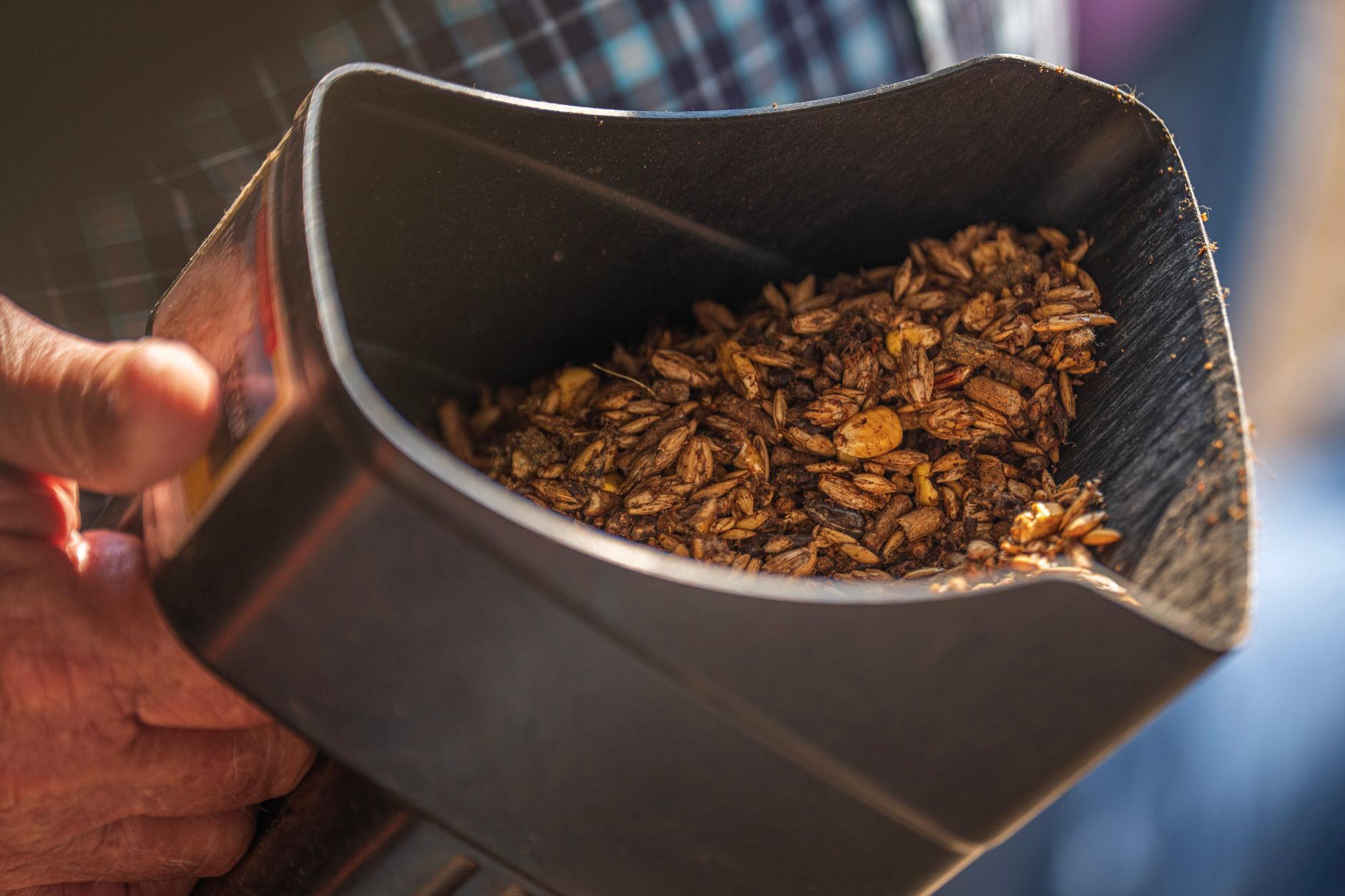
Textured feed is palatable and you can see what is in it, which is worth something. Its weakness is that a horse can sort through it, picking out the corn and leaving the pellets that carry the minerals.
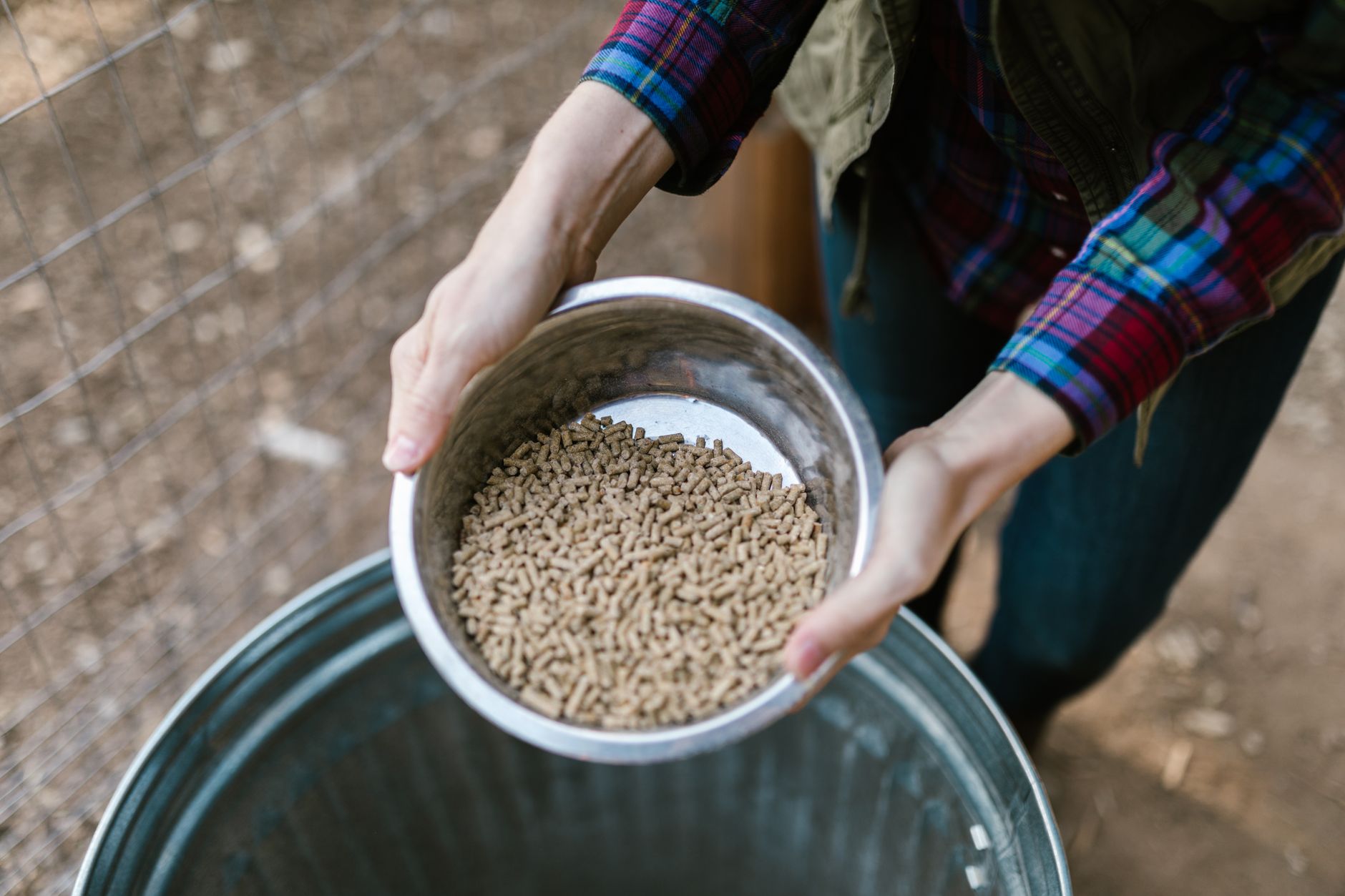
Pelleted feed cannot be sorted, which is the main argument for it. It is also easier on a worn mouth and soaks into a mash.
High-fat performance feeds deliver energy as oil rather than starch. At around 10% total fat, a feed carries roughly 1.6 Mcal a pound against 1.42 for a plain mix — so for a horse in moderate work the ration drops from 4.72 lb (2.14 kg) to 4.19 lb (1.9 kg) a day. Fewer pounds of feed and less starch in each meal is the reason hard-working horses are fed this way.
When the answer is a ration balancer
If the arithmetic says your horse needs no extra energy — which it does for a great many horses — feeding a small amount of a regular feed is the wrong response, for the reason above.
A ration balancer is built for this case. It supplies the protein, minerals and vitamins that forage alone leaves short, in 0.1–0.18% of body weight a day — about 1.54 lb (0.7 kg) for an 1,100 lb horse — with almost no calories attached. Fed to its label rate it balances the diet without adding to a horse that does not need adding to.
It is also the densest thing in the feed room, so the scoop that held 3.4 lb of sweet feed holds 4.2 lb of balancer. Weigh it.
What not to feed
Anything containing an ionophore. Monensin and related additives are routine in cattle and poultry feed and are lethal to horses at doses cattle tolerate easily. Never feed a cattle ration to a horse, and be careful about shared scoops and shared storage on a mixed farm.
Anything mouldy. A horse ferments its feed after the main site of absorption rather than before it, so mould toxins are absorbed rather than broken down first. Colic and laminitis follow.
More than 50% of the ration as concentrate, whatever it is made of, and never more than 0.5% of body weight in one meal. Choosing a better feed does not move either line.
Common questions about choosing a horse feed
What is the best grain to feed horses?
Usually none, and after that, whatever closes the gap your forage leaves with the least starch. Corn is 18% more energy-dense per pound than oats and denser again per scoop, so oats are more forgiving if you are measuring by volume. A balanced commercial feed fed at its label rate is simpler than correcting straight cereals by hand.
What grains should horses not eat?
Anything containing an ionophore such as monensin — routine in cattle and poultry feed and lethal to horses. Anything mouldy, because a horse absorbs mould toxins rather than breaking them down first. And in practice, any cereal fed in a meal larger than 0.5% of body weight, whatever the grain is.
Is corn or oats better for horses?
Neither is better; they are different densities. Corn carries 18% more energy per pound and more again per scoop, so the same volume of corn is a much bigger meal. Oats are the traditional choice precisely because that makes them harder to overfeed by accident.
Are pellets or sweet feed better for horses?
They carry the same energy per pound when made to the same formula, so this is not an energy question. Pellets cannot be sorted through, are easier on a worn mouth and soak into a mash. Sweet feed is more palatable and lets you see what you are feeding. A quart of pellets weighs about 18% more, so re-weigh the scoop if you switch.
What is a ration balancer and does my horse need one?
A concentrated source of protein, minerals and vitamins with almost no calories, fed at 0.1–0.18% of body weight a day — around 1.54 lb (0.7 kg) for an 1,100 lb horse. It is the right answer for a horse holding its weight on forage alone, which is most horses in light work. It is the wrong answer for one that needs feeding up.
Can I just feed a small amount of regular feed instead?
Not without losing the point of it. A commercial feed’s vitamin and mineral levels are formulated on the assumption you feed the full label amount, so half the label rate gives you an unbalanced diet rather than half a balanced one. That is exactly the gap a ration balancer exists to fill.
What is beet pulp used for?
Adding calories without starch. Its fibre is far more digestible than published tables suggest, it soaks into a mash for a horse with a worn mouth, and it carries no per-meal starch risk. Worth avoiding as a large part of the ration in a horse with diagnosed kidney trouble, because it is high in calcium.
Related calculators and guides
- Horse grain calculator — pick a feed form and it works out how much of that particular feed closes your gap
- How many scoops of grain should I feed my horse? — why changing feeds without re-weighing the scoop changes the ration
- All horse calculators — the rest of the tools in this section
Where these figures come from
Every figure on this page is published and cited. Where sources disagree we take the more conservative one and say so. Our full approach is set out in how we source our numbers.
- Basics of Feeding Horses: Feeding Management (G1781) — University of Nebraska-Lincoln Extension
- Equine Nutrition: Concentrates — Utah State University Extension
- Equine Senior Horse Feed – feeding directions — Purina Animal Nutrition LLC
- Feeding and Nutrition for the Senior Horse (UT Horse, Vol. 2 Issue 4) — University of Tennessee Institute of Agriculture Extension
- Forage for Horses (Idaho Forage Handbook, 3rd Edition, Chapter 17) — University of Idaho Extension
- Hay Storage: Dry Matter Losses and Quality Changes — Mississippi State University Extension
- Integrity Feed Weight Chart — Star Milling Co.
- Measuring the Digestible Energy Content of Horse Feeds — Kentucky Equine Research, Inc.
- Nutrient Requirements of Horses, Sixth Revised Edition — National Research Council / National Academies Press
- Nutritional Requirements of Horses and Other Equids — Merck Veterinary Manual
- Properly curing hay is crucial for forage quality — North Dakota State University Extension
- Purina Horse Feed Quart Weights (conversion chart) — Purina Animal Nutrition LLC
- Selecting and storing horse hay — University of Minnesota Extension
- The energy requirements of performance horses in training
- Winter Feeding for Horses, Fact Sheet #1143 — Rutgers University, Department of Animal Sciences