
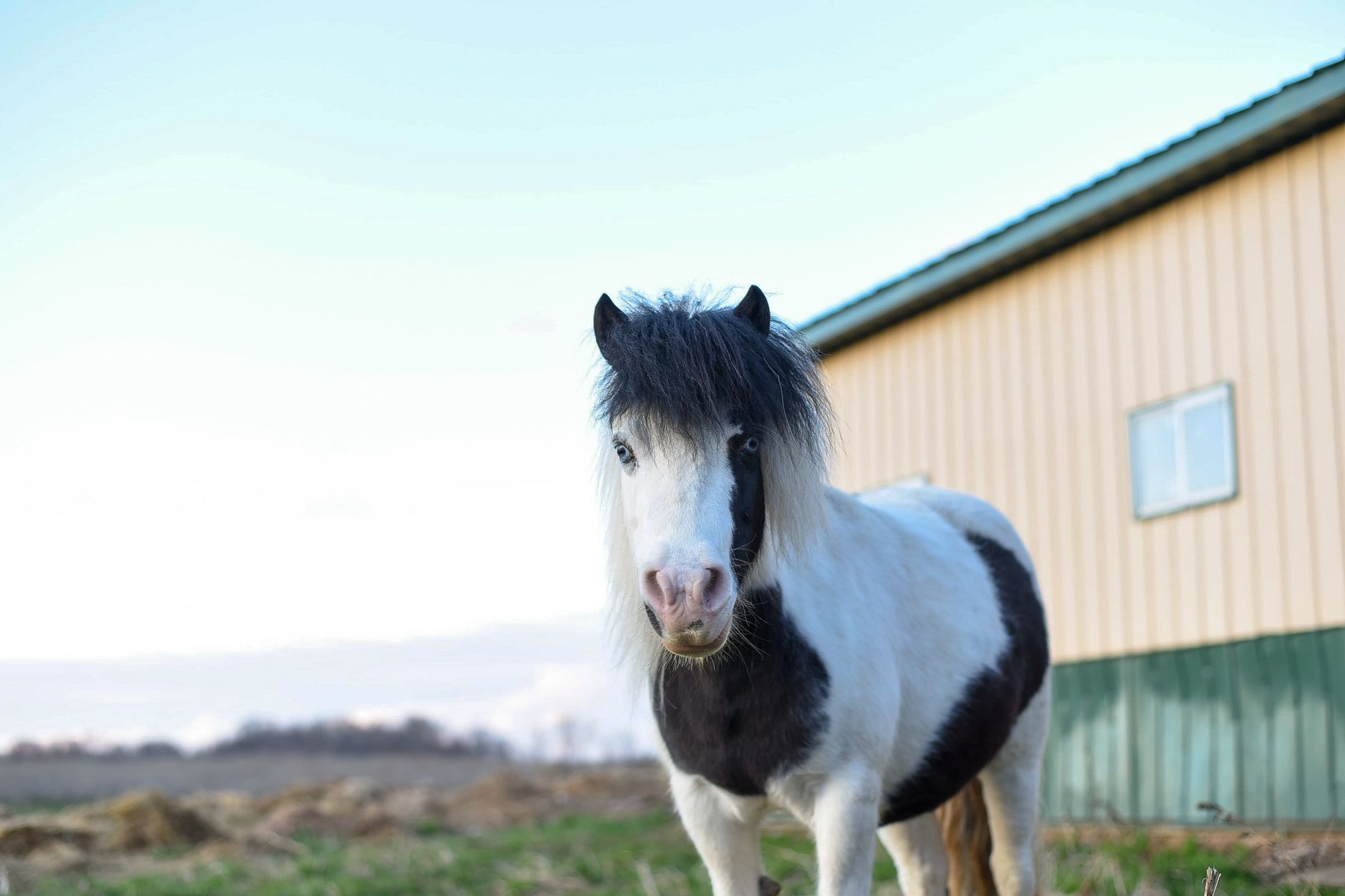
What size stall for a mini horse?
A 34 in (86 cm) miniature at 250 lb comes out at 32 sq ft (3 m²) to 50 sq ft (5 m²) on the published area rule, and 23 sq ft (2 m²) on the body-weight rule.
That is smaller than any stall on the market. The trade builds 8 × 8 for miniatures and 10 × 10 for the generous, which is 28% and 99% more than the top of the band.
So an 8 × 8 is already generous rather than tight, and that is the answer. Build one, and know that you are giving the animal more than either rule asks for rather than getting away with something.
Now the caveat, because it matters more here than on any other size of horse.
Neither rule was written about a miniature
The area rule comes from a study of eight ordinary riding horses. The body-weight rule comes from a table of care standards for university and research barns, whose own worked example is a 12 × 12 box.
Penn State’s stall design sheet says outright that it covers “a typical 1,000-pound horse”. Extension Horses adds only that box stalls for ponies may be smaller, depending on the breed, and leaves it there.
No extension or peer-reviewed publication located for this page sets a stall size for miniature horses. Not one.
Every figure in circulation traces to a stall manufacturer, a mat supplier or a forum thread.
Stretching a rule past the animals it was measured on is exactly the thing this site tries not to do, so treat the arithmetic below as a sanity check on the trade’s numbers rather than as a replacement for them.
| Height | Weight | Area rule | Weight rule | Arithmetic says | |
|---|---|---|---|---|---|
| Very small mini | 30 in (76 cm) | 180 lb | 25–39 sq ft | 16 sq ft | 6 × 6 ft |
| AMHA mini, at the limit | 34 in (86 cm) | 250 lb | 32–50 sq ft | 23 sq ft | 8 × 8 ft |
| AMHR B-size mini | 38 in (97 cm) | 300 lb | 40–63 sq ft | 27 sq ft | 8 × 8 ft |
| Small Shetland | 42 in (107 cm) | 400 lb | 49–77 sq ft | 36 sq ft | 8 × 8 ft |
| Riding horse, for scale | 64 in (163 cm) | 1,150 lb | 114–178 sq ft | 104 sq ft | 12 × 12 ft |
What the table shows is that the trade and the arithmetic agree on direction and disagree on scale, and the trade is the more generous of the two.
That is a comfortable place to be.
The 10-foot wall rule does not apply
You will read everywhere that a stall wall should never be under 10 ft. It is a real rule and it comes from Penn State, and it is written about riding horses.
The same body of guidance that sets it also says box stalls for ponies may be smaller.
Anything at or under 58 in (147 cm) — 14.2 hh — is a pony rather than a horse by the standard definition, and a miniature is far below that.
The reason for the 10 ft rule is getting cast: a horse that lies down close to a short wall can end up with its legs against it and no way to get them back underneath.
That risk scales with the animal.
A 34 in (86 cm) miniature has 53% of a riding horse’s height and needs less room to roll over in the same proportion. Applying a horse’s wall rule to it would mean building a stall 2.5 times the floor the area rule asks for.
Where the small stall does bite
Turnout, not floor space. The published standard is 30 minutes of free turnout or 15 minutes of controlled exercise a day for a horse in a box stall, and the source is candid that no study has established the right figure.
A miniature kept in an 8 × 8 for most of the day is short of exercise long before it is short of floor.
Our calculator moves the answer for a stall-bound animal — 41–50 sq ft against 32–41 sq ft for one that only comes in to eat — but no stall size fixes a horse that never goes out.
Two minis in one stall. Common, and not covered by either rule.
Both are written for one occupant, and two animals in a box need somewhere to get away from each other rather than simply twice the floor.
Handling room. The floor a miniature needs and the floor you need to hold, groom, rug or treat one are different numbers.
An 8 × 8 that suits the animal can be awkward with a person and a farrier in it.
The fittings, which do not scale down
This is the part people get wrong when they buy a mini stall, and it goes both ways.
Partitions stay tall. 8 ft is standard and 7.5 ft is Penn State’s minimum.
Those figures come from how high a horse can kick — 7 ft (2.1 m) — and from stopping animals fighting through the divider, and a miniature in a barn of full-sized horses is on the wrong side of both.
The gap under the door matters more, not less. Penn State asks for under 3 in (8 cm) of clearance beneath a full-length door so a hoof cannot get stuck.
A miniature’s leg is thinner, so the same gap is a bigger hazard.
Bars and grille spacing. Extension Horses specifies partition boards no more than 18 in apart and vertical pipes no more than 4 in (10 cm) centre to centre.
A miniature’s head fits through openings a horse’s will not.
Doors can come down. The 4 ft (1.2 m) recommended opening is about a horse’s hip and a handler beside it.
For a miniature the constraint is the handler, so 3.5 ft (1.1 m) is comfortable and the height is what you want to keep.
Light does not scale either.
4 sq ft of window per stall is the published minimum and it is about seeing into the stall to check the animal, which is no easier in a small box than a large one.
So what should you build?
8 × 8 for a miniature that goes out daily. That is 57% more floor than the middle of the published band, and it is what most of the trade builds.
10 × 10 if it is in for much of the day, or if two share. It is well past what either rule requires, and the reason to do it is handling room and boredom rather than the arithmetic.
Do not go under 6 × 8. Below that you are into a space where a person and an animal cannot both move safely, whatever the floor area says.
If your miniature is at the larger end, run it through the stall size calculator rather than reading a category off a chart.
A 38 in (97 cm) B-size mini needs 40–63 sq ft against 25–39 for a very small one, and that is most of a stall size between them.
Common questions about miniature horse stalls
What size stall for a mini horse?
8 × 8 ft is the working answer and it is generous.
The published area rule gives an 34 in (86 cm) miniature 32–50 sq ft and the body-weight rule 23 sq ft, so 64 sq ft is comfortably above both.
Go to 10 × 10 if the animal is in for most of the day or two share.
Is a 10×10 stall too big for a mini horse?
Not too big, just more than either rule asks for — 146% more floor than the middle of the published band. The study behind that band found horses lay down more in the larger box, so there is no welfare argument against it.
The cost is bedding and mucking out, both of which scale with the floor.
How much space does a mini horse need?
In a stall, less than anything on the market: 32–50 sq ft by the published rules.
Out of it, more than people expect — the standard is 30 minutes of turnout or 15 minutes of controlled exercise a day as a floor, and a miniature that lives in a small box without going out is short of exercise, not floor.
Can a mini horse live in a backyard?
The stall side of that is easy: an 8 × 8 shelter clears both published rules for a 34 in (86 cm) animal with room to spare. What decides it is grazing, turnout, company and your local zoning, none of which this page can answer.
A miniature is a horse in every way that matters except the size of the box.
What size stall for two mini horses?
Neither published rule covers two occupants in one box, so the arithmetic will not answer it.
Two miniatures at 41 sq ft each would be 81 sq ft, but the real requirement is room to get away from one another rather than doubled floor.
10 × 10 is what the trade builds and it is a reasonable place to land.
How tall should a mini horse stall partition be?
The same as any other: 8 ft is standard and 7.5 ft is the published minimum.
Those are set by how high a horse can kick (7 ft (2.1 m)) and by stopping animals reaching one another through the divider, and a miniature stabled next to full-sized horses is exposed to both.
Bars and boards want to be closer together, though, because a small head fits through gaps a large one will not.
Do miniature horses need a stall at all?
Not necessarily — a run-in shed with free access does the same job and the published figure for one is about the area of a box stall per animal.
A stall earns its place for feeding separately, for treatment, for foaling and for bad weather. What a miniature does not need is a large one.
Related calculators and guides
- What size stall does a horse need? — run your own animal’s height and weight through both published rules
- How many bags of shavings for a horse stall? — a smaller box is less floor to bed, though not less to muck out than you would think
- How much hay does a horse need per day? — miniatures are the animals easiest to overfeed, and the calculator scales properly
- All horse calculators — the rest of the tools in this section
Where these figures come from
Every figure on this page is published and cited. Where sources disagree we take the more conservative one and say so.
Our full approach is set out in how we source our numbers.
- Equine Facilities: Stall Dimensions — Extension Horses (eXtension)
- Guide for the Care and Use of Agricultural Animals in Research and Teaching, 3rd ed., Chapter 8: Horses — Federation of Animal Science Societies (FASS)
- Horse Stall Design (Horse Facilities #4) — Penn State Extension
- Lying behavior in horses in relation to box size — Journal of Equine Veterinary Science 26(1):11-17, 2006