
How much grain should I feed my horse daily?
Grain fills the gap between what your horse needs and what its forage already supplies. Tell us what the forage is doing first, and the answer comes out in pounds, in scoops, and in bags.
Why?
From your scoop size and quart weight, not a rule of thumb — there isn't one.Why?
Rounded up — you buy whole bags.How much grain should I feed my horse daily?
Grain is not a ration. It is the remainder — what is left after forage has done as much of the job as it can. So the question is never really “how much grain does a horse need”, it is “how big is the gap my hay leaves”, and that is what the calculator above works out.
For an 1,100 lb (499 kg) horse eating 20 lb of average grass hay a day, the answers come out like this: at maintenance, 0 lb (0 kg). In light work, 2.38 lb (1.08 kg). In moderate work, 4.72 lb (2.14 kg).
That first answer is not a rounding error. A mature horse in no work, on reasonable hay, does not need grain. Most horses being fed a scoop twice a day are being fed it out of habit, and the honest calculator says so instead of finding something to sell.
The formula, spelled out
Three steps. Every tool that gets this wrong skips the middle one.
Step 1 — the energy requirement. Maintenance runs about 0.0333 Mcal of digestible energy per kg of body weight per day. For our 1,100 lb (499 kg) horse that is 16.6 Mcal at maintenance, rising to 23.3 Mcal in moderate work.
Step 2 — subtract the forage. 20 lb of hay is not 20 lb of dry matter: cured hay runs about 90% dry matter, so it is 18 lb. Average grass hay carries about 0.92 Mcal per pound of dry matter, which makes that hay worth 16.6 Mcal.
This is the step almost nothing online does. A calculator that never asks what your hay is, or asks and then ignores the answer, is quietly assuming your forage supplies nothing — and hands you a grain figure to match.
Step 3 — divide the gap by the feed. In moderate work the gap is 6.7 Mcal. A plain commercial feed carries about 1.42 Mcal per pound, so 6.7 ÷ 1.42 = 4.72 lb (2.14 kg) a day, or 2.36 lb (1.07 kg) in each of two meals.
Why a scoop is a bad unit and a pound is a good one
Everyone feeds by the scoop. Nobody’s feed bag is written in scoops. That gap is where most over- and under-feeding lives, and it is not a small effect.
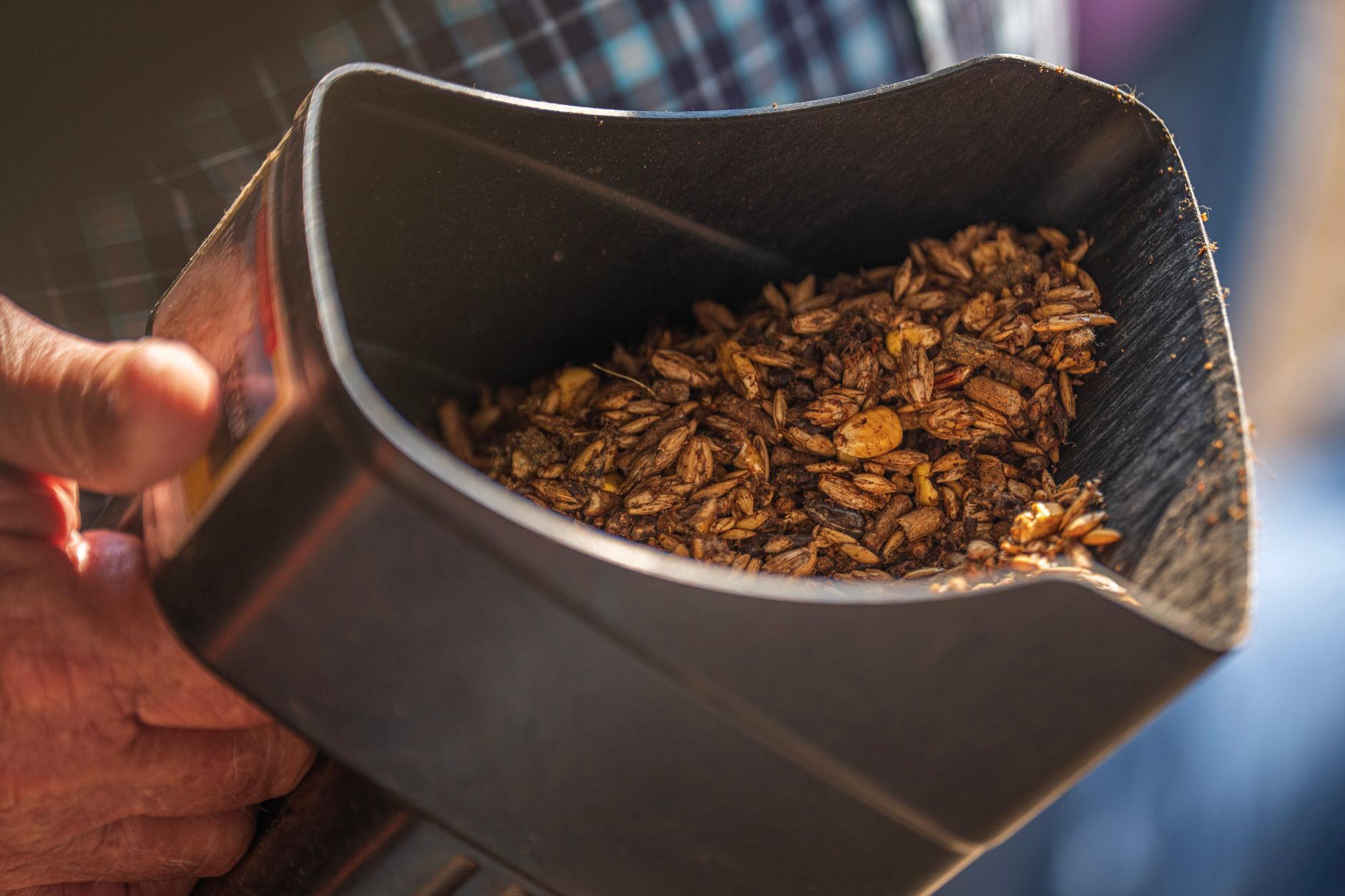
Two manufacturers publish measured quart weights for their own products: 29 feeds from one and 20 from the other. Across all 49, a quart of feed weighs between 0.89 lb and 1.53 lb. The heaviest is 72% heavier than the lightest. The same 3-quart scoop therefore delivers 2.7 lb of one feed and 4.6 lb of another.
The trap is sharper than that, because the two things move in opposite directions. Pellets and textured feed made to the same formula carry the same energy per pound — pressing a mix into pellets changes its density, not its calories. But a quart of pellets weighs about 18% more than a quart of sweet feed. Switch brands or forms without re-weighing your scoop and you have changed the ration by roughly a fifth while believing nothing has changed at all.
| Feed form | One quart | 2-quart scoop | 3-quart scoop | Scoops in a 50 lb bag |
|---|---|---|---|---|
| Textured / sweet feed | 0.9–1.2 lb | 1.9–2.4 lb | 2.8–3.6 lb | 14–18 |
| Pelleted feed | 1.2–1.4 lb | 2.5–2.8 lb | 3.7–4.2 lb | 12–13 |
| High-fat performance feed | 1.2–1.4 lb | 2.4–2.7 lb | 3.6–4.1 lb | 12–14 |
| Senior or complete feed | 0.9–1.3 lb | 1.8–2.6 lb | 2.7–3.8 lb | 13–19 |
| Ration balancer | 1.3–1.5 lb | 2.6–3.1 lb | 3.9–4.6 lb | 11–13 |
Tipping one level quart onto a kitchen scale takes a minute and turns every figure on this page from typical into exact.
Where each input comes from, and how to measure it
Body weight. Every limit here is a percentage of it. A weight tape is close enough for feeding decisions, though it reads low on stocky horses.
Hay fed per day. Weigh it. This is the input the whole answer pivots on, because the grain figure absorbs the entire error: overstate the hay and the tool under-feeds, understate it and the tool over-feeds. If you do not know, work out the forage side first.
Hay quality. Judge it by maturity, not by species. Stemmy hay with visible seed heads was cut late and carries about 18% less energy per pound than the same grass cut early — a bigger swing than the difference between grass and alfalfa. A forage analysis is the only way to be sure, and it costs less than a bag of feed.
Feed energy. Follows the feed form unless you change it. If your bag states a digestible energy figure you can type it in, but treat it with some suspicion: Kentucky Equine Research measured feeds directly and reported plainly that many manufacturers overestimate the energy in their own product. A plain mix without added fat lands near 1.42 Mcal per pound whatever the tag says.
Workload. Be conservative. Most horses described as being in light work are in maintenance with occasional exercise.
What changes the answer
Your hay changes it more than your horse does
Hold the horse and the workload still, change only the hay, and the grain figure moves by more than most people expect. For an 1,100 lb horse in moderate work on 20 lb of hay: mature stemmy grass leaves a gap of 6.24 lb (2.83 kg), average grass hay 4.72 lb (2.14 kg), and early-bloom alfalfa 2.69 lb (1.22 kg).
Better hay is almost always the cheaper way to close an energy gap, and it is the safer one — it carries no per-meal ceiling.
| Hay you feed | Maintenance | Light work | Moderate work |
|---|---|---|---|
| Grass hay, mature and stemmy | 1.56 lb (0.71 kg) | 3.9 lb (1.8 kg) | 6.24 lb (2.83 kg) |
| Grass hay, mid to full bloom | 0 lb (0 kg) | 2.38 lb (1.08 kg) | 4.72 lb (2.14 kg) |
| Grass hay, early bloom | 0 lb (0 kg) | 1.75 lb (0.79 kg) | 4.09 lb (1.85 kg) |
| Mixed grass and legume | 0 lb (0 kg) | 2 lb (0.91 kg) | 4.34 lb (1.97 kg) |
| Alfalfa, mid to full bloom | 0 lb (0 kg) | 1.24 lb (0.56 kg) | 3.58 lb (1.62 kg) |
| Alfalfa, early bloom | 0 lb (0 kg) | 0 lb (0 kg) | 2.69 lb (1.22 kg) |
Pasture counts, and it counts for a lot
Grass is forage. Our 1,100 lb horse on 10 lb of hay plus nine hours a day at grass needs 0 lb (0 kg) — the pasture has already closed the gap. Grazing intake is the least certain figure on this page, so treat it as a reason to feed less grain and watch the horse, rather than a number to trust to the decimal.
How much grain is too much
Two limits, and they bite in different places.
Per meal: 0.5% of body weight. 5.5 lb for an 1,100 lb horse. Beyond that, starch the small intestine cannot absorb reaches the hindgut and ferments there, which is the route to grain-associated colic and laminitis. Notice that this is a limit you cannot see in a daily figure: 12 lb a day is fine in three meals and dangerous in one.
Across the day: under 50% of the ration, better at 20–30%. And forage must stay above 1.5% of body weight whatever else happens — a horse’s gut needs something to work on continuously, and the ulcer and colic risk of a forage-starved horse is not repaid by any amount of concentrate.
There is a third, narrower one worth knowing: a meal over 2.75 lb for this horse should not be fed within an hour of hard work.
Senior horses
Senior horses have no separate published nutrient requirements — most do well on a normal adult maintenance formulation, and the energy arithmetic above applies unchanged. What changes is the mouth and the meal.
A single meal for a senior should never exceed 5 lb, an absolute limit rather than a percentage, which means it binds before the 0.5% rule on any horse under 1,000 lb. Worn or missing teeth make choke the immediate risk, so soft pellets or an extruded feed beat a textured mix, and either can be soaked into a mash. A horse that can no longer chew hay at all needs a complete feed fed at forage quantities, which is a different calculation from topping up a ration.
What kind of grain
The differences between straight cereals are real and larger than the way people talk about them suggests.
| Feed | Digestible energy (Mcal per lb, as fed) | Compared with oats |
|---|---|---|
| Corn | 1.54 | +18% |
| Oats | 1.30 | — |
| Wheat middlings | 1.38 | +6% |
| Molasses | 1.18 | −9% |
| Rice bran | 1.19 | −8% |
| Beet pulp, dry | 1.06 | −18% |
| Alfalfa hay | 0.94 | −28% |
| Timothy hay | 0.80 | −38% |
| Soybean hulls | 0.77 | −41% |
| Oat hulls | 0.65 | −50% |
Those figures are direct digestion-trial measurements rather than book estimates, and two of them are worth pausing on. Beet pulp and soybean hulls are far more digestible than their fibre content suggests, so published tables understate them; oat hulls are far less digestible, so tables overstate them. It is why a feed’s ingredient list tells you more than its guaranteed analysis does.
Grain per day: charts by weight, workload and hay
These tables are generated by the same code the calculator runs, so they cannot drift apart from it.
| Body weight | Maintenance | Light work | Moderate work | Heavy work |
|---|---|---|---|---|
| 500 lb (227 kg) | 0 lb (0 kg) | 0.55 lb (0.25 kg) | 1.61 lb (0.73 kg) | 2.68 lb (1.22 kg) |
| 800 lb (363 kg) | 0 lb (0 kg) | 0.88 lb (0.4 kg) | 2.58 lb (1.17 kg) | 4.29 lb (1.94 kg) |
| 1,000 lb (454 kg) | 0 lb (0 kg) | 1.1 lb (0.5 kg) | 3.23 lb (1.47 kg) | 5.36 lb (2.43 kg) |
| 1,100 lb (499 kg) | 0 lb (0 kg) | 1.21 lb (0.55 kg) | 3.55 lb (1.61 kg) | 5.89 lb (2.67 kg) |
| 1,200 lb (544 kg) | 0 lb (0 kg) | 1.32 lb (0.6 kg) | 3.88 lb (1.76 kg) | 6.43 lb (2.92 kg) |
| 1,400 lb (635 kg) | 0 lb (0 kg) | 1.54 lb (0.7 kg) | 4.52 lb (2.05 kg) | 7.5 lb (3.4 kg) |
| 1,600 lb (726 kg) | 0 lb (0 kg) | 1.76 lb (0.8 kg) | 5.17 lb (2.34 kg) | 8.57 lb (3.89 kg) |
Common questions about feeding grain to horses
How much grain should a 1,000 lb horse eat?
In light work, on 20 lb of average grass hay, about 1.1 lb (0.5 kg) a day. At maintenance on the same hay, none at all. The honest answer is that body weight alone cannot decide it — what the horse does and what its hay is worth decide it, and grain fills whatever is left over.
How much grain should I feed my horse daily?
Work out the gap rather than a percentage. An 1,100 lb horse on 20 lb of average grass hay needs 0 lb (0 kg) at maintenance, 2.38 lb (1.08 kg) in light work and 4.72 lb (2.14 kg) in moderate work. Change the hay to early-bloom alfalfa and that moderate figure drops to 2.69 lb (1.22 kg).
Can you feed a horse too much grain?
Yes, and the limit is on the meal rather than the day. More than 0.5% of body weight of grain-based feed in one sitting — 5.5 lb for an 1,100 lb horse — sends starch the small intestine cannot handle into the hindgut, where it ferments. That is the mechanism behind grain-associated colic and laminitis. A horse that genuinely needs more than that in a day needs more meals, at least 4 hours apart, not bigger ones.
How much grain is too much for a horse?
Two ceilings, and whichever you hit first is the answer. Per meal: 0.5% of body weight. Across the day: concentrate should stay under 50% of everything the horse eats, and is better at 20–30%. Forage must never drop below 1.5% of body weight to make room for grain.
Do horses need to eat grain every day?
Most do not need it at all. A mature horse in no work or light work, on decent forage, meets its energy requirement from hay and grass alone — which is what the calculator above returns for that case. What such a horse is often short of is protein, minerals and vitamins, not calories, and that is what a ration balancer is for: 0.1–0.18% of body weight a day, roughly 1.54 lb (0.7 kg) for an 1,100 lb horse, with almost no calories attached.
Is it okay to feed horses grain once a day?
Only if the daily amount fits inside one meal — under 5.5 lb for an 1,100 lb horse. Below that, once a day is fine. Above it, splitting is not a refinement, it is the difference between a safe ration and a risky one.
How much is one scoop of horse feed?
Somewhere between 0.89 and 1.53 lb per quart, depending entirely on the feed. Across 49 products from two manufacturers that is a 72% spread, so a 3-quart scoop holds anywhere from 2.7 lb to 4.6 lb. There is no universal answer, which is why the calculator asks you for the number instead of assuming one.
How many scoops of grain should I feed my horse?
For an 1,100 lb horse in moderate work on average grass hay, 1.25 scoops of a 3-quart scoop if the feed is pelleted, and 1.5 scoops of the same scoop if it is textured — for the identical 4.72 lb (2.14 kg) of feed. The scoop did not change and the horse did not change. Only the density did.
How much feed should a horse have per day?
Hay and grain together, 1.5–2% of body weight at maintenance and up to 2–3% in hard work. Forage should be most of it: at least 1.5% of body weight, and ideally far more.
How much to feed a 500 kg horse?
A 500 kg horse is 1,102 lb. In light work on 22 lb (10 kg) of average grass hay, about 1.24 lb (0.56 kg) of grain a day. At maintenance on the same hay, none.
How much grain should I feed my senior horse?
The same energy arithmetic — senior horses have no separate published nutrient requirements, and most do well on an adult maintenance formulation. What changes is the mouth and the meal. A single meal for a senior should never exceed 5 lb, which on a horse under 1,000 lb binds tighter than the 0.5% rule does. Worn teeth also make a soaked pellet or an extruded feed safer than a textured mix, because choke is the real risk.
What is the best senior feed for older horses?
The one the horse can chew. Pelleted and extruded feeds are easier to chew and more digestible than textured mixes for an older horse, and both soak into a mash for a horse that cannot chew at all. A feed labelled “complete” carries enough fibre to replace hay when a horse can no longer manage long-stem forage — but it then has to be fed at hay-like quantities, split across the day.
What is the best grain to feed horses?
Usually none, and after that, whatever closes the gap your forage leaves. Corn carries 18% more energy per pound than oats, so a scoop of one is not a scoop of the other. Commercial mixes exist because straight cereals leave the mineral and protein side unbalanced; a bagged feed fed at its label rate is the simpler way to get that right.
What is the 1/2/3 rule in horses?
Nothing to do with feeding, despite how often it comes up beside these questions. It is a foaling checklist: the foal should be standing within one hour, nursing within two, and the mare should have passed the placenta within three. If any of those slips, call a vet.
Read next
- How many scoops of grain should I feed my horse? — turning the pounds above into the unit you actually feed with.
- How much does a scoop of horse feed weigh? — the conversion tables, by feed form, scoop size and bag.
- How much grain can you feed a horse per day? — the three ceilings in full, and which one binds first.
- How much grain should I feed my senior horse? — the smaller meal limit, and when feed starts replacing hay.
- What kind of grain should I feed my horse? — measured energy figures for every common feed and ingredient.
- Do horses need grain every day? — why the answer above is so often none, and what to feed instead.
- How much hay does a horse need per day? — the forage side, which decides everything on this page.
- All horse calculators — the rest of the tools in this section.
Where these figures come from
Every coefficient behind this calculator is published and cited. Where a manufacturer’s own measurement is the best available evidence — as it is for what a quart of feed weighs — we say so and corroborate it against a second manufacturer rather than take one company’s word. Our full approach is set out in how we source our numbers.
- Basics of Feeding Horses: Feeding Management (G1781) — University of Nebraska-Lincoln Extension
- Effect of Restricted Pasture Access on Pasture Dry Matter Intake Rate, Dietary Energy Intake, and Fecal pH in Horses — Journal of Equine Veterinary Science (2013)
- Equine Nutrition: Concentrates — Utah State University Extension
- Equine Senior Horse Feed – feeding directions — Purina Animal Nutrition LLC
- Feeding and Nutrition for the Senior Horse (UT Horse, Vol. 2 Issue 4) — University of Tennessee Institute of Agriculture Extension (2012)
- Forage for Horses (Idaho Forage Handbook, 3rd Edition, Chapter 17) — University of Idaho Extension (2005)
- Hay Storage: Dry Matter Losses and Quality Changes — Mississippi State University Extension
- Integrity Feed Weight Chart — Star Milling Co.
- Measuring the Digestible Energy Content of Horse Feeds — Kentucky Equine Research, Inc.
- Nutrient Requirements of Horses, Sixth Revised Edition — National Research Council / National Academies Press (2007)
- Nutritional Requirements of Horses and Other Equids — Merck Veterinary Manual
- Properly curing hay is crucial for forage quality — North Dakota State University Extension (2024)
- Purina Horse Feed Quart Weights (conversion chart) — Purina Animal Nutrition LLC (2023)
- Selecting and storing horse hay — University of Minnesota Extension
- The energy requirements of performance horses in training (2020)
- Winter Feeding for Horses, Fact Sheet #1143 — Rutgers University, Department of Animal Sciences (2011)