
How many bags of shavings for a horse stall?
The number printed on a bag of shavings is the squashed volume, not what comes out of it — a 2.5 cu ft bag opens to nearer nine. That is why most answers to this question come out far too high, and it is built into the sums below.
Why?
Floor area times depth. This is what the bags have to fill, and why the squashed figure on the label misleads.Why?
What goes out in the barrow, replaced. It depends on how much water the material holds and how long the horse is actually in.Why?
Four and a third weeks, so this is the figure to order against.Why?
At 45 bags to a pallet, which six suppliers state independently.Why?
Top-ups only, at the price you entered. The first bedding-down is on top of this.Why?
The cross-check. Rutgers publishes 8–15 lb a day for a stalled horse, and this is worked out from absorbency instead, without being fitted to it.What the answer means
Bedding a 12 × 12 stall over rubber mats takes 5 bags of flake shavings, and keeping it up takes about one bag a week. On a bare floor bedded to 6 inches the first figure roughly doubles, to 9, while the weekly one does not move at all.
That split is the thing to take away. Laying a bed is a question about the floor, and topping it up is a question about the horse.
The single most useful fact on this page is that the number printed on a bag of shavings is not what comes out of it. Guardian state 8–9 cubic feet of shavings compressed into a 2.5 cubic foot bag, a factor of about 3.4.
Work out that your stall needs 72 cu ft (2 m³) of bedding, divide by the 2.5 on the label, and you will order 240% too many bags.
It is the commonest way this sum goes wrong.
How many bags of shavings for a 12×12 stall?
A 12 × 12 stall is 144 square feet. At 3 inches over mats that is 36 cu ft (1 m³) of bedding, so 5 bags at 8.5 cu ft each.
At 6 inches on a bare clay or concrete floor it is 72 cu ft (2 m³) and 9 bags. Deeper than that and you are buying cushion the mats already give you.
How many bags of shavings for a 10×10 stall?
3 bags at 3 inches over mats, against 5 for the 12 × 12. A 10 × 10 is 100 square feet, 31% less floor.
What does not change is the top-up. Both stalls come to about a bag a week, because that figure is set by the horse and not by the box it stands in.
How many bags of shavings for a stable?
Bedding a whole yard is the one-stall answer multiplied, because bedding does not share. An 8-stall barn on mats at 3 inches takes 34 bags to lay down, or about 0.75 of a pallet.
How many bags of shavings per stall you need does not fall as the yard grows — only what you pay for them does. Eight stalled horses get through 93 bags a month, which is a 45-bag pallet about every 2 weeks.
The formula, and a worked example
There are two sums here and they are unrelated to each other. The first is pure geometry.
Bags to bed the stall. Floor area × depth ÷ what one bag actually spreads to.
For the stall above: 144 sq ft × 3⁄12 ft = 36 cu ft, ÷ 8.5 = 4.2, so 5 bags.
The second sum is the one nobody else does, and it starts from what the bedding is actually for. A horse is not standing on shavings for comfort so much as to keep its feet out of its own urine.
Bags to keep it up. A 1,000 lb horse passes 2.4 US gal of urine a day, which is 20 lb (9 kg) of water.
Pine shavings hold 2 lb of water to the pound, so 10 lb (5 kg) of shavings a day is saturated and has to leave.
Here is the check that makes this worth trusting. Rutgers publishes, in a different table for a different purpose, that a stalled horse gets through 8–15 lb of bedding a day.
Our 10 lb falls inside that range without having been fitted to it. Two independent published figures agreeing is a good deal more reassuring than either one on its own.
Turnout then scales it.
A horse out 12 hours a day only leaves 50% of that in the stall, which is why the calculator asks and why the answer halves when you tell it.
What type of shavings are best for a horse stall?
On absorbency alone the spread across materials is more than sixfold, from hardwood chips at 1.5 lb of water to the pound up to peat moss at 9.5.
Pine shavings sit at 2 and straw at 2.2.
That is the whole reason a single “bags per stall” answer cannot be right for everyone, and it is why the calculator asks what you are bedding on before it answers.
One safety point outranks all of it. Never bed a horse on hardwood chips whose species you do not know.
Bedding containing as little as 20% black walnut causes laminitis, and contact is enough — the horse does not have to eat it. Signs follow within 8 to 24 hours of standing on fresh shavings, and prompt removal often resolves it.
| Bedding | Water held per lb | One bag spreads to | Bags a month |
|---|---|---|---|
| Pine shavings, flake | 2 lb | 8.5 cu ft | 5 |
| Pine shavings, fine | 2 lb | 8 cu ft | 5 |
| Wood pellets | 2.5 lb | 4.5 cu ft | 3 |
| Pine sawdust | 2.5 lb | 8 cu ft | 4 |
| Straw | 2.2 lb | 18 cu ft | 3 |
| Hardwood chips | 1.5 lb | 8.5 cu ft | 6 |
| Shredded paper | 1.6 lb | 6 cu ft | 9 |
| Peat moss | 9.5 lb | 7 cu ft | 1 |
Wood pellets deserve a note, because the usual explanation of them is wrong. They are not more absorbent than shavings pound for pound; they are the same pine, and a pellet is sawdust with the air pressed out.
What a pellet bag buys you is 40 lb of material in under a cubic foot of storage, against about 25 lb in a shavings bag. They also have to be wetted — 1–1.5 US gal a bag — or they stay as pellets underfoot.
Where each input comes from
Stall dimensions. Measure inside the walls, not the outside of the frame.
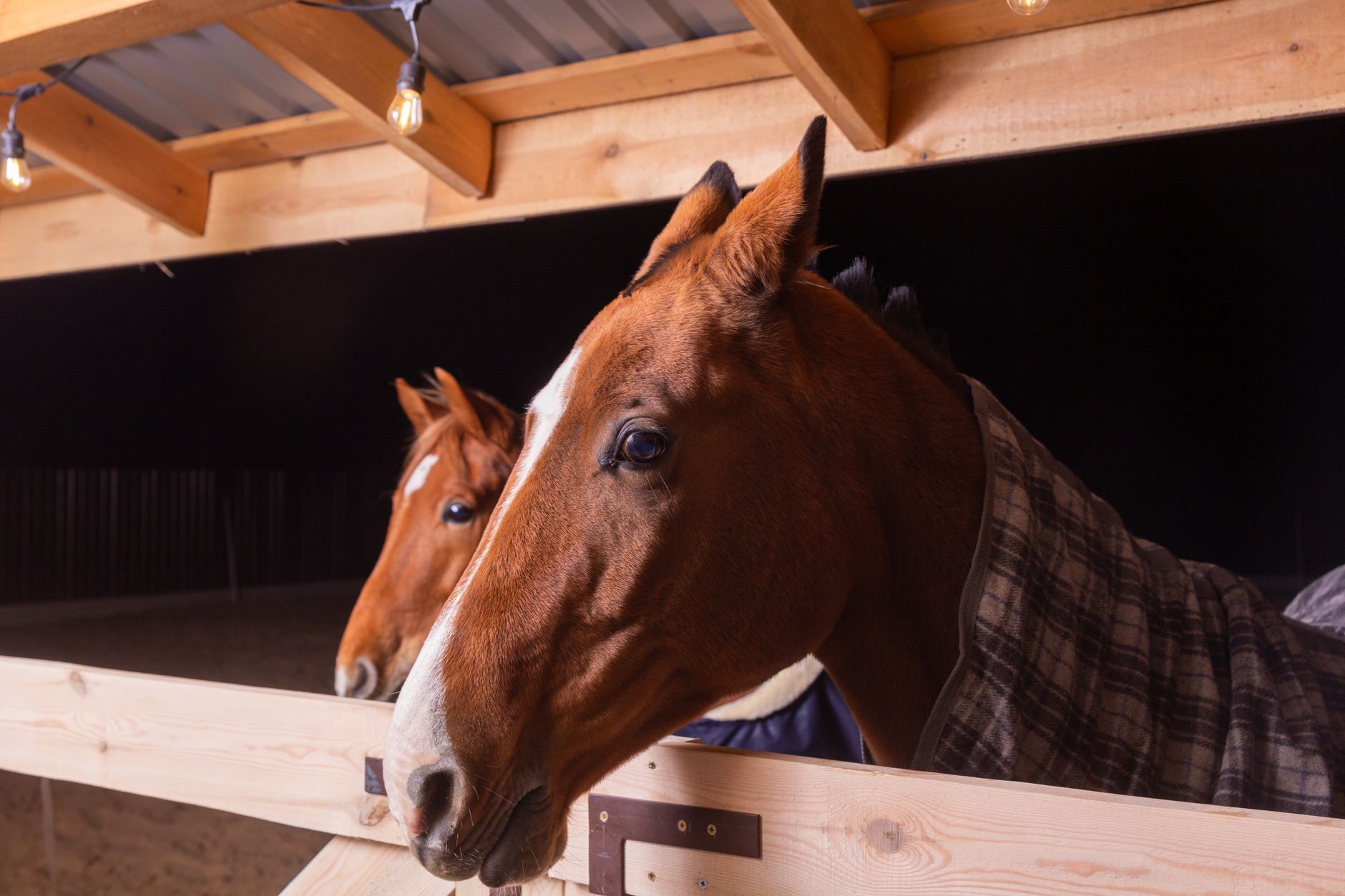
A stall advertised as 12 × 12 is often a little under.
What a bag spreads to. Expanded, not the figure on the label.
If your brand states a coverage rather than a volume, divide: a bag that covers 40 sq ft at 2 inches is holding 6.7 cu ft.
Depth. This is the input with the weakest evidence behind it, and we would rather say so than pretend otherwise.
No extension or peer-reviewed publication we could find specifies a bedding depth in inches. Every “4 to 6 inches” in circulation traces back to bedding retailers and mat manufacturers.
The absorbency arithmetic does support roughly that figure, which is some comfort: enough shavings to hold a day’s urine in the wet patch of a stall comes to about three inches, so four to six is that plus a working margin.
Hours turned out. The one input that changes the recurring cost more than anything else, and the one no competing tool asks for.
What changes the answer
Mats. Rubber mats let the bed be shallower, because the cushion no longer has to come from the bedding.
The widely advertised “60% to 75% less bedding” figures come from mat manufacturers, and we found no study behind them.
What is published is a much smaller flooring effect: Nebraska extension puts unsealed asphalt at about 20 percent less bedding than sealed asphalt or concrete.
How you muck out. The published range for soiled bedding removed spans 1.5 to 2.5 times the manure volume, and the source says plainly that it “varies based on management practices”.
Picking the wet patch out carefully puts you at the bottom of that range and stripping the bed puts you at the top.
Ammonia. Bedding choice is a respiratory question as well as a cost one.
Measured in working stables, peat held stall ammonia below 0.25 ppm where wood shavings ran 4–7 ppm by day 84.
Worker exposure over an eight-hour shift was 5.9 ppm on shavings and none on peat. The fine dust you breathe in, which is the reason usually given for choosing between the two, was no different.
How many bags of shavings does a horse go through a month?
About 5 bags a month for a horse in overnight and out 12 hours, and 12 for one stalled around the clock. At $8 a bag that is $35 for the first and $92 for the second.
A 45-bag pallet therefore lasts the first horse about 10.4 months and the second about 3.9.
| Hours turned out | Bags a week | Bags a month | A pallet lasts |
|---|---|---|---|
| 0 hours | 2.7 | 11.5 | 3.9 months |
| 6 hours | 2 | 8.6 | 5.2 months |
| 12 hours | 1.3 | 5.8 | 7.8 months |
| 18 hours | 0.7 | 2.9 | 15.6 months |
| 24 hours | 0 | 0 | indefinitely |
Quick reference — bags to bed a stall
Flake shavings at 8.5 cu ft to the bag, rounded up because you buy whole bags. Read down for your stall and across for your depth.
| Stall | 2″ deep | 3″ deep | 4″ deep | 6″ deep | 8″ deep |
|---|---|---|---|---|---|
| 10 × 10 ft | 2 | 3 | 4 | 6 | 8 |
| 10 × 12 ft | 3 | 4 | 5 | 8 | 10 |
| 12 × 12 ft | 3 | 5 | 6 | 9 | 12 |
| 12 × 14 ft | 4 | 5 | 7 | 10 | 14 |
| 14 × 14 ft | 4 | 6 | 8 | 12 | 16 |
| 16 × 16 ft | 6 | 8 | 11 | 16 | 21 |
Common questions about stall bedding
How many bags of shavings do I need for a 12×12 stall?
On rubber mats at 3″ deep, 5 bags of flake shavings — that is 36 cu ft (1 m³) of bedding, and a bag opens to about 8.5 cu ft.
On a bare floor at 6″ you need 9. Divide by the number printed on the bag instead and you will buy three times too many.
How many bags of shavings per pallet?
45 bags, stated independently by six suppliers of large-flake bagged shavings, though at least one 8 cu ft barnyard flake comes 54 to the pallet. Our pallet guide covers what that weighs, what it costs against buying singles, and how long one lasts.
Is 10×10 big enough for a horse stall?
It is a common size for a pony or a small horse and it takes 3 bags to bed at 3″, against 5 for a 12 × 12.
Bedding cost barely changes with stall size, though. What the horse wees is what you replace, and that is the same in either box.
How much is a pallet of shavings?
At a typical $8 a bag, a 45-bag pallet is about $360 — and buying by the pallet is normally where the saving is rather than in the brand.
One pallet lasts the horse above about 10.4 months.
How many 4×6 stall mats for a 12×12 stall?
Six.
A 4 × 6 mat covers 24 sq ft and a 12 × 12 stall is 144 sq ft, so six laid in two rows of three fill it exactly with no cutting.
Mats want to be at least 5/8 in thick and laid on a level, well-drained base or they will rock and gap.
How often should stall bedding be replaced?
The wet patch daily; the whole bed as rarely as you can get away with. Wood bedding that is picked over rather than stripped ran 4–7 ppm of ammonia by day 84 in the one study that measured it.
Peat over the same period stayed under 0.25 ppm.
How much waste does one stalled horse produce?
About 2.4 cu ft a day of manure and soiled bedding together, which comes to 12–13 short tons a stall a year. The horse’s own share is 37 lb of feces and 2.4 US gal of urine daily; soiled bedding is roughly 2 times the volume of the manure.
Read next
- How many bags of shavings per pallet? — what a pallet holds, weighs and costs, and whether buying one is worth it for your number of stalls.
- What type of shavings are best for a horse stall? — the absorbency table in full, the black walnut problem, and what dust actually does.
- How much does a horse weigh? — the urine and manure figures here are for a 1,000 lb horse; a draft horse produces proportionally more.
- How much hay does a horse need per day? — the other thing that arrives by the bale and leaves in the barrow.
- All horse calculators — the rest of the tools in this section.
Where these figures come from
Every coefficient behind this calculator is published and cited, and where two published sources disagree we say so rather than quietly pick one. Two such disagreements sit on this page.
The first is bedding use: Rutgers publishes 8–15 lb a day and the same author’s summary elsewhere says 15–20, so our band spans both. The second is depth, where the honest answer is that no research source specifies one, and the sourcing note says exactly that.
- Bagged shavings pallet quantities – supplier listings — Glover Custom Wood, Pine Products Inc., HollysWood Shavings, Belmont Bedding, Southwest Shavings, Agcare Products
- Bedding depth: stated trade practice, and why no better source is cited here — Rural Calc – sourcing note
- Can black walnut wood shavings be used as a bedding source for horses and/or other livestock? — Extension Horses (USDA NIFA)
- Certified Straw Grab & Go Compressed Bale – product specification — Standlee Premium Forage
- Horse Manure Management: Bedding Use (FS537) — Rutgers NJAES Cooperative Extension
- Horses and black walnut shavings — Ontario Ministry of Agriculture, Food and Agribusiness
- Housing for Horses: Flooring for Stalls (G1876) — University of Nebraska-Lincoln Extension
- Medium Flake Pine Shavings, 8.0 cu ft usable volume – product specification — KBC International
- Pine Pellet Horse Stall Bedding – product specification — Guardian Horse Bedding (Equustock LLC)
- Premium Flake Pine Shavings – product specification — Guardian Horse Bedding (Equustock LLC)
- Reducing Respiratory Health Risks to Horses and Workers: A Comparison of Two Stall Bedding Materials — Animals (Basel) 5(4):965-977 (2015)
- Stall Waste Production and Management — Livestock and Poultry Environmental Learning Community (LPELC)