
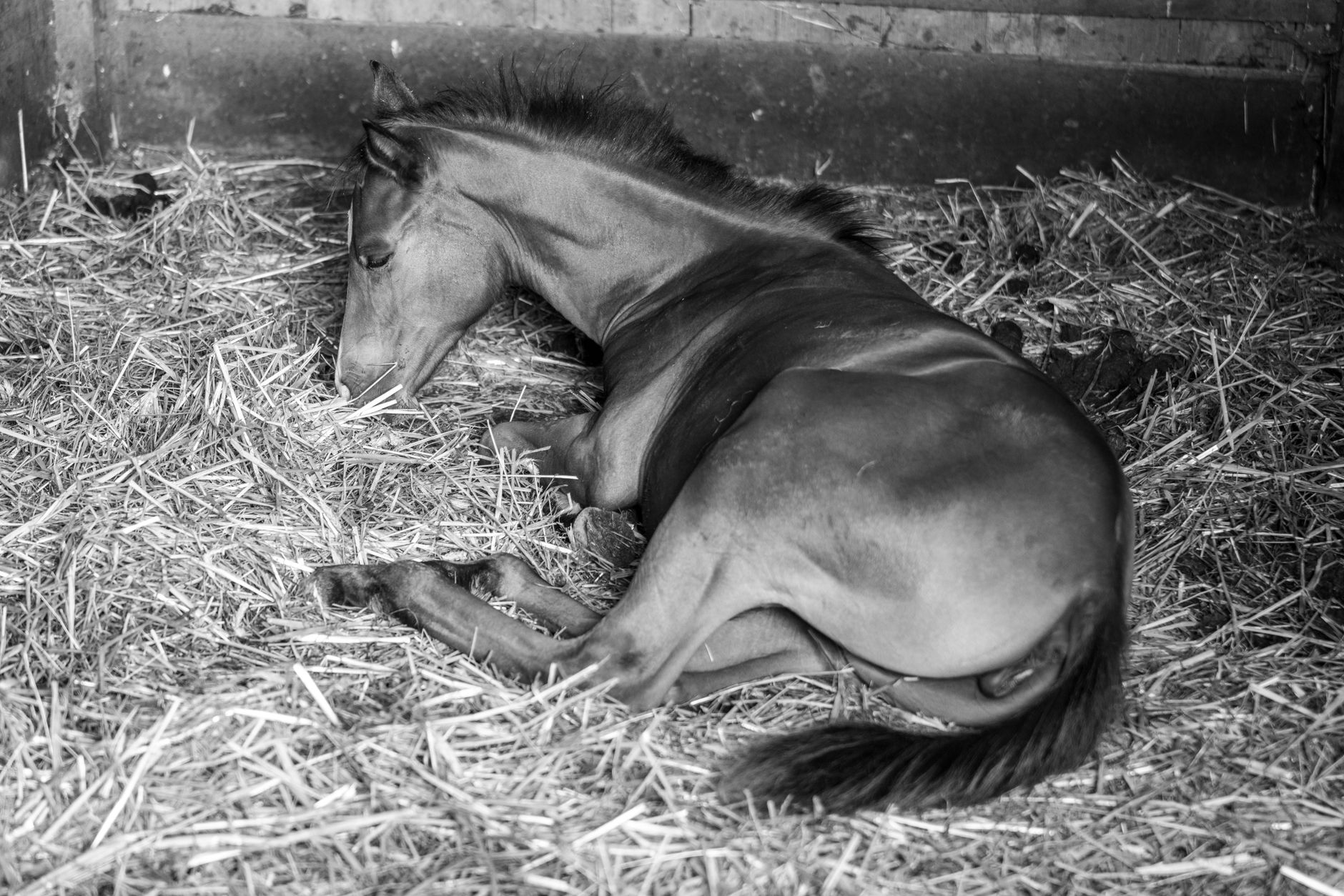
What type of shavings are best for a horse stall?
For most horses in most barns the answer is large-flake kiln-dried pine, screened for dust. It absorbs adequately, it is light to fork, it composts, it is sold everywhere, and it does not tempt the horse to eat it.
But “best” hides a real decision, and the ranking articles on this question all skip the measurement that settles it. Beddings differ sixfold in how much water a pound of them will hold, and that single figure sets what you spend every month.
The measurement nobody publishes
Rutgers put a number on it. Their fact sheet on bedding use gives water absorbed per pound of bedding for nine materials, and the spread is enormous.
Hardwood chips hold 1.5 lb of water to the pound. Peat moss holds 9.5, more than six times as much, and pine shavings sit at 2 in the middle.
That matters because bedding is not really there for comfort.
It is there to keep the horse’s feet out of its own urine, and a 1,000 lb horse passes 2.4 US gal of that a day — 20 lb (9 kg) of water for the bed to hold.
| Bedding | Water held per lb | Saturated per day | Bags a month |
|---|---|---|---|
| Peat moss | 9.5 lb | 2.1 lb | 1 |
| Straw pellets | 4.5 lb | 4.5 lb | — |
| Pine chips | 3 lb | 6.7 lb | — |
| Pine sawdust | 2.5 lb | 8 lb | 4 |
| Oat straw | 2.5 lb | 8 lb | — |
| Wheat straw | 2.2 lb | 9.1 lb | 3 |
| Pine shavings | 2 lb | 10 lb | 5 |
| Shredded newspaper | 1.6 lb | 12.5 lb | 9 |
| Hardwood chips | 1.5 lb | 13.4 lb | 6 |
Read the middle column as the pounds of bedding that get soaked and have to leave every day.
Rutgers separately publishes 8 to 15 lb a day as what a stalled horse gets through, and pine shavings land inside that at 10 lb without having been fitted to it.
Never buy hardwood of unknown species
This is the one part of choosing bedding that is a safety question rather than a money one, and it outranks everything else on this page.
Bedding containing as little as 20% black walnut causes laminitis. The horse does not have to eat it — standing on it is enough, and signs follow within 8 to 24 hours of contact with fresh shavings.
Prompt removal often resolves it, which is worth knowing if you suspect a bad load. But the sensible rule is simpler: buy pine, or get the species in writing.
Mixed hardwood chips from a mill or a tree service are the usual way this goes wrong. They are cheap, sometimes free, and there is no way to tell walnut from the rest by eye once it is chipped.
Pine shavings, flake or fine?
Large flake is the default for a reason. It stays where you put it, forks cleanly, and separates from droppings instead of going out with them.
Fine shavings and sawdust hold a little more water per pound — sawdust is 2.5 against 2 — but they pack down, they cling to a wet horse, and they carry more dust.
Whichever you buy, kiln-dried and screened is worth paying for. Absorbency is a function of dryness, and the screening is what takes the fines out.
Wood pellets: the usual explanation is wrong
Pellets are widely described as more absorbent than shavings. Pound for pound they are not, and they cannot be — a pellet is pine sawdust with the air pressed out, so the chemistry is unchanged.
What a pellet bag genuinely buys you is density. Forty pounds of material arrives in under a cubic foot of storage, against about 26 lb in a shavings bag several times the size.
For the same horse that gets through 5 bags of flake shavings a month, pellets come to 3 bags. Fewer bags, less storage, less to carry.
The catch is that they must be wetted to work.
Pellets need 1 to 1.5 US gal a bag, left fifteen to twenty minutes, or they stay as pellets underfoot and only break down where the horse wets them.
Straw, paper and peat
Straw is warm, cheap where it is grown, and composts fast. Wheat straw holds 2.2 lb of water to the pound and oat straw 2.5, so it is competitive with shavings on absorbency.
Its real drawback is that some horses eat it. That is unmeasured forage going into a horse whose ration you thought you knew, and on an easy keeper or a laminitic it matters.
Shredded paper is dust-free, which is its whole case, and it suits a horse with a respiratory problem. At 1.6 lb of water to the pound it is among the least absorbent things you can bed on, and it blows about.
Peat is the outlier on every axis.
It holds 9.5 lb of water to the pound, and in the one controlled comparison we could find it kept stall ammonia below 0.25 ppm where wood shavings ran 4 to 7 ppm by day 84.
Worker exposure over an eight-hour shift was 5.9 ppm on shavings and none at all on peat. It is dark, heavy to muck out, and not sold everywhere, which is why it stays a minority choice.
What about dust?
Dust is the reason usually given for choosing one bedding over another, and the evidence for it is thinner than the confidence behind it.
In that same peat-versus-shavings study the authors reported that the amount of dust collected was small for both materials, with no major difference between them. What did differ, clearly, was ammonia.
So if you are choosing bedding for a horse with a cough, the useful lever is probably not the dust rating on the bag. It is how often the wet patch comes out.
So which should you buy?
Large-flake kiln-dried pine unless you have a specific reason otherwise. It is the sensible default and nothing on the table above dislodges it for an ordinary horse.
Choose pellets if storage or carrying is your constraint, straw if it is cheap locally and your horse ignores it, paper if dust is genuinely the problem, and peat if ammonia is.
Never hardwood you cannot identify.
Then put the choice into our bedding calculator, because the monthly figure changes more than most people expect between one material and the next.
Common questions about stall bedding materials
What type of shavings are best for a horse stall?
Large-flake kiln-dried pine, screened for dust, for most horses in most barns. It forks cleanly, separates from droppings, composts and does not tempt the horse to eat it.
The alternatives are worth it for specific reasons: pellets for storage, paper for dust, peat for ammonia, straw where it is cheap.
What kind of shavings are best for horse stalls?
Pine, in a large flake, kiln-dried and screened.
What you are avoiding is just as important: never bed on hardwood chips whose species you do not know, because as little as 20% black walnut causes laminitis on contact within 8 to 24 hours.
Are pine shavings or pellets better for horse stalls?
Neither is more absorbent per pound — pellets are compressed pine sawdust, so a pound holds what a pound of sawdust holds. Pellets win on storage and handling, at 3 bags a month against 5 for flake shavings on the same horse.
They must be wetted with 1 to 1.5 US gal a bag or they will not break down.
Why can horses not be bedded on black walnut?
Black walnut wood causes laminitis in horses standing on it, and ingestion is not required.
Ontario’s agriculture ministry states that bedding containing as little as 20% black walnut shavings is a problem, with clinical signs typically within one to two days of exposure to fresh shavings.
Removing the bedding promptly often resolves it.
Is straw or shavings better for horse bedding?
On absorbency they are close — wheat straw holds 2.2 lb of water to the pound against 2 for pine shavings. Straw is warmer and composts faster; shavings are easier to muck and the horse will not eat them.
The deciding factor is usually whether your horse picks at its bed, because that is unmeasured forage.
What is the most absorbent horse bedding?
Peat moss, at 9.5 lb of water per pound of bedding, well ahead of everything else Rutgers measured. Straw pellets come next at 4.5 and pine chips at 3.
Hardwood chips are the least absorbent at 1.5, and that is before the black walnut risk.
Does bedding type affect a horse’s breathing?
Ammonia does, and bedding changes it. Measured in working stables, peat kept stall ammonia below 0.25 ppm where wood shavings reached 4 to 7 ppm by day 84.
The fine dust you breathe in was no different between the two materials in that study, which is worth knowing because dust is the usual reason given for switching.
Related calculators and guides
- How many bags of shavings for a horse stall? — put your bedding choice in and it works out the bags and the monthly cost
- How many bags of shavings per pallet? — once you have chosen, this is what buying it in bulk looks like
- How much does a horse weigh? — the urine and manure figures here are per 1,000 lb of horse
- All horse calculators — the rest of the tools in this section
Where these figures come from
Every figure on this page is published and cited. Where sources disagree we take the more conservative one and say so.
Our full approach is set out in how we source our numbers.
- Bagged shavings pallet quantities – supplier listings — Glover Custom Wood, Pine Products Inc., HollysWood Shavings, Belmont Bedding, Southwest Shavings, Agcare Products
- Can black walnut wood shavings be used as a bedding source for horses and/or other livestock? — Extension Horses (USDA NIFA)
- Certified Straw Grab & Go Compressed Bale – product specification — Standlee Premium Forage
- Horse Manure Management: Bedding Use (FS537) — Rutgers NJAES Cooperative Extension
- Horses and black walnut shavings — Ontario Ministry of Agriculture, Food and Agribusiness
- Medium Flake Pine Shavings, 8.0 cu ft usable volume – product specification — KBC International
- Pine Pellet Horse Stall Bedding – product specification — Guardian Horse Bedding (Equustock LLC)
- Premium Flake Pine Shavings – product specification — Guardian Horse Bedding (Equustock LLC)
- Reducing Respiratory Health Risks to Horses and Workers: A Comparison of Two Stall Bedding Materials — Animals (Basel) 5(4):965-977
- Stall Waste Production and Management — Livestock and Poultry Environmental Learning Community (LPELC)