
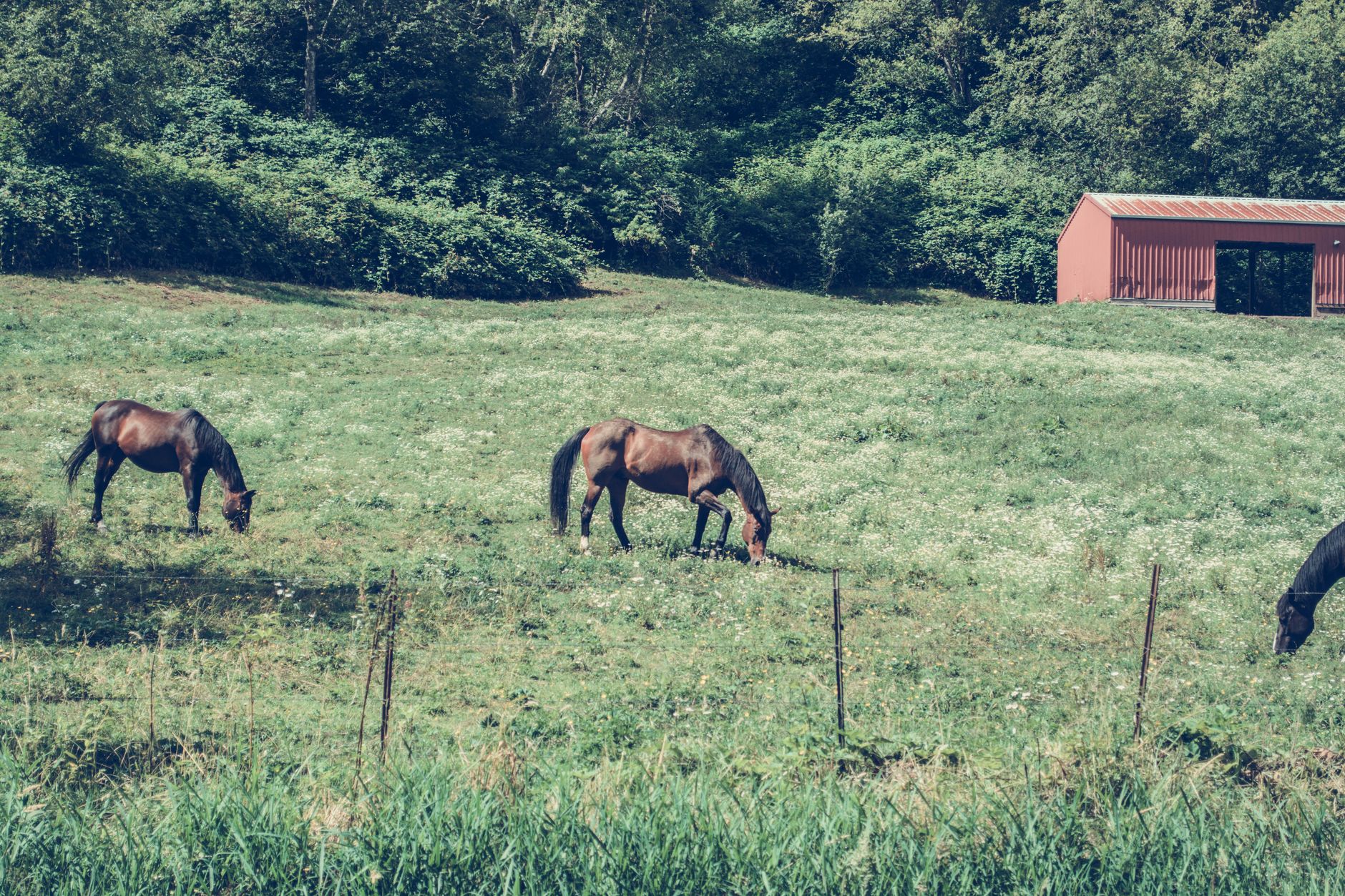
How much grazing does a horse need?
How much grazing does a horse need is two questions in one coat, and they have different answers.
By time, a horse needs six to ten hours a day at grass to take a full day’s forage off it, and a young growing horse up to fifteen.
By land, it needs somewhere between 0.73 acres (0.3 ha) and 12 acres (4.9 ha) depending entirely on what the ground grows and how you graze it.
Almost every page on this subject answers one and lets the reader assume it has answered the other. They are not interchangeable: you can have plenty of hours and not enough grass, and the horse will still be hungry.
How much grazing time does a horse need?
An 1,100 lb horse eats about 22 lb (10 kg) of dry matter a day.
Fresh pasture is only 20–30% dry matter, so that is 73 to 110 lb of grass to bite, chew and swallow — and there is a physical limit on how fast that can be done.
Hence the six to ten hours.
Horses left out around the clock typically graze for about sixteen hours of the twenty-four and rest for the other eight, which is the pattern the digestive system is built for: a trickle rather than meals.
Turnout below about three hours is exercise and company rather than feeding.
It is still worth having — an hour at spring grass replaces roughly 2.75 lb of grass hay, so four hours a day through a month is about 330 lb of hay you do not buy — but it does not feed the horse.
One thing that surprises people managing an easy keeper: shortening the window does not cut intake proportionally. Horses on short turnout graze considerably faster than horses with all day, because they have learned the gate shuts.
Cutting from nine hours to three roughly halves intake rather than cutting it to a third.
How much land does a horse need to graze?
This is the half that actually varies, and it varies enormously.
| Where the pasture is | One field, all season | Rotated weekly | Rotated every 1–3 days |
|---|---|---|---|
| Arid West, dryland | 12 acres (4.9 ha) | 8.8 acres (3.6 ha) | 5.82 acres (2.36 ha) |
| Northern, cool-season grass | 3.49 acres (1.41 ha) | 2.56 acres (1.04 ha) | 1.69 acres (0.68 ha) |
| Mid and southern, cool-season grass | 2.71 acres (1.1 ha) | 1.99 acres (0.81 ha) | 1.31 acres (0.53 ha) |
| Irrigated or high rainfall | 1.5 acres (0.61 ha) | 1.1 acres (0.45 ha) | 0.73 acres (0.3 ha) |
Two things drive the whole spread.
The first is what the ground grows: an acre of irrigated pasture produces about 8,000 lb of dry matter a year and an acre of dryland range about 1,000.
The second is how much of it the horse actually gets — 33% in an open field, 45% moved weekly, 68% moved every day or two, because horses left to choose graze the sweet patches to death and leave the rest to seed.
That is why the familiar two-acres-a-horse figure causes so much trouble. It is a real number from Kentucky extension for year-round grazing on good ground, and it is quoted unchanged in Arizona and in Ireland.
Grazing is seasonal, and the calendar is not negotiable
Everything above is per grazing season. The Midwest grows grass for something like 142 to 185 days a year; the South and the irrigated West run longer, nowhere runs twelve months.
So a horse that needs 2.71 acres of grazing also needs 185 days of hay, and that is the larger bill.
A horse eats roughly the same weight of dry matter whether it comes off a field or out of a bale — 1.5% to 2.5% of body weight a day, all year.
Two rules keep the grazing half working. Do not turn out until the grass averages 6 to 8 inches, and take the horses off at 3 to 4.
Grazing below that eats the root reserves rather than the leaves; the stand thins, weeds take the gaps, and next season the same field grows less.
What a horse needs that grazing is not
The third thing hiding inside this question is space to move, and it is not the same as grazing.
A horse can be fed entirely on hay in a drylot, and the published minimum for one is 400 to 500 square feet a horse — about a hundredth of an acre.
That is standing room. It supplies no feed at all and it is not, on its own, a life.
Most small-acreage horses need both: a sacrifice area they can live on when the ground is wet or the grass needs resting, and grazing treated as a seasonal crop rather than as the floor.
Trying to do everything with the same acre is what turns a pasture into a dirt lot inside two summers.
Working out your own figure
If you want the acreage half for your own place rather than a table row, three inputs get you most of the way:
- What the ground grows. If you have cut hay off it, divide the bales by the acres and multiply by the bale weight — your own figure beats any published average.
- How you graze it. Whether the horses live in one field or move between paddocks changes the answer by roughly half.
- How long your season is. Grass growth, not the calendar year.
The pasture calculator takes those, works both directions — land needed, and horses supported — and prices the shortfall in hay and bales.
Common questions about how much grazing a horse needs
How many hours a day should a horse be turned out?
As many as the yard allows, and at least six if the grass is meant to be feeding it. Horses on full turnout graze for around sixteen hours out of twenty-four, in short bouts rather than meals, which is what the digestive system is built for.
Under about three hours, turnout is exercise and company — worth having, but the forage has to come from hay.
How much grazing does a horse need per month?
About 660 lb of dry matter a month for an 1,100 lb horse, which on average mid-country pasture comes off roughly 0.45 acres’ worth of a season’s growth.
Grass does not arrive evenly across the months, though — cool-season pasture produces most of its year in spring, which is why a field that carries the horses in May runs short in August.
How much hay does a 500kg horse need a day?
A 499 kg horse eats about 10 kg of dry matter a day at 2% of body weight, which as baled hay is roughly 11 kg. The same requirement met from pasture is 73 to 110 lb of grass, because grass is mostly water.
Can a horse live on grazing alone?
Through the growing season, most can. A mature horse in light work or none, on decent pasture, needs nothing but grass, salt and water.
What stops it being a year-round answer is the calendar: the grass stops growing for four to six months in most of the country, and those months are hay whatever the acreage.
Is a few hours of turnout enough for a horse?
Enough for movement and company, not enough to feed it. Three hours at grass supplies well under half a day’s forage, so a horse on that schedule needs hay for the rest.
That is a perfectly normal arrangement — it just should not be mistaken for the horse being at grass.
How much space does a horse need for turnout?
The published floor for a drylot is 400 to 500 square feet a horse, and that is standing room rather than exercise.
Space above that buys movement, which is worth buying: a horse that can trot and roll in its turnout is better off than one that can only stand in a bigger version of a stall.
Related calculators and guides
- How many acres does a horse need? — the acreage half of the answer, for your ground and your grazing season
- How much grass can a horse eat in an hour? — why halving the turnout hours does not halve the grass
- How much grass does a horse eat per day? — the daily requirement, in dry matter and in grass as it grows
- All horse calculators — the rest of the tools in this section
Where these figures come from
Every figure on this page is published and cited. Where sources disagree we take the more conservative one and say so.
Our full approach is set out in how we source our numbers.
- Caring for Horses in Cold Weather — Utah State University Extension
- Drylots for Horses — eXtension / Extension Horses
- Equine Nutrition: Forages — Utah State University Extension
- Estimating Carrying Capacity of a Pasture — Colorado State University Extension
- Forages for Horses (ASC-120) — University of Kentucky Cooperative Extension Service
- Grazing Strategies for Horse Pastures — Colorado State University Cooperative Extension
- Hay Storage: Dry Matter Losses and Quality Changes — Mississippi State University Extension
- Horse Care on Small Acreages in Colorado — Colorado State University Cooperative Extension
- Maine Pasture Management Course, Lesson 5: Grazier’s Arithmetic — University of Maine Cooperative Extension
- Nutritional Requirements of Horses and Other Equids — Merck Veterinary Manual
- Pastures for Profit: A Guide to Rotational Grazing (A3529) — University of Wisconsin-Extension
- Properly curing hay is crucial for forage quality — North Dakota State University Extension
- Rotational Grazing (ID-143) — University of Kentucky Cooperative Extension Service
- Selecting and storing horse hay — University of Minnesota Extension
- Winter Feeding for Horses, Fact Sheet #1143 — Rutgers University, Department of Animal Sciences