
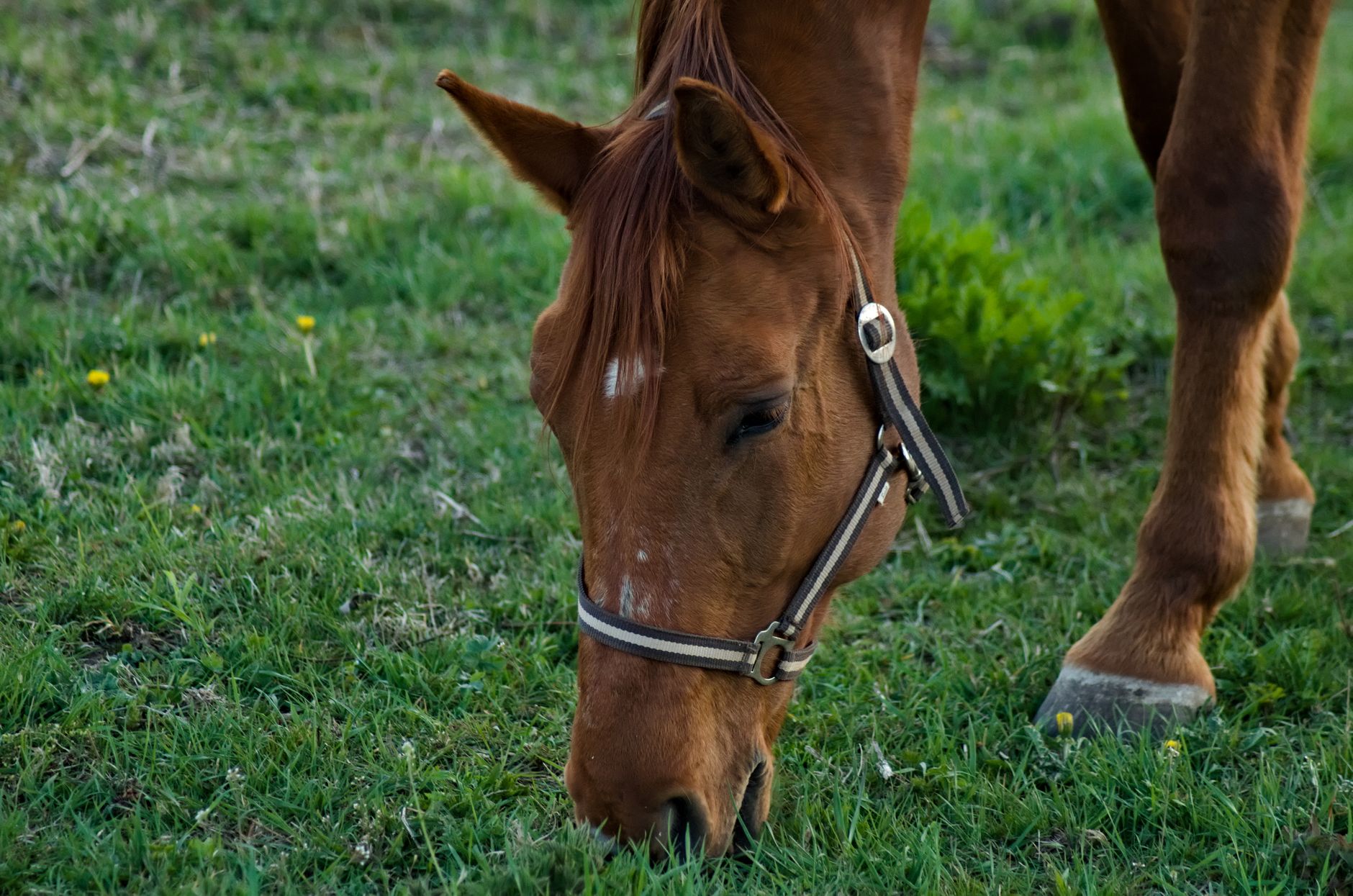
How much grass does a horse eat per day?
An 1,100 lb (499 kg) horse eats about 22 lb (10 kg) of dry matter a day. As grass — water and all, the way it comes off the field — that is 73 to 110 lb (33 to 50 kg).
Both numbers are correct, and confusing them is the single commonest error in what is written about grazing horses. Almost every page that answers this question prints the first one and calls it grass.
Why there are two numbers
Feeding figures for horses are always given in dry matter: what is left when you take the water out. That is the only way to compare a bale of hay with a field of grass, because they hold wildly different amounts of water.
Hay is about 90% dry matter. Fresh growing pasture is only 20 to 30% — 70 to 80% water. So the same 22 lb of dry matter arrives as roughly 24 lb of hay or 73 to 110 lb of grass. Multiply by 3.3 to 5 to go from the dry matter figure to grass; that factor is the whole difference.
It also explains something owners notice and rarely get a straight answer about: a horse can graze for sixteen hours a day and still act hungry. It is not greed. It is working through eighty-odd pounds of wet grass to get at twenty pounds of feed.
How much grass does a horse eat per day, by body weight
Intake runs from 1.5% to 2.5% of body weight in dry matter, with 2% the normal working figure. It scales straight off the horse, which is why the weight matters more than the breed.
| Horse | Dry matter a day | Fresh grass a day | Dry matter range |
|---|---|---|---|
| 500 lb (227 kg) | 10 lb (5 kg) | 33–50 lb (15–23 kg) | 8–13 lb |
| 800 lb (363 kg) | 16 lb (7 kg) | 53–80 lb (24–36 kg) | 12–20 lb |
| 1,000 lb (454 kg) | 20 lb (9 kg) | 67–100 lb (30–45 kg) | 15–25 lb |
| 1,100 lb (499 kg) | 22 lb (10 kg) | 73–110 lb (33–50 kg) | 17–28 lb |
| 1,200 lb (544 kg) | 24 lb (11 kg) | 80–120 lb (36–54 kg) | 18–30 lb |
| 1,400 lb (635 kg) | 28 lb (13 kg) | 93–140 lb (42–64 kg) | 21–35 lb |
| 1,600 lb (726 kg) | 32 lb (15 kg) | 107–160 lb (48–73 kg) | 24–40 lb |
The fresh-grass column is a range rather than a figure because pasture moisture moves with the weather and the season. Grass after rain, or lush spring growth, sits at the wet end; a mature summer sward that has begun to set seed sits at the dry end. In kilograms, an average riding horse is eating something like 33 to 50 kg of grass a day.
How long it takes to eat that much
Longer than most people plan for. A maintenance horse needs roughly six to ten hours at grass to take a full day’s forage off it. A young growing horse can need up to fifteen.
Turnout of an hour or two is exercise and company rather than a meal. Colorado puts a figure on what it is worth in feed: an hour at grass replaces about 2.75 lb of grass hay in spring and 1.75 lb in summer, so four hours a day through a month saves roughly 330 lb of hay in spring — real money, but a long way short of feeding the horse.
Intake is not flat across the day either. A horse turned out for three hours grazes far faster per hour than one out for twenty-four, because it has learned the window is short. That is why restricting turnout hours restricts intake much less than the arithmetic suggests, and why grazing muzzles exist.
What that means for your field
How much grass does a horse need, in acres rather than pounds? Turn the daily figure into a season and the acreage question answers itself. That same 1,100 lb horse eats 3,960 lb of dry matter across a 180-day grazing season. An acre of average mid-country pasture grows about 4,430 lb of dry matter in a year, and horses grazing it as a single open field eat about a third of that.
You can check what is standing in your own field with a ruler. Good pasture carries roughly 275 lb of dry matter per acre for every inch of grass above your stubble height, fair pasture about 175, an excellent stand about 350. Measure the height, subtract the 3 to 4 inches you intend to leave, and multiply.
The pasture calculator does that arithmetic for your horses, your ground and your grazing season, and tells you how much hay the gap comes to.
When more grass becomes a problem
Two of them, and they are different. The first is simple weight: an easy keeper on good spring pasture will get fat, and obesity is the commonest welfare problem in leisure horses.
The second is sugar. Non-structural carbohydrate in grass peaks in spring and autumn growth, and in a horse with equine metabolic syndrome or a history of laminitis that can be enough on its own. For those horses the standard tools are a grazing muzzle, a few hours of turnout rather than all day, or a drylot with tested hay. A horse in work with no metabolic history is not at risk from ordinary grass.
Neither problem is solved by knowing the daily figure alone — but you cannot manage what you have not measured, and most people are working from a number that is four times too small.
Common questions about how much grass a horse eats
How much grass does a horse eat a day in kg?
About 10 kg of dry matter for a 499 kg horse, which arrives as roughly 33 to 50 kg of fresh grass. The spread is moisture: pasture runs 20–30% dry matter depending on season and weather, where hay is about 90%.
How much grass should I let my horse eat?
For most horses, as much as it wants — 1.5% to 2.5% of body weight in dry matter a day is what it will settle at, and that is normal. Restriction is for a specific reason: an easy keeper carrying too much weight, or a horse with a laminitis or metabolic history, where spring and autumn sugars are the risk rather than the bulk.
Can horses live off eating grass?
Most can, and most did. A mature horse in light work or none, on decent pasture in the growing season, needs nothing but grass, salt and water. What limits it is the calendar and the acreage rather than the nutrition: the grass stops growing, and the rest of the year is hay. Horses in hard work, growing horses and lactating mares are the genuine exceptions.
How much hay should a 1000 pound horse eat a day?
The same dry matter as it would eat in grass — 20 lb at 2% of body weight — which as baled hay at about 90% dry matter is roughly 22 lb of hay. It is the same horse and the same requirement; only the water content changes.
How much grass does a horse eat in an hour?
Enough to replace about 2.75 lb of grass hay in spring and 1.75 lb in summer, on Colorado’s figures. But the rate is not constant: a horse with three hours of turnout grazes considerably faster than one that has all day, so hours and intake are not proportional.
Why does my horse graze all day and still look hungry?
Because it is eating water. Getting 22 lb of dry matter out of pasture at 20–30% dry matter means processing 73 to 110 lb of grass, and there is a limit to how fast a horse can bite and chew. If a horse looks genuinely underfed on full turnout, the pasture is usually short rather than the horse greedy — measure the grass height before adding feed.
Related calculators and guides
- How many acres does a horse need? — turns the daily figure below into the land it takes to grow it
- How much grass can a horse eat in an hour? — the same appetite measured by the clock rather than by the day
- How much hay does a horse need per day? — the same requirement for the months the grass is not growing
- All horse calculators — the rest of the tools in this section
Where these figures come from
Every figure on this page is published and cited. Where sources disagree we take the more conservative one and say so. Our full approach is set out in how we source our numbers.
- Caring for Horses in Cold Weather — Utah State University Extension
- Drylots for Horses — eXtension / Extension Horses
- Equine Nutrition: Forages — Utah State University Extension
- Estimating Carrying Capacity of a Pasture — Colorado State University Extension
- Forages for Horses (ASC-120) — University of Kentucky Cooperative Extension Service
- Grazing Strategies for Horse Pastures — Colorado State University Cooperative Extension
- Hay Storage: Dry Matter Losses and Quality Changes — Mississippi State University Extension
- Horse Care on Small Acreages in Colorado — Colorado State University Cooperative Extension
- Maine Pasture Management Course, Lesson 5: Grazier’s Arithmetic — University of Maine Cooperative Extension
- Nutritional Requirements of Horses and Other Equids — Merck Veterinary Manual
- Pastures for Profit: A Guide to Rotational Grazing (A3529) — University of Wisconsin-Extension
- Properly curing hay is crucial for forage quality — North Dakota State University Extension
- Rotational Grazing (ID-143) — University of Kentucky Cooperative Extension Service
- Selecting and storing horse hay — University of Minnesota Extension
- Winter Feeding for Horses, Fact Sheet #1143 — Rutgers University, Department of Animal Sciences