
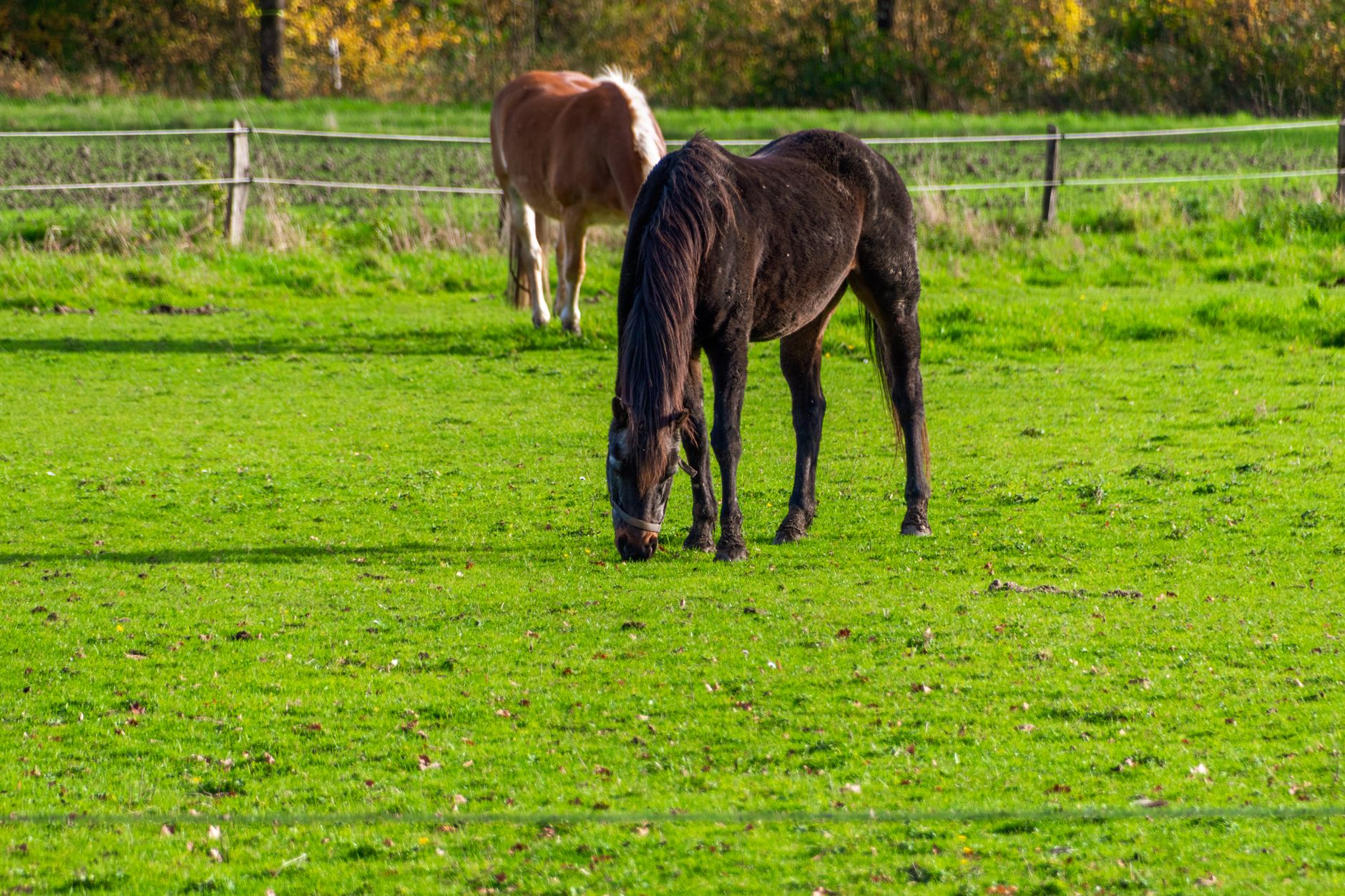
How many horses can graze on 3 acres?
On average mid-country pasture grazed as one open field all season, three acres feeds about 1.1 horses. Split the same three acres into paddocks and move the horses weekly and it feeds about 1.5.
Move them every day or two and it feeds about 2.3.
How many horses can graze on 3 acres is therefore three answers rather than one.
That is the real answer, and the reason nobody gives it is that it is not a whole number and it depends on something the questioner did not mention.
Three acres is not a quantity of feed. It is a quantity of land, and how much feed comes off it is mostly up to you.
Why the same three acres gives three different answers
Horses are selective grazers.
Left in one open field they eat the sweet patches to the ground, walk past the rest, and come back to the same patches as soon as anything regrows.
The good grass is grazed to death and the rest goes to seed uneaten.
Kentucky’s summary of what that costs is blunt: “only about one-third of the pasture forages produced are actually used by grazing animals”.
Fence the field into paddocks and the horses eat what is in front of them instead of choosing, and the share that ends up inside a horse rises from about 33% to 45%, or to 68% if you move them every day or two.
This has been measured rather than argued.
A three-year University of Georgia trial ran continuous against rotational stocking on the same mixed pasture and the rotational side carried 36% more stock — 0.50 against 0.68 cow-calf units an acre — with weaning weights identical and 29% less hay fed.
Cattle rather than horses, but the mechanism belongs to the grass.
How many horses can I have on 3 acres, by region
The second thing nobody asks is where the three acres are. An acre of irrigated pasture grows 8 times what an acre of dryland range grows, and no single answer spans both.
| Where the pasture is | One field, all season | Rotated weekly | Rotated every 1–3 days |
|---|---|---|---|
| Arid West, dryland | 0.3 | 0.3 | 0.5 |
| Northern, cool-season grass | 0.9 | 1.2 | 1.8 |
| Mid and southern, cool-season grass | 1.1 | 1.5 | 2.3 |
| Irrigated or high rainfall | 2.0 | 2.7 | 4.1 |
Read the top row carefully.
Three acres of dryland range in the arid West does not feed a horse for a season, and no amount of rotation changes that — it feeds about a quarter of one.
This is the reason the familiar two-acres-a-horse rule causes so much trouble west of the hundredth meridian: it was written for ground that grows 4,430 lb of dry matter an acre, and it is quoted on ground that grows 1,000.
What to do if you have three acres and two horses
Which is the commonest version of this question, and it is workable. Grazed as one field, two horses on three acres of average pasture are about 81% over what the grass will carry.
The field runs out after roughly 100 days days of a 180-day season. You feed about 10.9 lb (4.94 kg) of hay a horse a day to cover the rest, around 79 bales over the season.
Rotate the same three acres and two horses fits: 1.5 is the carrying figure, so the grass covers the season with a little to spare. Nothing about the land changed.
Three things make the difference between three acres that stay a pasture and three acres that become a dirt lot:
- Fence it into paddocks. Even three or four, with polytape and step-in posts, and even at one to two acres a paddock. Move the horses when the grass is down to 3–4 inches, not when the calendar says so.
- Do not turn out too early. Wait until the grass is 6–8 inches. Grazing it shorter than that eats the root reserves, and next season’s yield falls — which moves every number on this page the wrong way.
- Build a sacrifice area. A drylot of at least 400–500 square feet a horse, where they live when the ground is wet, when the grass needs resting, and through the winter. Without one the whole three acres is the sacrifice area.
Rest is what makes rotation work rather than just being extra fencing.
A cool-season grass needs about 14 days to recover in cool weather and 42 in high summer, and horses should not stay in one paddock more than 7 days — past that they are grazing their own regrowth.
How many acres to graze one horse?
Run the same arithmetic for a single horse and the answer is 2.71 acres (1.1 ha) grazed continuously on average pasture, 1.99 acres (0.81 ha) rotated weekly and 1.31 acres (0.53 ha) rotated hard.
On irrigated ground it is nearer 1.1 acres (0.45 ha).
All of those assume a 180-day grazing season, which is a fair middle for the Midwest — the growing season there runs from about 142 days in the far north to 185 in the south.
A shorter season needs proportionally more land, and the months either side of it are hay whatever the acreage.
The pasture calculator runs it for your own acreage, region, pasture condition and season, and tells you what the shortfall costs in hay and bales.
Common questions about grazing horses on 3 acres
How many horses can I have on 3 acres?
About 1.1 on average pasture grazed as one field, 1.5 if you divide it into paddocks and move them weekly, and 2.3 if you move them every day or two — over a 180-day grazing season with 1,100 lb horses.
Keeping more than that on three acres is perfectly possible; you will be feeding hay for part or all of the year.
Is 2 acres enough for 2 horses?
Enough to keep them, not usually enough to feed them. Two acres of average pasture grazed continuously carries about 0.7 horses; rotated it carries about 1.0.
Two horses on two acres will need hay through part of the summer, and the field will need a sacrifice area beside it if it is to stay a field.
How many horses can you have on 10 acres?
About 3.7 grazed continuously and 5.0 rotated, on average mid-country pasture.
That is five horses on two acres each, which is where the familiar rule of thumb comes from — and it holds on this ground because it was written for it.
How many acres for 4 horses?
On average pasture, about 10.8 acres (4.39 ha) grazed continuously or 7.95 acres (3.22 ha) rotated. On dryland range it is many times that; on irrigated ground about 4.4 acres (1.8 ha).
Can 3 acres support a horse year round?
It can feed one through the grazing season on decent ground.
Year round is a different question: in most of the country the grass stops growing for four to six months and every mouthful in that window is hay, whatever the acreage.
Three acres plus a sacrifice area plus winter hay is a normal, workable setup for one or two horses.
What happens if you keep too many horses on 3 acres?
The grass is grazed below the point it can recover from, the desirable species die out, weeds take the gaps, and inside a season or two you have bare ground with thistles in it.
Bare ground brings its own problems — sand colic from grazing dirt, and a heavier worm burden because horses are forced to eat close to their own droppings.
The fix is a sacrifice area and hay, not more grazing pressure.
Related calculators and guides
- How many acres does a horse need? — runs the same arithmetic for your ground, your horses and your grazing season
- How many acres for 2 horses? — the same question from the other end, worked through for a pair
- How much grass does a horse eat per day? — the daily figure everything on this page is built from
- All horse calculators — the rest of the tools in this section
Where these figures come from
Every figure on this page is published and cited. Where sources disagree we take the more conservative one and say so.
Our full approach is set out in how we source our numbers.
- Caring for Horses in Cold Weather — Utah State University Extension
- Drylots for Horses — eXtension / Extension Horses
- Equine Nutrition: Forages — Utah State University Extension
- Estimating Carrying Capacity of a Pasture — Colorado State University Extension
- Forages for Horses (ASC-120) — University of Kentucky Cooperative Extension Service
- Grazing Strategies for Horse Pastures — Colorado State University Cooperative Extension
- Hay Storage: Dry Matter Losses and Quality Changes — Mississippi State University Extension
- Horse Care on Small Acreages in Colorado — Colorado State University Cooperative Extension
- Maine Pasture Management Course, Lesson 5: Grazier’s Arithmetic — University of Maine Cooperative Extension
- Nutritional Requirements of Horses and Other Equids — Merck Veterinary Manual
- Pastures for Profit: A Guide to Rotational Grazing (A3529) — University of Wisconsin-Extension
- Properly curing hay is crucial for forage quality — North Dakota State University Extension
- Rotational Grazing (ID-143) — University of Kentucky Cooperative Extension Service
- Selecting and storing horse hay — University of Minnesota Extension
- Winter Feeding for Horses, Fact Sheet #1143 — Rutgers University, Department of Animal Sciences