
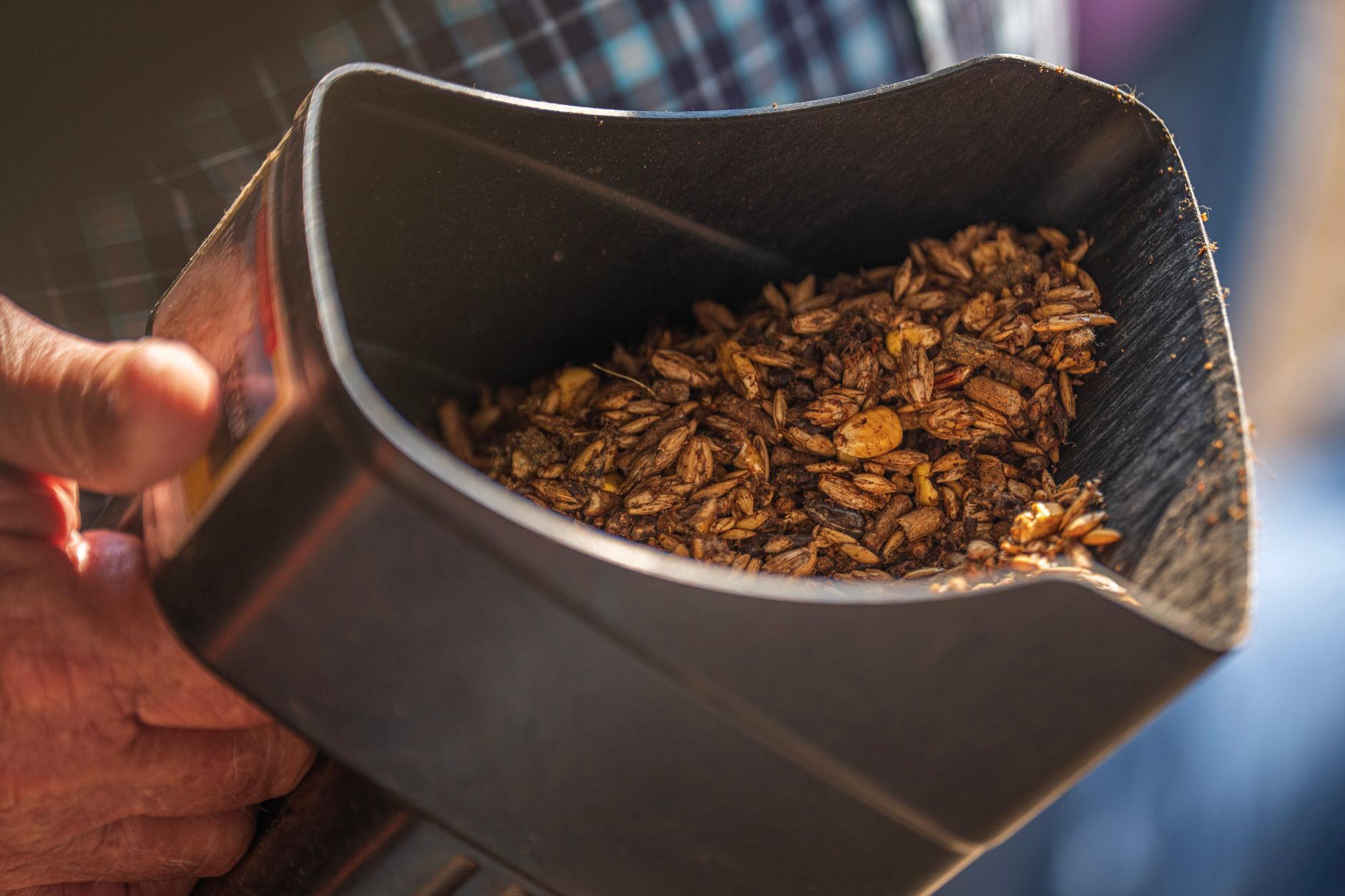
How much does a scoop of horse feed weigh?
How much does a scoop of horse feed weigh? Between 0.89 lb and 1.53 lb per quart, and there is no single answer because it depends entirely on what is in the scoop.
Those figures are not estimates. Two manufacturers publish measured quart weights for their own products — 29 from one and 20 from the other — and across all 49 the heaviest quart weighs 72% more than the lightest. A 3-quart scoop therefore holds anywhere from 2.7 lb to 4.6 lb of feed.
The number stamped on a feed-store scoop is its volume in quarts. It has never been a weight, and no scoop sold anywhere claims to be one.
Scoop weight by feed form
Grouped by form, because that is what predicts density. Ration balancers are the heaviest thing in most feed rooms; textured mixes and complete feeds the lightest.
| Feed form | 1-quart scoop | 2-quart scoop | 3-quart scoop | 4-quart scoop |
|---|---|---|---|---|
| Textured / sweet feed | 0.9–1.2 lb | 1.9–2.4 lb | 2.8–3.6 lb | 3.8–4.8 lb |
| Pelleted feed | 1.2–1.4 lb | 2.5–2.8 lb | 3.7–4.2 lb | 5.0–5.6 lb |
| High-fat performance feed | 1.2–1.4 lb | 2.4–2.7 lb | 3.6–4.1 lb | 4.8–5.4 lb |
| Senior or complete feed | 0.9–1.3 lb | 1.8–2.6 lb | 2.7–3.8 lb | 3.6–5.1 lb |
| Ration balancer | 1.3–1.5 lb | 2.6–3.1 lb | 3.9–4.6 lb | 5.2–6.1 lb |
The ranges are real spread between products, not uncertainty in the measurement. Two pelleted feeds from the same manufacturer can sit at opposite ends of that column.
In kilograms and litres
A US quart is 0.946 litres, so the two columns below are close but not the same number. The scoop is a US quart measure wherever it was sold.
| Feed form | Per quart | Per litre | 3-quart scoop |
|---|---|---|---|
| Textured / sweet feed | 0.43–0.54 kg | 0.45–0.57 kg | 1.3–1.6 kg |
| Pelleted feed | 0.56–0.64 kg | 0.59–0.67 kg | 1.7–1.9 kg |
| High-fat performance feed | 0.55–0.62 kg | 0.58–0.65 kg | 1.6–1.9 kg |
| Senior or complete feed | 0.40–0.58 kg | 0.43–0.61 kg | 1.2–1.7 kg |
| Ration balancer | 0.59–0.69 kg | 0.62–0.73 kg | 1.8–2.1 kg |
How many scoops are in a bag
Useful for ordering, and useful as a sanity check: if you count the scoops it takes to empty a bag, dividing the bag weight by that count gives you your own scoop weight for free.
| Feed form | 25 lb bag, 2-quart scoop | 25 lb bag, 3-quart scoop | 50 lb bag, 2-quart scoop | 50 lb bag, 3-quart scoop |
|---|---|---|---|---|
| Textured / sweet feed | 11–13 | 7–9 | 21–27 | 14–18 |
| Pelleted feed | 9–10 | 6–7 | 18–20 | 12–13 |
| High-fat performance feed | 9–10 | 6–7 | 18–21 | 12–14 |
| Senior or complete feed | 10–14 | 7–9 | 20–28 | 13–19 |
| Ration balancer | 8–10 | 5–6 | 16–19 | 11–13 |
How to measure your own, properly
Every figure above is a range because it has to be. Yours does not.
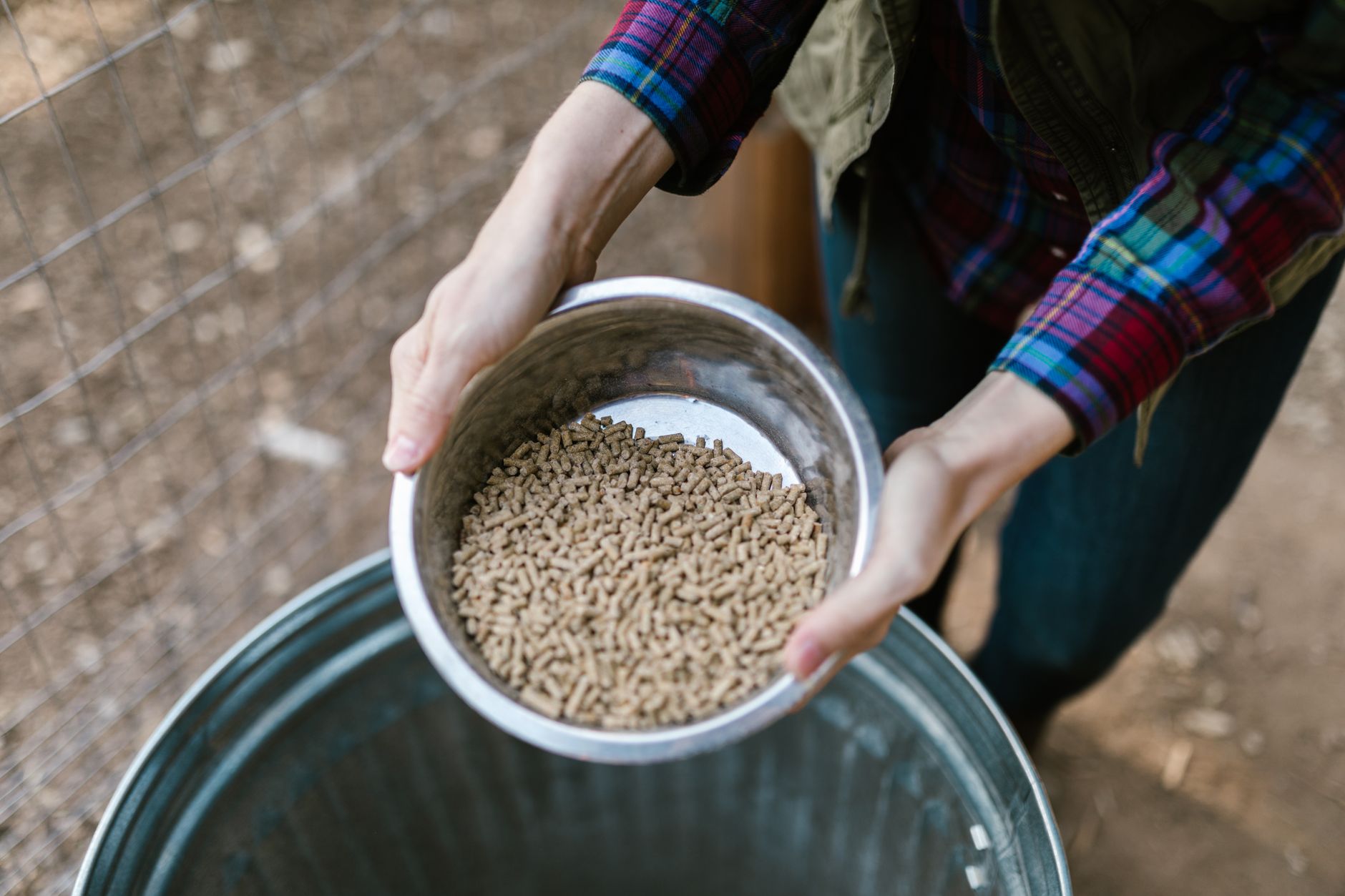
The quart method. Put any container on a kitchen scale, zero it, tip in one level quart of your feed, read the number. That is your feed’s quart weight and it will not change until you change feeds.
The scoop method, which is better. Weigh the empty scoop. Fill it the way you actually fill it — heaped, levelled, however you really do it at six in the morning. Weigh it again. The difference is what your horse gets per scoop, including your own habits, which the quart method leaves out.
The bag method, if you have no scale. Count the scoops it takes to empty a 50 lb bag and divide 50 by the count. Less precise, but it costs nothing and it beats guessing by a wide margin.
Then mark the scoop. Once you know your horse needs, say, 2.5 lb, find that level on the scoop and draw a line with a permanent marker. The ration then survives you being away, and survives whoever is covering.
Why this matters more than it sounds
Two feeds of the same formula — one pressed into pellets, one loose and molassed — carry the same energy per pound and differ by about 18% per scoop. Changing feeds without re-weighing the scoop therefore changes the ration by roughly a fifth while nothing visible has changed at all.
There is also a safety line drawn in pounds. No more than 0.5% of body weight of grain-based feed in a single meal — 5.5 lb for an 1,100 lb horse — because starch beyond that ferments in the hindgut, which is the route to colic and laminitis. In scoops that ceiling moves with the feed, which is precisely why the rule is written in pounds.
Weighing a quart takes a minute, once. Almost nothing else in horse keeping repays a minute that well.
Common questions about scoop weights
How much is one scoop of horse feed?
Between 0.89 and 1.53 lb per quart across 49 measured products, so a 2-quart scoop holds about 1.8–3.1 lb and a 3-quart scoop about 2.7–4.6 lb. Your own feed sits at one specific point in that range and a kitchen scale will tell you where.
How many pounds is a 3-quart feed scoop?
About 4 lb of pelleted feed, 3.4 lb of a textured mix and 4.2 lb of a ration balancer. The scoop is a volume measure; only the feed decides the weight.
How many scoops are in a 50 lb bag of horse feed?
With a 3-quart scoop, roughly 12–13 scoops of pelleted feed or 14–18 of a textured mix. Counting them as you empty the bag is a free way to work out your own scoop weight.
How much does a horse feed scoop weigh in kg?
A 3-quart scoop holds about 1.5 kg of textured feed and about 1.8 kg of pelleted feed. Per litre rather than per quart, feeds run roughly 0.43–0.73 kg.
Why does the same scoop weigh different amounts?
Because bulk density varies with what the feed is made of and how it is processed. Pellets pack tightly with little air between them; a textured mix full of whole grains and flakes traps far more air. Processing, moisture and how firmly the feed has settled in the bag all move it as well.
Should I level or heap the scoop?
Whichever you do, do it the same way every time, and weigh the scoop that way when you calibrate it. A heaped scoop can hold well over a tenth more than a level one, which is enough to matter on a large ration.
How many scoops should I feed my horse?
Work out the pounds first, then divide. An 1,100 lb horse in moderate work on 20 lb of average grass hay needs 4.72 lb (2.14 kg) of feed a day, which is 1.25 scoops of a 3-quart scoop of pelleted feed.
Related calculators and guides
- Horse grain calculator — enter your own scoop size and quart weight and it gives the answer in scoops as well as pounds
- How many scoops of grain should I feed my horse? — how many of them your horse actually needs, once you know what one weighs
- All horse calculators — the rest of the tools in this section
Where these figures come from
Every figure on this page is published and cited. Where sources disagree we take the more conservative one and say so. Our full approach is set out in how we source our numbers.
- Basics of Feeding Horses: Feeding Management (G1781) — University of Nebraska-Lincoln Extension
- Equine Nutrition: Concentrates — Utah State University Extension
- Equine Senior Horse Feed – feeding directions — Purina Animal Nutrition LLC
- Feeding and Nutrition for the Senior Horse (UT Horse, Vol. 2 Issue 4) — University of Tennessee Institute of Agriculture Extension
- Forage for Horses (Idaho Forage Handbook, 3rd Edition, Chapter 17) — University of Idaho Extension
- Hay Storage: Dry Matter Losses and Quality Changes — Mississippi State University Extension
- Integrity Feed Weight Chart — Star Milling Co.
- Measuring the Digestible Energy Content of Horse Feeds — Kentucky Equine Research, Inc.
- Nutrient Requirements of Horses, Sixth Revised Edition — National Research Council / National Academies Press
- Nutritional Requirements of Horses and Other Equids — Merck Veterinary Manual
- Properly curing hay is crucial for forage quality — North Dakota State University Extension
- Purina Horse Feed Quart Weights (conversion chart) — Purina Animal Nutrition LLC
- Selecting and storing horse hay — University of Minnesota Extension
- The energy requirements of performance horses in training
- Winter Feeding for Horses, Fact Sheet #1143 — Rutgers University, Department of Animal Sciences