
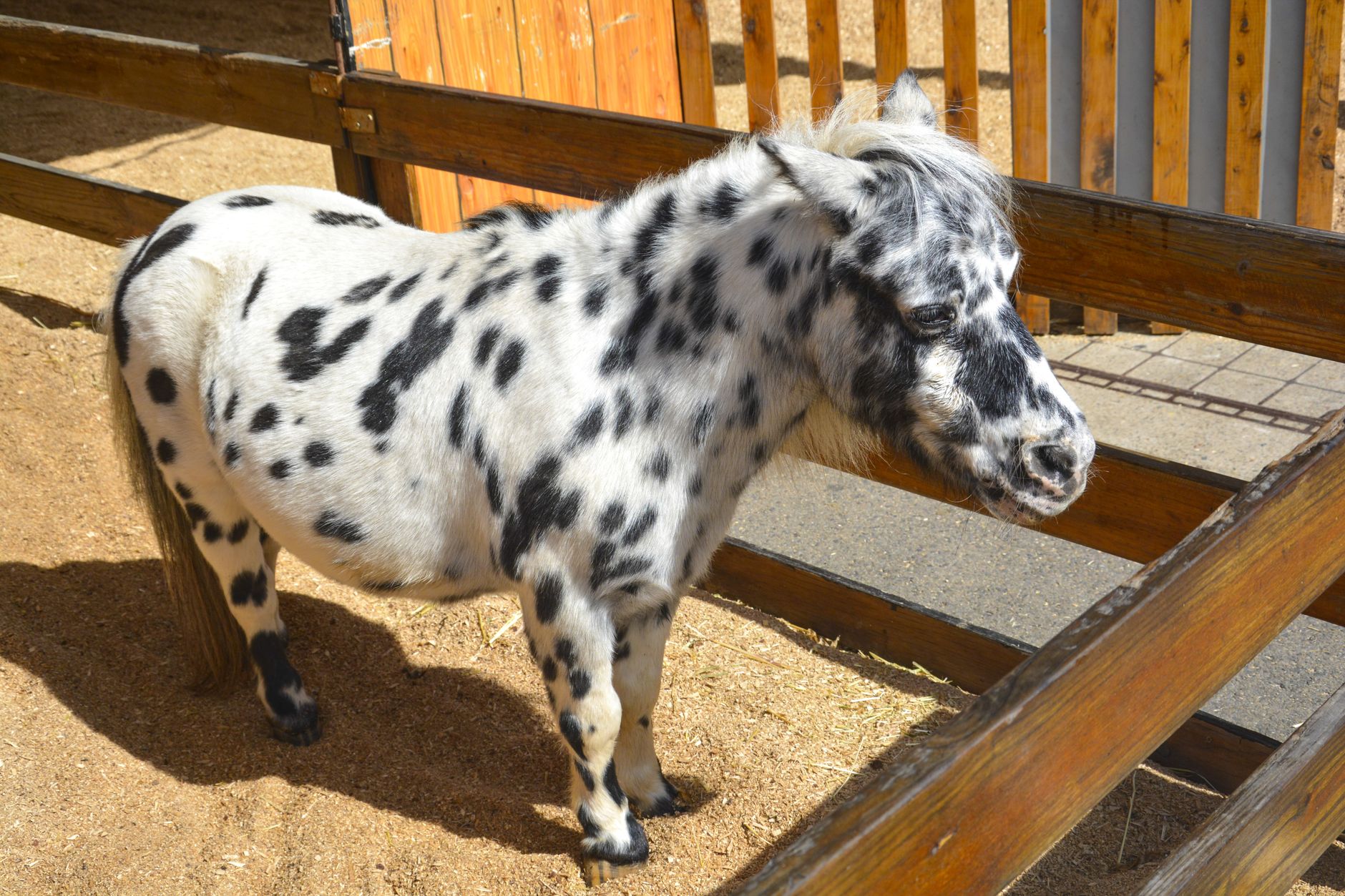
How much hay does a mini horse need?
A 300 lb miniature horse needs about 7.02 lb (3.18 kg) of hay a day — around one flake per feeding on typical bales, or 5 bales a month.
The percentage rule does not change for a small horse. What changes is that the tools people use to measure hay stop being fine enough, and the direction of the risk flips: with a full-size horse the common mistake is feeding too little, and with a mini it is feeding too much.
How much hay should a mini horse eat per day?
The same 2% of body weight in dry matter that applies to any horse. On the scale that is a little more, because hay is about 90% dry matter and the rest is water.
| Body weight | Hay per day | A 3.21 lb flake is | Bales a month | |
|---|---|---|---|---|
| Small miniature | 200 lb | 4.68 lb (2.12 kg) | 69% of the day | 3 bales |
| Miniature | 250 lb | 5.85 lb (2.65 kg) | 55% of the day | 4 bales |
| Large miniature | 300 lb | 7.02 lb (3.18 kg) | 46% of the day | 5 bales |
| Small pony | 350 lb | 8.19 lb (3.71 kg) | 39% of the day | 5 bales |
| Pony | 400 lb | 9.36 lb (4.24 kg) | 34% of the day | 6 bales |
| Large pony | 500 lb | 11.7 lb (5.31 kg) | 27% of the day | 8 bales |
| Small horse | 600 lb | 14 lb (6.4 kg) | 23% of the day | 9 bales |
Note the fourth column, which is the whole problem in one number.
How many flakes of hay for a mini horse?
About one per feeding — and that answer is much less useful than it sounds.
Penn State weighed three flakes from a single bale at 4.57 lb, 3.21 lb, 4.54 lb. For an 1,100 lb horse eating 25.7 lb (11.7 kg) a day, the difference between the lightest and heaviest of those is a rounding error. For a 300 lb mini eating 7.02 lb (3.18 kg), one flake is somewhere between 46% and 65% of the entire day’s food.
So the flake, which is a rough unit for a big horse, is a bad unit for a small one. At this size, weigh it. A cheap luggage scale and a hay net is all it takes, and it turns guesswork into a number.
Why over-feeding is the real risk
Miniatures and ponies are the group most likely to be overweight, and obesity in these animals leads to laminitis, which is painful, expensive and sometimes permanent. A mini that is a hundred pounds heavy is carrying a third more than it should.
The instinct when a mini is too fat is to cut the hay right back. That is the wrong lever, and it causes ulcers and stereotypies. Forage should not drop below about 1.5% of body weight, and a horse eating nothing for long stretches is a horse in trouble.
The right levers, in order:
- Change the hay, not the amount. A mature, later-cut grass hay carries less energy per pound, so the same weight of it does less damage.
- Slow it down. A small-hole net makes the same weight last several times longer, which is closer to how a horse is built to eat.
- Weigh what you feed. Not the flakes — the pounds.
- Cut hard feed first. A mini in light work rarely needs any concentrate at all.
What type of hay is best for miniature horses?
Usually a plain, later-cut grass hay. It is lower in energy and sugar than a leafy early cutting, so it fills the animal without loading it.
Alfalfa is generally the wrong choice for an easy-keeping mini, and it is doubly wrong if you feed by the flake: alfalfa bales are heavier and denser, so a flake of alfalfa carries considerably more feed than a flake of grass hay. Swapping one for the other flake-for-flake can overfeed by half without anyone changing what they think they are doing.
The ceiling still applies
Voluntary forage intake tops out near 3% of body weight in dry matter for a mini as much as for a full-size horse. If the arithmetic asks for more than that — a very cold snap, a hard-keeping older mini — extra hay is not the answer, because it will not be eaten. That is the point to talk to a vet rather than add another flake.
Weighing a mini
Everything above scales off body weight, and this is the input people get most wrong for small horses. A standard weight tape is designed around full-size horses and does not read a miniature accurately.
The practical answer is a livestock scale if you have access to one — many vets and some feed stores do — and a body condition score in between. You are feeling for ribs you can find easily but not see, and a neck that is not cresty. That assessment beats any tape, and for a mini it beats any table, including this one.
Common questions about feeding miniature horses
Do horses need to eat hay all day?
A mini does, as much as a full-size horse — the stomach produces acid whether there is forage in it or not. The trick with an easy keeper is making a small ration last, which is what a small-hole net is for, rather than leaving the animal empty between feeds.
Is 2 flakes of hay enough for a mini horse?
For most miniatures that is too much, not too little. Two Penn State flakes weigh between 6.4 lb and 9.1 lb, against a daily requirement of 7.02 lb (3.18 kg) for a 300 lb mini. Weigh it rather than counting it.
Can a mini horse eat too much hay?
Yes, and this is the risk that matters at this size. Minis and ponies are the group most prone to obesity and laminitis, and unlimited access to good hay will do it. The answer is not less forage but lower-energy forage and a slow feeder, because dropping below about 1.5% of body weight in forage causes its own problems.
How much hay does a mini horse need in winter?
More — 9.9 lb (4.5 kg) a day at 20 °F overnight against 7.02 lb (3.18 kg) in mild weather. Small animals lose heat faster relative to their size, and forage is what keeps them warm.
How many bales of hay does a mini horse need a month?
About 5 bales of 50 lb small squares for a 300 lb miniature. A single bale lasts a mini about a week, which is worth knowing when you buy — hay that sits that long needs storing properly.
Related calculators and guides
- Horse hay calculator — enter your mini’s actual weight and bale weight and it returns pounds, flakes and bales
- How many flakes of hay per horse per day? — why a flake is not a unit of weight, with the measurements behind it
- All horse calculators — the rest of the tools in this section
Where these figures come from
Every figure on this page is published and cited. Where sources disagree we take the more conservative one and say so. Our full approach is set out in how we source our numbers.
- Caring for Horses in Cold Weather — Utah State University Extension
- Hay Storage: Dry Matter Losses and Quality Changes — Mississippi State University Extension
- Nutrient Requirements of Horses, Sixth Revised Edition — National Research Council / National Academies Press
- Nutritional Requirements of Horses and Other Equids — Merck Veterinary Manual
- Properly curing hay is crucial for forage quality — North Dakota State University Extension
- Selecting a small square-bale feeder — University of Minnesota Extension
- Selecting and storing horse hay — University of Minnesota Extension
- Ten ways to stretch your horse’s hay supply — University of Minnesota Extension
- The effect of small square-bale feeder design on hay waste and economics during outdoor feeding of adult horses — Journal of Equine Veterinary Science
- The energy requirements of performance horses in training
- The Importance of Weighing Horse Feed — Penn State Extension
- Winter Care for Horses (G1873) — University of Nebraska-Lincoln Extension
- Winter Feeding for Horses, Fact Sheet #1143 — Rutgers University, Department of Animal Sciences