
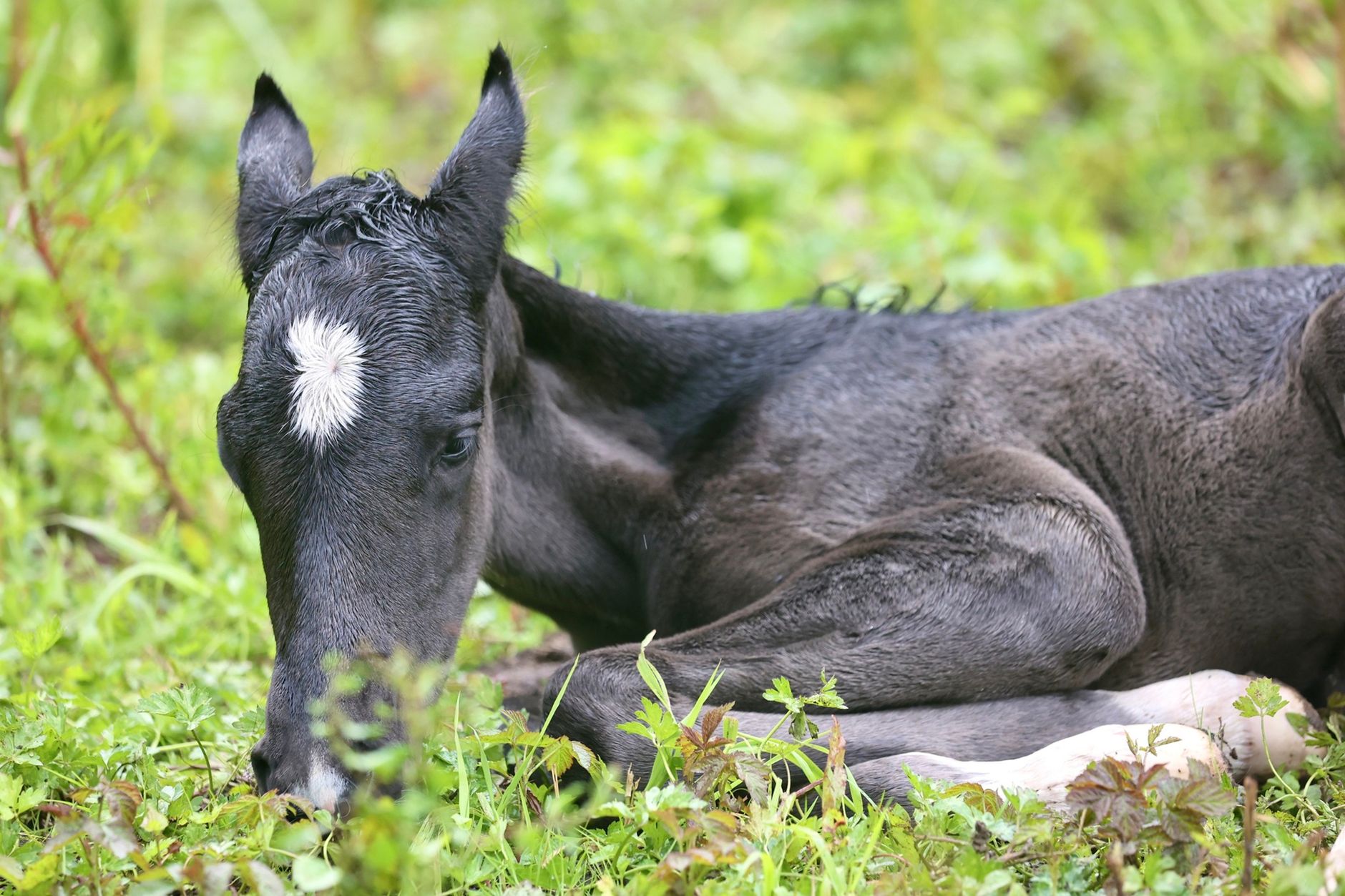
How much does a horse weigh at birth?
A foal is born at about 10% of the weight it will carry as an adult.
Out of an average riding mare that is 110 lb (50 kg); out of a draft mare nearer 180 lb (82 kg), and out of a pony mare around 70 lb (32 kg).
The percentage is the useful part, because it barely changes with how big the horse will end up.
What it needs from you is an estimate of the adult weight, and that is a genuine estimate based on the sire, the dam and the breed rather than anything you can measure on the foal in front of you.
How much does a horse weigh at birth in kg?
50 kg for a foal out of a 500 kg riding mare, 82 kg out of an 800 kg draft mare, 32 kg out of a pony. The same 10% applies whichever unit you work in.
| Mature weight | At birth | At birth, metric | At 6 months | At 12 months |
|---|---|---|---|---|
| 700 lb (318 kg) | 70 lb | 32 kg | 322 lb | 469 lb |
| 900 lb (408 kg) | 90 lb | 41 kg | 414 lb | 603 lb |
| 1,100 lb (499 kg) | 110 lb | 50 kg | 506 lb | 737 lb |
| 1,300 lb (590 kg) | 130 lb | 59 kg | 598 lb | 871 lb |
| 1,800 lb (816 kg) | 180 lb | 82 kg | 828 lb | 1,206 lb |
Notice what happens in that first six months. A foal roughly quintuples its birth weight before it is weaned, gaining something like 71.5 lb a day across the first four months on a riding-horse line.
That growth is coming almost entirely out of the mare, which is why a lactating mare’s forage requirement goes up so sharply — she is feeding two.
Height comes first, weight fills in behind
A newborn foal stands at about 60% of the height it will finish at while weighing only 10% of the weight. That mismatch is the whole reason foals look like legs with a horse attached.
It is not an accident either: a prey animal has to be able to run on the day it is born, and weight is no help with that.
It also means height tells you almost nothing about a young horse’s weight. The adult equations lean heavily on girth and body length precisely because those fill in later, and a foal has barely started.
Average foal weight month by month
The full curve, as a percentage of mature weight and then in pounds for five common mature sizes. It runs to four years because a horse is not actually finished at three.
| Age | % of mature weight | 700 lb mature | 900 lb mature | 1,100 lb mature | 1,300 lb mature | 1,800 lb mature |
|---|---|---|---|---|---|---|
| Birth | 9% | 63 | 81 | 99 | 117 | 162 |
| 4 months | 36% | 252 | 324 | 396 | 468 | 648 |
| 6 months | 46% | 322 | 414 | 506 | 598 | 828 |
| 8 months | 54% | 378 | 486 | 594 | 702 | 972 |
| 10 months | 61% | 427 | 549 | 671 | 793 | 1,098 |
| 12 months | 67% | 469 | 603 | 737 | 871 | 1,206 |
| 14 months | 71% | 497 | 639 | 781 | 923 | 1,278 |
| 16 months | 76% | 532 | 684 | 836 | 988 | 1,368 |
| 18 months | 79% | 553 | 711 | 869 | 1,027 | 1,422 |
| 24 months | 90% | 630 | 810 | 990 | 1,170 | 1,620 |
| 36 months | 97% | 679 | 873 | 1,067 | 1,261 | 1,746 |
| 48 months | 99% | 693 | 891 | 1,089 | 1,287 | 1,782 |
The two figures worth carrying in your head are half the adult weight by six months and 67% of it by the first birthday. After that the curve flattens: a two-year-old is at 90%, and the last 10% takes another two years.
Why you cannot weigh a foal with a tape or a formula
Every method on our adult weight calculator is wrong on a foal, and it is worth being clear about why rather than quietly returning a number.
Weight tapes are calibrated on adult proportions and only start being reliable at about eighteen months of age. Before that the foal’s girth-to-body relationship is nothing like a grown horse’s, and the tape is reading a scale that was never drawn for it.
The measurement formulae have the same problem for the same reason, and the research behind the good ones excluded anything under three years old from the study population entirely.
So the percent-of-mature-weight table above is not a poor substitute for a formula — for a growing horse it is the better tool.
Pair it with hands-on condition scoring, which works at any age, and you have everything you actually need: the table gives you the target and your hands tell you whether the foal is meeting it.
What the number is for
Chiefly dosing.
Wormers and most medications are given per unit of body weight, and a foal’s weight is a moving target — the figure you used two months ago is meaningfully wrong now.
Working off the table and re-checking monthly is more accurate than a tape and takes less time.
The other use is feeding rate. Growing horses are fed as a percentage of body weight in the same way adults are, so the same moving target applies.
And because they are still growing, the consequences of getting it badly wrong run in both directions: too little slows development, and too much, too fast is associated with developmental orthopaedic problems rather than simply with fat.
If you have access to a livestock scale, use it. Nothing on this page beats standing the foal on a scale, and a monthly weight is one of the most useful records a breeding operation can keep.
Common questions about foal weight
How much does a foal weigh at birth in pounds?
About 110 lb out of an average riding mare, which is 10% of the 1,100 lb she will pass on. Out of a pony mare it is nearer 70 lb and out of a draft mare around 180 lb.
Work it as a tenth of whatever the foal is expected to mature at and you will not be far out.
What is the average foal weight in kg?
50 kg for a foal out of a 500 kg mare. The rule is the same in metric: 10% of mature weight at birth, half of it by six months, 67% by twelve months.
For a draft foal expecting to mature at 800 kg that is 82 kg at birth.
How heavy is a 2 year old horse?
About 90% of its adult weight — 990 lb (449 kg) for a horse that will mature at 1,100 lb.
It looks nearly grown by then and is at full height, but the last 10% of the weight is still to come and arrives slowly over the next two years.
Is a 4 year old horse still a baby?
Not by weight — a four-year-old is at 99% of its mature weight, which is finished for practical purposes.
Skeletally it is a different story: growth plates close at different ages up the leg and into the spine, and the last of them are still closing well past four in larger types.
Weight and maturity are not the same measurement.
How much does a foal grow in the first month?
Fast — around 71.5 lb a day on average across the first four months for a riding-horse line, and faster than that in the first month than in the fourth.
A foal roughly quintuples its birth weight before weaning. Almost all of it comes through the mare’s milk, which is why her own forage requirement rises so sharply while she is lactating.
Can horses weigh 1000 pounds?
Easily — 1,000 lb (454 kg) is an ordinary adult weight for a light riding horse, and a foal destined for it would have been born at about 100 lb.
For comparison, a 15-hand stock-type horse has a published ideal weight of 1,139 lb (517 kg), so a thousand pounds sits at the lighter end of normal rather than at any extreme.
Related calculators and guides
- How much does a horse weigh? — the adult calculator — measurements, ideal weight and a condition score
- How much does a horse weigh in stone? — the same weights in the unit British and Irish riders use
- How much hay does a horse need per day? — forage for the mare, whose intake goes up sharply while she is feeding a foal
- All horse calculators — the rest of the tools in this section
Where these figures come from
Every figure on this page is published and cited. Where sources disagree we take the more conservative one and say so.
Our full approach is set out in how we source our numbers.
- Bodyweight Estimations for Adult Horses — Stable Management
- Estimating Body Weight of Growing Foals — Star Milling Co. (Dr. Bray’s Corner)
- Estimation of Actual and Ideal Bodyweight Using Morphometric Measurements and Owner Guessed Bodyweight of Adult Draft and Warmblood Horses — Journal of Equine Veterinary Science 39:1-6
- Estimation of Actual and Ideal Bodyweight Using Morphometric Measurements of Miniature, Saddle-Type, and Thoroughbred Horses — Journal of Equine Veterinary Science
- Estimation of body weight and development of a body weight score for adult equids using morphometric measurements — Journal of Animal Science 92(5):2230-2238
- Evaluating Body Composition of Horses (AS-1024) — Ohio State University Extension (Ohioline)
- Foal Growth and Development — Merck Animal Health USA, Equine Health Library
- The Horse (2nd edition) — W.H. Freeman and Company, New York