
What weight blanket does my horse need?
Every blanket chart online starts with the thermometer. The temperature outside is the one number that tells you least on its own — what decides this is the horse's own coat, whether it can get out of the wind, and whether it is wet.
Why?
The temperature you entered after wind chill. This is the number the horse is actually standing in.Why?
Its lower critical temperature — below this it starts burning calories to keep warm. Coat and acclimatisation set it; being wet overrides both.Why?
The gap the blanket has to close. A negative number means the horse is already warm enough and the answer is no rug.Why?
The other way to close the same gap. A horse heats itself by fermenting forage, so cold that is not covered by a blanket has to be covered by hay.What weight blanket does my horse need?
There is no answer to that from the thermometer alone, and every chart that offers one is guessing at the input that actually matters.
A horse stays warm unaided down to a temperature of its own, called its lower critical temperature. Below that point it starts burning calories to hold its body heat, and a rug’s job is to close the gap.
That threshold moves 32 °F (17.8 °C) on coat alone.
It is why the same 30 °F (-1 °C) morning calls for nothing on one horse in the field and a medium weight on the one beside it.
At what temperature does a horse need a blanket?
Here is what the published figures actually say. Every number in this table comes from a university extension service, a veterinary reference or a peer-reviewed paper.
| Coat | Lives out through the winter | Ordinary turnout | Stabled or newly moved |
|---|---|---|---|
| Full winter coat, never clipped | 5 °F to 18 °F | 5 °F to 30 °F | 18 °F to 30 °F |
| Part-grown coat or a trace clip | 18 °F to 34 °F | 18 °F to 50 °F | 34 °F to 50 °F |
| Clipped, or a short summer coat | 40 °F to 50 °F | 40 °F to 60 °F | 50 °F to 60 °F |
The spread inside each cell is real disagreement between sources, not a safety margin. Nebraska’s table runs consistently colder-tolerant than Georgia’s, and both are published.
That is why this calculator answers with a range and never with one confident number.
What temperature should a horse be under a blanket?
Below its own threshold, and not before. For an ordinary unclipped horse in normal turnout that is around 18 °F (-8 °C), and for a clipped one around 50 °F (10 °C).
Colorado State’s equine hospital puts the unrugged line at temperatures “routinely colder than 10 °F”, which lands in the same place from a different direction.
The chart everybody uses puts the rug on far too early
The industry chart is SmartPak’s, and it is the first organic result on this search. It is worth taking seriously, because on clipped horses it is right.
Pair its clipped rows with the published threshold for a clipped horse, 50 °F (10 °C), and its lightest band falls out exactly.
Nothing up to 100 g of fill, across 50 °F down to 40 °F, is 100 g for every 10 °F (5.6 °C) — and that rate is where this calculator’s arithmetic comes from.
Its heavier bands step faster than that. Fitted through the midpoints of all three, the chart implies about 15 g per degree Fahrenheit — 50% steeper than the rate its own lightest band sets.
We keep the shallower rate, because that is the one that reproduces the veterinary anchors. A clipped horse at 40 °F (4 °C) comes out at 100 g here, which is Colorado State’s “lightweight blanket” exactly.
The two rates part company as it gets colder.
At 20 °F (-7 °C) the same clipped horse is on 300 g by this arithmetic and 425 g by the chart’s own slope, which is past the heaviest rug anybody makes.
Its unclipped rows are a different story again.
| Horse | Temperature | The chart says | This calculator says |
|---|---|---|---|
| Clipped | 45 °F (7 °C) | Light weight | 50 g — a sheet or light weight |
| 35 °F (2 °C) | Medium weight | 150 g — a medium weight | |
| 25 °F (-4 °C) | Heavy weight | 250 g — a medium weight | |
| Unclipped, full winter coat | 35 °F (2 °C) | Light weight | No rug |
| 25 °F (-4 °C) | Medium weight | No rug | |
| 15 °F (-9 °C) | Heavy weight | 25 g — a sheet or light weight |
The bottom half of that table is the finding. A full-coated horse at 35 °F (2 °C) is 18 °F (9.7 °C) clear of needing anything, and the chart puts a light rug on it.
Three independent lines of evidence say the chart is wrong there rather than us. Georgia’s extension service warns in as many words against blanketing too soon, because horses overheat and sweat under a rug they did not need.
Colorado State’s threshold is 10 °F, not 35 °F. And in Norway a group of horses was trained to tell researchers directly.
The horses were asked, and they said no
Twenty-three horses were taught to touch one symbol meaning “blanket on”, another meaning “blanket off” and a third meaning “no change”. All twenty-three learned it inside a fortnight, and their choices tracked the weather rather than being random.
Asked under real conditions, they chose to go without above about 50 °F (10 °C). Wind made them more likely to want a rug, rain made them more likely still, and sunshine made them less likely.
That is as close to asking the horse as anyone has got, and it agrees with the extension services and not with the chart.
How heavy should my horse’s blanket be?
Once you know the gap, the fill weight follows: 100 g of fill for every 10 °F (5.6 °C) the horse is below its own threshold, capped at 400 g because that is the heaviest fill in ordinary production.
| Temperature | Full winter coat | Part-grown coat | Clipped or short coat |
|---|---|---|---|
| 50 °F (10 °C) | — | — | — |
| 40 °F (4 °C) | — | — | 100 g |
| 30 °F (-1 °C) | — | 40 g | 200 g |
| 20 °F (-7 °C) | — | 140 g | 300 g |
| 10 °F (-12 °C) | 75 g | 240 g | 400 g |
| 0 °F (-18 °C) | 175 g | 340 g | 400 g |
| -10 °F (-23 °C) | 275 g | 400 g | 400 g |
| -20 °F (-29 °C) | 375 g | 400 g | 400 g |
Read down the right-hand column and the clipped horse needs something almost all winter. Read down the left and the unclipped one needs nothing until it is genuinely cold.
What temperature is a 200g horse blanket good for?
This is the question the same arithmetic answers backwards, and it is the second most common thing people ask on these searches.
| Fill weight | The trade calls it | Full winter coat, down to | Clipped, down to |
|---|---|---|---|
| No fill — a turnout sheet | Sheet | 18 °F (-8 °C) | 50 °F (10 °C) |
| 100 g | sheet or light weight | 8 °F (-14 °C) | 40 °F (4 °C) |
| 200 g | medium weight | -2 °F (-19 °C) | 30 °F (-1 °C) |
| 300 g | heavy weight | -12 °F (-25 °C) | 20 °F (-7 °C) |
| 400 g | heavy weight | -22 °F (-30 °C) | 10 °F (-12 °C) |
The gaps in that table are worth noticing. The trade’s own bands stop at 100 g and restart at 150 g, then stop again at 250 and restart at 300.
So a computed 130 g has no name on any shelf. What it means in practice is a light rug plus a liner, which is also the answer above 400 g.
The top row needs a word of explanation, because a turnout sheet plainly does something and this arithmetic scores it at zero fill.
It does something, and it does it somewhere else in the sum.
A sheet’s whole contribution is keeping wind and water off, so it shows up here by removing the wind chill and the wet penalty rather than by closing a temperature gap.
Wet beats cold, and it is not close
A wet coat stops working.
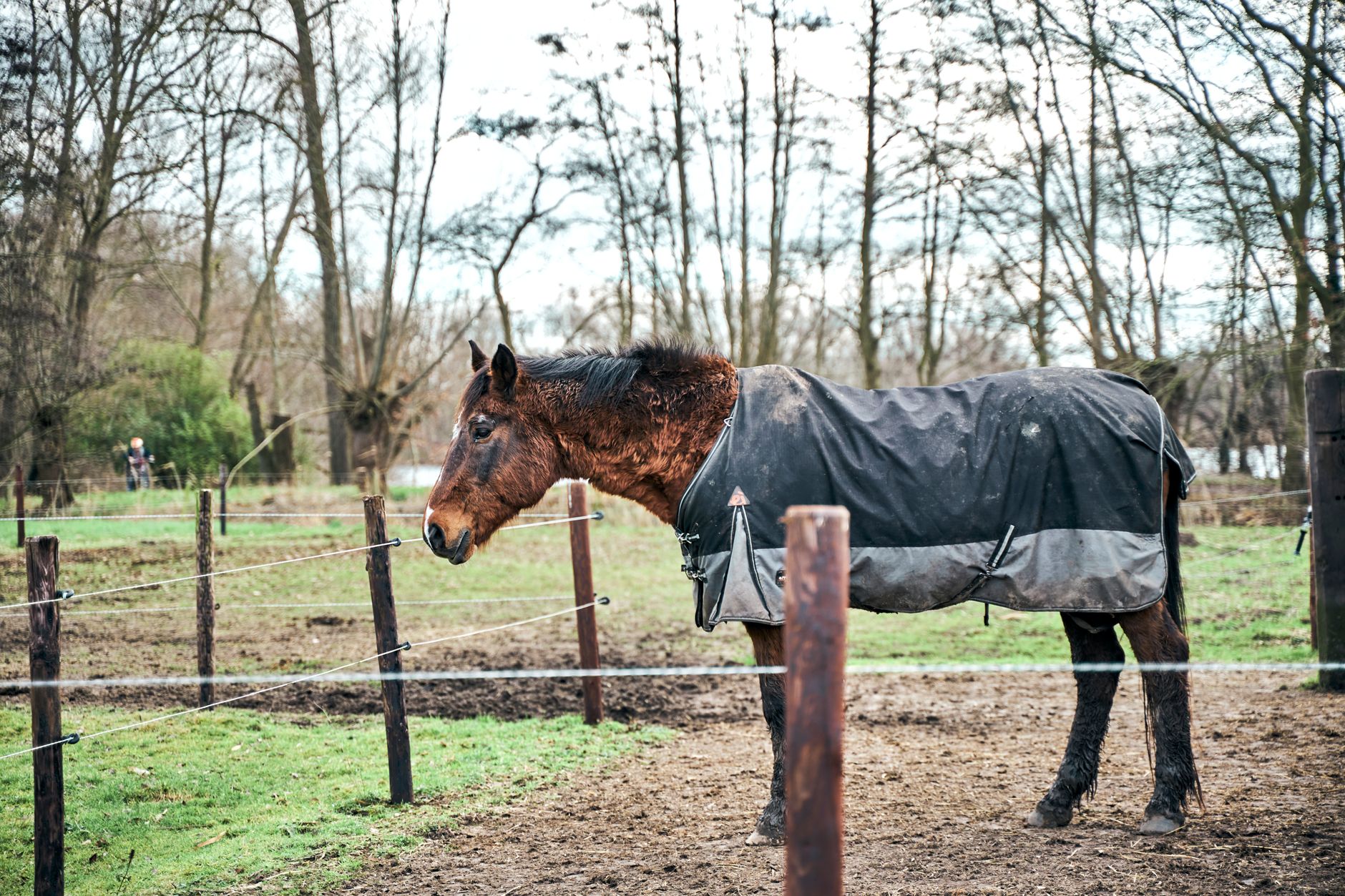
The hairs lie flat, the trapped air goes, and Nebraska’s table puts a horse with a soaked coat at 60 °F (16 °C) whatever it grew underneath — a swing of up to 30 °F (16.7 °C).
Owners already know this by instinct. In a survey of 1,450 North American horse owners, exposure to precipitation was the most frequently given reason for rugging at all.
Our 38 °F (3 °C) horse needs nothing dry. Standing out in the rain it comes to 109 g, and with a shed it can use it goes back to nothing.
What that horse actually needs in the rain is waterproofing rather than fill. The one study that measured fill weights found the largest single gain was the shell itself, before any stuffing at all.
Bare skin came off an hour at -9 °F (-23 °C) at 22.3 °C. A fill-free turnout sheet took it to 26.8, 200 g to 30.3, and 400 g only as far as 31.5.
Doubling the fill from medium to heavy bought about a quarter of what the empty sheet bought. That is the argument for a waterproof shell and a liner over a thicker rug.
Wind takes off more than the next weight up puts back
The calculator wind-chills the temperature you type before it does anything else, using the National Weather Service index.
At 20 °F (-7 °C) a horse behind a hedge is standing in 4 °F (-15 °C), and one with a shed to use is standing in 20 °F (-7 °C).
That is 133 g of fill between them.
A windbreak is therefore worth more than a blanket upgrade, and it is cheaper. The largest review of horses in cold climates says the same thing: the most demanding weather is not the coldest, it is cold rain with wind.
One honest caveat.
That wind chill index was built for human faces, and a horse’s winter coat is deeper than bare skin, so it will overstate the effect on a hairy horse.
It is used here because there is no equine version published and because equine researchers use it themselves — the fill-weight study above reports its own conditions as -9 °F (-23 °C) with a wind chill of -26 °F (-32 °C).
When to blanket a horse, and when to leave it alone
A shelter beats a rug, and the evidence for that is unusually direct. In the same North American survey, the most common reason people gave for not rugging was that the horse had somewhere to get out of the weather.
But a shelter only works while the horse is standing in it.
Blanketed horses given a free choice between a field and two sheds were inside for 20.6% of observations overall, and 39.7% on wet windy days against 11.8% when it was merely windy.
The researchers’ conclusion was that rugs “reduced the impact of inclement weather, but did not make the shelter redundant”. Neither replaces the other.
Three groups of horses feel it sooner than any of the figures above assume: seniors, foals under a year, and thin horses at a body condition score of 3 or below.
Every extension source says so and not one of them puts a number on it. So this calculator does not adjust the arithmetic for them — it tells you to work from the top of the range instead of inventing a coefficient.
The formula, spelled out
Four steps, and you can do all of them on paper.
One. Wind-chill the air temperature for where the horse actually stands: 0 mph with a shed or trees, 10 mph behind a hedge, 20 mph in an open field.
Two. Look up the horse’s own threshold from its coat and what it is used to.
If it is out in the rain, that threshold rises towards 60 °F (16 °C).
Three. Subtract.
Threshold minus what it feels like outside is the gap the rug has to close, and a negative answer means no rug.
Four. Multiply the gap by 10 g per degree Fahrenheit, and stop at 400 g.
Worked through for a clipped horse in a sheltered field at 40 °F (4 °C): its threshold is 50 °F (10 °C), so the gap is 10 °F.
Times 10 g a degree, that is 100 g — a sheet or light weight.
Colorado State’s own words for that exact case, in °F: “if it’s 40 degrees, your horse probably only needs a lightweight blanket”. Nothing was fitted to make those agree.
Where each input comes from
Temperature. The overnight low, not the afternoon high, because that is when the rug is doing its work.
This is also the commonest way people cook an unclipped horse — the rug that was right at 3am is still on at noon.
Coat. Look at the horse rather than the calendar.
A coat grown in response to shortening days in July is doing more for it than anything you can buy.
What it is used to. Acclimatisation takes several weeks, and it is worth 13 °F (6.9 °C) on the threshold for the same coat.
Where it stands. Answer for the worst place the horse will be overnight, not the gateway it happens to be in now.
Body weight. Only used for the extra-hay figure, and the horse weight calculator will give it to you from a tape measure.
The alternative to a rug is hay
A horse heats itself by fermenting forage, so cold that a blanket does not cover has to be covered by feed.
The calculator prints both. Cold that is 20 °F (11.1 °C) past a horse’s threshold costs roughly 5.5 lb of extra hay a day if you do not rug it.
That works out at about 2.7 lb per 10 °F (5.6 °C), against the 2 lb Nebraska publishes for the same step. The difference is that we compute it from the horse’s own weight rather than from a rounded rule.
The hay calculator runs the same coefficient the other way round, and in deep cold the hay matters more than the rug does.
Common questions about blanketing horses
What temperature is a 200g horse blanket good for?
A 200 g rug closes a gap of about 20 °F (11.1 °C), so the temperature it suits depends entirely on where that horse’s threshold sits.
On a clipped horse in ordinary turnout it covers down to about 30 °F (-1 °C); on the same horse unclipped in a full winter coat it would not go on until about -2 °F (-19 °C).
That is the whole reason a chart of temperatures against grams cannot work.
Is 200g a medium weight rug?
Yes.
The trade bands are 100 g and under for a sheet or light weight, 150 to 250 g for a medium and 300 g or more for a heavy.
Note that those bands do not tile — a computed 130 g has no trade name at all, and the honest answer there is a light rug with a liner.
At what temperature should I start blanketing my horse?
For an average horse in ordinary turnout with a full winter coat, not until about 18 °F (-8 °C) — and a horse that lives out all winter can go lower still.
A clipped horse is a different animal entirely and starts at about 50 °F (10 °C). Being wet moves both of those to 60 °F (16 °C).
When should you not blanket a horse?
When it does not need one, which is more often than the charts suggest, and whenever the only rug you have is not waterproof and the horse is going out.
A stable rug turned out in rain holds water against the horse and leaves it colder than bare. The other case is a wet or dirty coat: a rug goes on clean and dry or not at all.
How can you tell if a horse is cold?
Shivering is the obvious one, and a horse that is not shivering is probably not cold.
The others are a hunched stance, moving stiffly, huddling with the others, and skin that feels cold under the coat rather than at the tips of the ears.
Feeling a horse’s ears tells you about its ears.
What is the difference between a 600D and 1200D horse blanket?
Denier is the thickness of the thread in the outer shell, so it measures how hard the rug is to destroy and not how warm it is. The same maker sells 220 g of fill behind both a 600D shell and a 1200D one.
Warmth is the fill number; durability is the denier number, and they are printed side by side on the same label.
What happens if a horse gets too cold at night?
It burns calories to make up the difference, which is why this calculator also prints the extra hay that would cover the same gap. A horse 20 °F (11.1 °C) below its threshold needs roughly 5.5 lb of extra hay a day if it is not rugged.
Forage, not a blanket, is where a cold horse’s warmth actually comes from.
Is it better for a horse blanket to be too big or too small?
Too big, and the trade agrees: rugs come in 3-inch steps and every size guide says to take the larger one if you fall between. A tight rug rubs out the shoulders and restricts a horse getting up.
There is more in how to measure a horse for a blanket.
When to use a 100g turnout rug?
A 100 g rug closes about 10 °F (5.6 °C), which on a clipped horse in ordinary turnout means roughly 40 °F (4 °C) and warmer.
On an unclipped horse it is rarely the right answer at all — by the time that horse is cold enough to need something, it usually needs more than 100 g.
Read next
- How to measure a horse for a blanket — the size, in inches and centimetres, and why the European numbers are not conversions.
- What is the difference between 1200d and 600d horse blankets? — the number on the label that has nothing to do with warmth.
- How cold is too cold for a horse without a blanket? — where the published limits actually sit.
- Do horses need blankets in the rain? — the weather horses cope with worst, and what to put on.
- How much hay does a horse need per day? — the winter feeding this page’s last answer comes from.
- How much does a horse weigh? — the input the extra-hay figure scales off.
Where these figures come from
- Caring for Horses in Cold Weather — Utah State University Extension
- Caring for the horse in a cold climate – Reviewing principles for thermoregulation and horse preferences — Applied Animal Behaviour Science
- Effect of Different Blanket Weights on Surface Temperature of Horses in Cold Climates — Journal of Equine Veterinary Science
- Grams of fill against temperature: a sourcing note, not a source — Rural Calc – sourcing note
- Horse Blanket Size Guide — WeatherBeeta
- Horses can learn to use symbols to communicate their preferences — Applied Animal Behaviour Science
- Nutrient Requirements of Horses, Sixth Revised Edition — National Research Council / National Academies Press
- Nutritional Requirements of Horses and Other Equids — Merck Veterinary Manual
- Temperature regulation in horses during exercise and recovery in a cool environment — Acta Veterinaria Scandinavica
- The effect of blankets on horse behaviour and preference for shelter in Nordic winter conditions — Applied Animal Behaviour Science
- The effect of weather conditions on the preference in horses for wearing blankets — Applied Animal Behaviour Science
- The Ultimate Horse Blanketing Guide — SmartPak Equine
- To Blanket or not to Blanket? That’s a Good Cold-Weather Question — Colorado State University College of Veterinary Medicine and Biomedical Sciences
- To Blanket, or Not to Blanket: That is the Question. — University of Georgia Equine Program (UGA Extension)
- What is denier? — WeatherBeeta
- Wind Chill (WxCalc formula sheet) — National Weather Service, NOAA
- Winter blanketing practices: An online survey of North American horse owners — Journal of Equine Veterinary Science
- Winter Care for Horses (G1873) — University of Nebraska-Lincoln Extension