
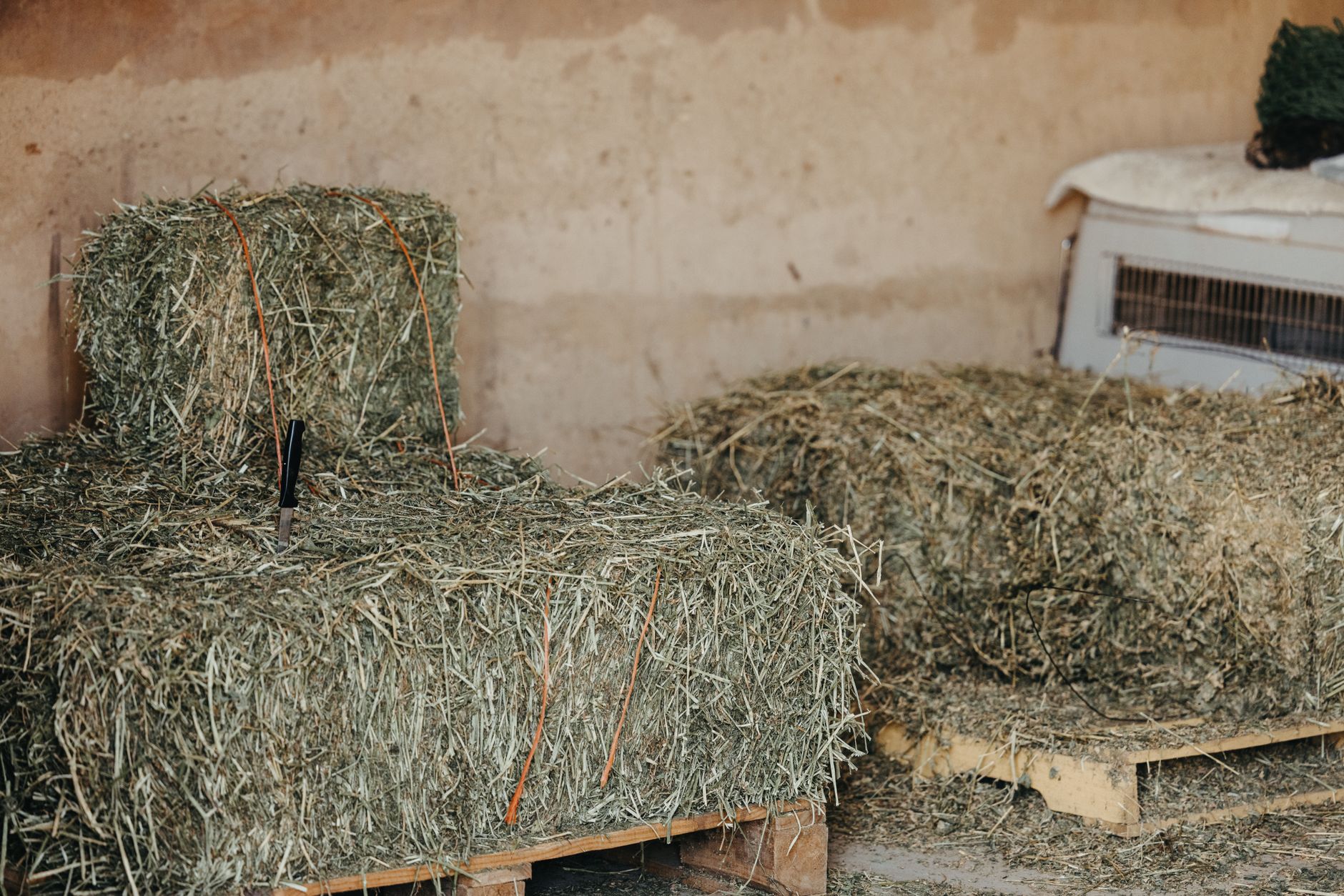
How many flakes of hay are in a bale?
Usually 10 to 14 flakes in a standard two-string bale. But that number is set by the baler, not by any standard, and it is the wrong number to build a feeding plan on.
So when someone asks how many flakes of hay are in a bale, the useful answer is a question back: what does your bale weigh, and how many slices did it fall into? That you can work out in about a minute.
What is considered a flake of hay?
A flake is the slab a small square bale falls apart into when you cut the strings. Nothing more. The baler compresses hay in slices as it works, and those slices are what you see.
Because it is a by-product of how the machine was set that day, a flake is not a unit of anything. It has no defined weight, no defined thickness, and no standard behind it. Two farms twenty miles apart will hand you flakes that differ by half.
How many flakes of hay are in a square bale?
For the two-string grass bale most people mean by “a bale”: 10 to 14. Oregon State’s guide to buying hay puts grass bales at 40 to 80 lb, with 55 lb common; alfalfa bales run heavier, around 110 lb.
| Bale | Bale weight | Flakes | Flake weight | Cost per flake |
|---|---|---|---|---|
| Two-string grass, light | 40 lb | 12 | 3.3 lb | $0.17 |
| Two-string grass, typical | 50 lb | 12 | 4.2 lb | $0.21 |
| Two-string grass, common (OSU) | 55 lb | 13 | 4.2 lb | $0.21 |
| Two-string grass, heavy | 80 lb | 14 | 5.7 lb | $0.29 |
| Three-string alfalfa (OSU) | 110 lb | 16 | 6.9 lb | $0.34 |
Look at the flake weight column. A flake off a heavy three-string bale weighs about 2.1 times what a flake off a light two-string does. Same word, different object.
How many flakes are in a 50 lb bale, and why it varies
Penn State weighed three flakes from a single bale: 4.57 lb, 3.21 lb, 4.54 lb. That is a 42% spread without leaving the bale, let alone the farm.
The count moves with baler setting, with cutting, with how dry the hay was going in, and with how tightly the crew wanted the bales for stacking. A second cutting is usually leafier and denser than a first, so the same slice weighs more.
| Flakes in the bale | 10 | 12 | 14 | 16 | 18 |
|---|---|---|---|---|---|
| Each flake weighs | 5 lb | 4.2 lb | 3.6 lb | 3.1 lb | 2.8 lb |
| Flakes to feed per day | 5 | 6 | 7 | 8 | 9 |
Read the bottom row. The same bale, the same horse, and the honest answer ranges from 5 flakes to 9. Anyone who tells you a horse eats “four flakes a day” without asking about your bales is guessing.
How to count flakes properly, once
- Weigh a bale. Bathroom scale, hold the bale, subtract yourself.
- Count the flakes as you feed that bale out.
- Divide. That is your flake weight, and it holds for the rest of that load.
Then you can go back to counting flakes at the barn, which is what everyone wants to do anyway. You are not feeding by weight forever — you are calibrating the unit once so the counting means something.
Do it again with the next load. New cutting, new number.
How much does a flake of hay cost?
Cost per flake is the same arithmetic run the other way: price per bale ÷ flakes per bale. At hay valued around $100 a short ton, a 50 lb bale is about $2.50 and a flake around $0.21.
The number worth knowing is not the price of a flake, though — it is the price of the flakes that never reach the horse. Hay fed on the ground with no feeder loses a share to trampling and soiling, and that is money leaving on exactly the same per-flake rate.
A flake is a measuring cup, not a measurement
Everything above is one point: use flakes to portion out hay, never to decide how much hay is right. The right amount is a weight — about 90% of it is actual dry matter, the rest water — and once you know what your flakes weigh, counting them out is a perfectly good way to serve it.
An 1,100 lb horse at maintenance needs 25.7 lb (11.7 kg) a day. Whether that is four flakes or nine depends entirely on the bale in front of you.
Common questions about bales and flakes
How many flakes are in a 50 lb bale?
Usually 10 to 14, giving flakes of about 3.6 lb to 5 lb. Nothing standardises it — the baler’s setting does, and it changes between farms, between cuttings and sometimes within a single load.
How much is one flake of hay?
Bale weight divided by the number of flakes in it. There is no standard figure to look up, because no published study establishes one. Real measured examples run from 3.8 lb on a 50 lb eastern two-string to 6.9 lb on a 110 lb western three-string.
How many flakes of hay are in a regular square bale?
A “regular” bale usually means the two-string grass bale, which runs 40 to 80 lb and typically breaks into 10 to 14 flakes. Three-string bales are a different animal — heavier, denser, and the flakes off them are close to double.
How many flakes in a bale of alfalfa?
Alfalfa bales are heavier than grass — Oregon State puts them around 110 lb against 40 to 80 lb for grass. The flake count is not much different, so each flake weighs considerably more. Feeding alfalfa flake-for-flake against grass hay is one of the easier ways to overfeed a horse.
Does a bale get lighter in storage?
Yes, and it catches people out when they buy a winter’s hay in one go. Hay baled a little damp keeps drying in the stack — Mississippi State’s worked example shows hay baled at 20% moisture reaching 12% after three weeks, with about 8% of the dry matter gone with it. The bale you weigh in September is not quite the bale you feed in January.
Related calculators and guides
- How many flakes of hay per horse per day? — the other half of this question — how many of them your horse actually needs
- Horse hay calculator — enter your own bale weight and flake count and it converts a ration into flakes, bales and pounds
- All horse calculators — the rest of the tools in this section
Where these figures come from
Every figure on this page is published and cited. Where sources disagree we take the more conservative one and say so. Our full approach is set out in how we source our numbers.
- Caring for Horses in Cold Weather — Utah State University Extension
- Hay Storage: Dry Matter Losses and Quality Changes — Mississippi State University Extension
- Horse Owner’s Guide to Buying Hay (EC 1249) — Oregon State University Extension Service
- How Much Does That Round Bale Weigh? — Kansas State University Research and Extension, Greenwood County
- Implications of Round Bale Dimensions on Hay Use (AN326) — University of Florida IFAS Extension (EDIS)
- Nutrient Requirements of Horses, Sixth Revised Edition — National Research Council / National Academies Press
- Nutritional Requirements of Horses and Other Equids — Merck Veterinary Manual
- Properly curing hay is crucial for forage quality — North Dakota State University Extension
- Selecting a small square-bale feeder — University of Minnesota Extension
- Selecting and storing horse hay — University of Minnesota Extension
- Ten ways to stretch your horse’s hay supply — University of Minnesota Extension
- The effect of small square-bale feeder design on hay waste and economics during outdoor feeding of adult horses — Journal of Equine Veterinary Science
- The energy requirements of performance horses in training
- The Importance of Weighing Horse Feed — Penn State Extension
- Winter Feeding for Horses, Fact Sheet #1143 — Rutgers University, Department of Animal Sciences