
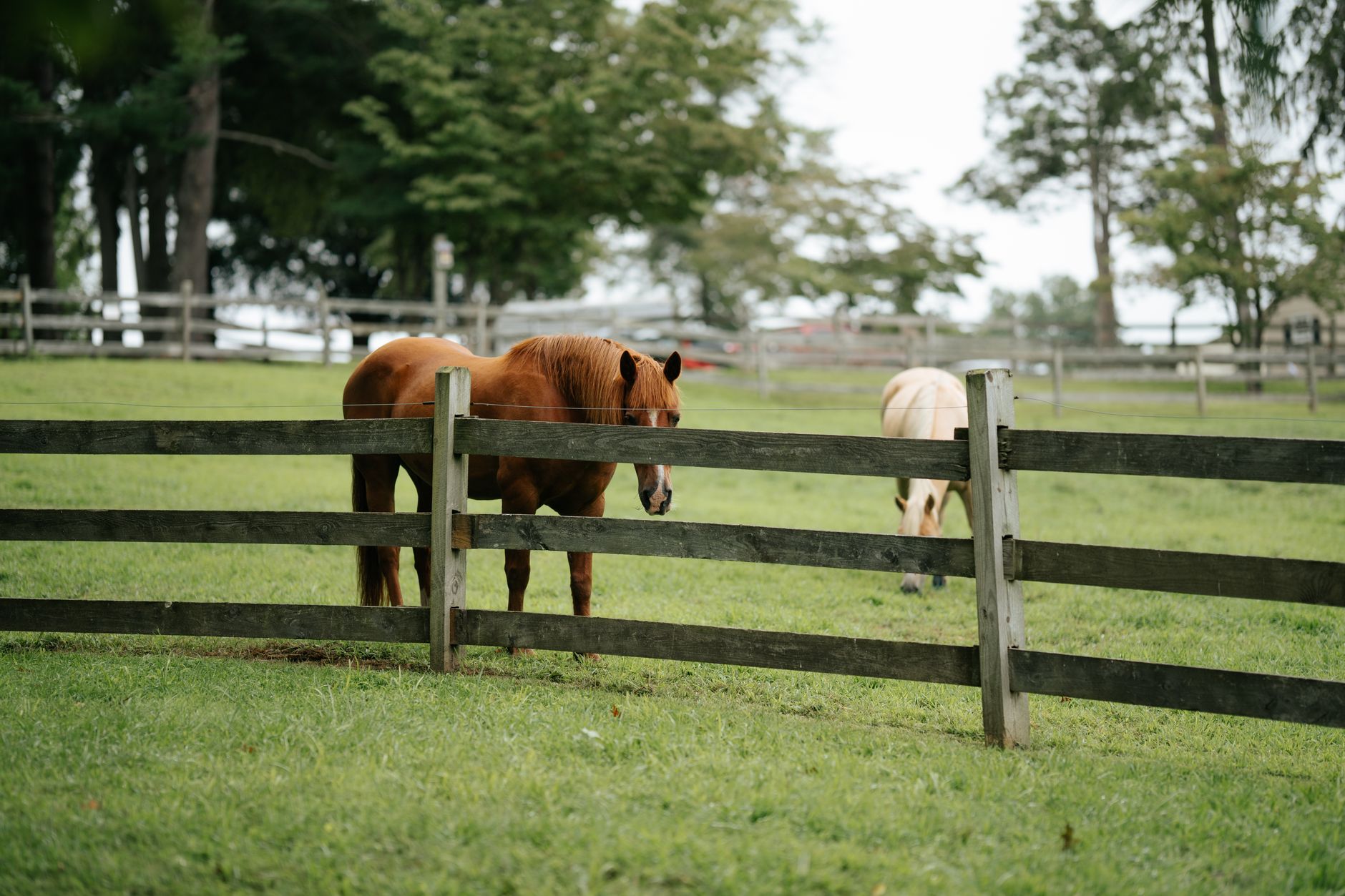
How many acres for 2 horses?
On average mid-country pasture, two 1,100 lb horses need 5.42 acres (2.19 ha) grazed as a single open field, 3.97 acres (1.61 ha) if you split it into paddocks and move them weekly, or 2.63 acres (1.06 ha) moved every day or two.
How many acres for 2 horses has no single answer because two of the three things that decide it are not in the question: what the ground grows, and what you do with it.
The third — the horses — is the one everybody gives.
The land, by region and by how you graze it
| Where the pasture is | One field, all season | Rotated weekly | Rotated every 1–3 days |
|---|---|---|---|
| Arid West, dryland | 24 acres (9.7 ha) | 17.6 acres (7.12 ha) | 11.7 acres (4.71 ha) |
| Northern, cool-season grass | 6.98 acres (2.82 ha) | 5.12 acres (2.07 ha) | 3.39 acres (1.37 ha) |
| Mid and southern, cool-season grass | 5.42 acres (2.19 ha) | 3.97 acres (1.61 ha) | 2.63 acres (1.06 ha) |
| Irrigated or high rainfall | 3 acres (1.2 ha) | 2.2 acres (0.89 ha) | 1.46 acres (0.59 ha) |
The spread across that table is more than tenfold, and it is not an argument about method. An acre of irrigated pasture grows about 8,000 lb of dry matter a year and an acre of dryland range about 1,000.
Two horses eat the same amount either way.
Within a region, the grazing system is the lever you actually control. Left in one field horses eat about 33% of what grows — they graze the sweet patches to the ground and leave the rest to seed.
Moved between paddocks they eat 45% or more, because they eat what is in front of them rather than choosing.
The familiar figure of 2 to 3 acres a horse — four to six acres for a pair — is Kentucky’s, for year-round grazing on ground much like the third row.
It is a good answer to a question about Kentucky and a poor one anywhere else.
Is 3 acres enough for two horses?
Grazed as one field, not quite: three acres carries about 1.1 horses on average ground, so the grass runs out after about 100 days days of a 180-day season.
Split into paddocks it is enough — 1.5 horses’ worth of carrying capacity, which covers two with something in hand for a dry August. Three acres and two horses is a workable, common setup.
It just is not a workable setup if you leave the gate open all summer.
Is 1 acre big enough for 2 horses?
Big enough to keep them on. Not remotely big enough to feed them.
One acre of average pasture carries about 0.4 of a horse over a season.
Two horses on it eat hay for most of the year — about 19.9 lb (9.03 kg) a horse a day even in the grazing season, 144 bales bales across it.
And the acre will not survive: under about an acre a horse, continuously grazed, a field becomes bare ground with weeds in it inside two summers, which brings sand colic and a heavier worm burden with it.
If one acre is the land, the honest plan is to stop thinking of it as pasture.
Fence a sacrifice area of at least 400–500 square feet a horse, feed hay in it year round, and let the rest of the acre rest so that turnout onto it stays worth having.
What the shortfall costs
The useful question for someone who already owns the land is not whether it is enough. It is what the difference costs.
| Land you have | Days the grass lasts | Hay a day | Hay for the season | Bales |
|---|---|---|---|---|
| 1 acre | 33 days | 19.9 lb (9.03 kg) a horse | 7,176 lb (3,255 kg) | 144 bales |
| 2 acres | 66 days | 15.4 lb (6.99 kg) a horse | 5,551 lb (2,518 kg) | 112 bales |
| 3 acres | 100 days | 10.9 lb (4.94 kg) a horse | 3,927 lb (1,781 kg) | 79 bales |
| 5 acres | 166 days | 1.9 lb (0.86 kg) a horse | 678 lb (308 kg) | 14 bales |
| 10 acres | 180 days | 0 lb (0 kg) a horse | 0 lb (0 kg) | 0 bales |
Those figures cover the grazing season only. The other 185 days of the year are hay whatever the acreage, and that is the larger bill.
A horse eats the same weight of dry matter either way, 1.5% to 2.5% of its body weight a day, whether it comes off a field or out of a bale.
Making two horses fit
Four things move the numbers above, roughly in order of how much they move them:
- Divide the field. Three or four paddocks of polytape cuts the land needed by about 27%. It is the cheapest change available and the largest.
- Lime and fertilise to a soil test. A well-managed stand on the same ground grows 2.6 times what a neglected one does.
- Respect the heights. Turn out at 6–8 inches, take them off at 3–4. Grazing shorter eats the root reserves and next year’s yield falls.
- Build a sacrifice area. Somewhere for the horses to be when the ground is wet and when the grass needs resting. Without one, every wet week undoes a month of grazing management.
None of it changes the season. The Midwest grows grass for something like 142 to 185 days a year, and the South and the irrigated West for longer, but nowhere for twelve months.
Two horses, a few acres and a winter’s hay is the normal shape of this, and the acreage question is really a question about how much of the hay bill the land can take off you.
The pasture calculator runs all of it for your own ground: acres, region, condition, grazing system and season, with the hay and the bale count for whatever is left over.
Common questions about acreage for two horses
Is 2 acres enough for 2 horses?
Two acres of average pasture carries about 0.7 horses grazed as one field and about 1.0 rotated, so it is short of two either way and you should plan on hay through part of the summer.
It is enough land to keep two horses well if a sacrifice area and winter hay are part of the plan from the start.
How many acres for 2 horses in Texas?
Texas is the reason a state-level answer does not work: the east of it grows grass like the Gulf South and the west of it is dryland range.
Two horses might need 5.42 acres (2.19 ha) in the piney woods and 24 acres (9.7 ha) in the Trans-Pecos, on the same arithmetic. Your county extension office has the local forage-production figure, and it is worth the phone call.
Is 10 acres enough for two horses?
Comfortably, on any ground but dryland range — two horses need 5.42 acres (2.19 ha) of average pasture grazed continuously. Ten acres gives you room to rest paddocks, cut hay off part of it, and carry a dry summer without the field suffering.
On arid dryland, ten acres for two horses is still short.
Can I have two horses on 2 acres?
Yes, with management.
Two acres of average pasture carries about 0.7 horses grazed as one field and about 1.0 rotated, so expect to feed hay for part of the summer and all of the winter, and to need a sacrifice area for wet ground.
Is 5 acres enough for 2 horses?
Yes on ordinary ground — it is comfortably above the 5.42 acres (2.19 ha) two horses need on average pasture grazed continuously, which leaves margin for a poor year and the option of resting half of it.
Five acres is roughly where most people stop having to think about grazing management and start being able to choose it.
How many acres for 3 horses?
On average pasture, about 8.13 acres (3.29 ha) grazed continuously or 5.96 acres (2.41 ha) rotated weekly, through a 180-day season. The arithmetic is per pound of horse rather than per head, so three ponies need considerably less and three warmbloods considerably more.
Related calculators and guides
- How many acres does a horse need? — runs this for your own ground, region and grazing season
- How many horses can graze on 3 acres? — the same question with the acreage fixed instead of the horses
- How much hay does a horse need per day? — what the shortfall and the off-season actually cost to feed
- All horse calculators — the rest of the tools in this section
Where these figures come from
Every figure on this page is published and cited. Where sources disagree we take the more conservative one and say so.
Our full approach is set out in how we source our numbers.
- Caring for Horses in Cold Weather — Utah State University Extension
- Drylots for Horses — eXtension / Extension Horses
- Equine Nutrition: Forages — Utah State University Extension
- Estimating Carrying Capacity of a Pasture — Colorado State University Extension
- Forages for Horses (ASC-120) — University of Kentucky Cooperative Extension Service
- Grazing Strategies for Horse Pastures — Colorado State University Cooperative Extension
- Hay Storage: Dry Matter Losses and Quality Changes — Mississippi State University Extension
- Horse Care on Small Acreages in Colorado — Colorado State University Cooperative Extension
- Maine Pasture Management Course, Lesson 5: Grazier’s Arithmetic — University of Maine Cooperative Extension
- Nutritional Requirements of Horses and Other Equids — Merck Veterinary Manual
- Pastures for Profit: A Guide to Rotational Grazing (A3529) — University of Wisconsin-Extension
- Properly curing hay is crucial for forage quality — North Dakota State University Extension
- Rotational Grazing (ID-143) — University of Kentucky Cooperative Extension Service
- Selecting and storing horse hay — University of Minnesota Extension
- Winter Feeding for Horses, Fact Sheet #1143 — Rutgers University, Department of Animal Sciences