
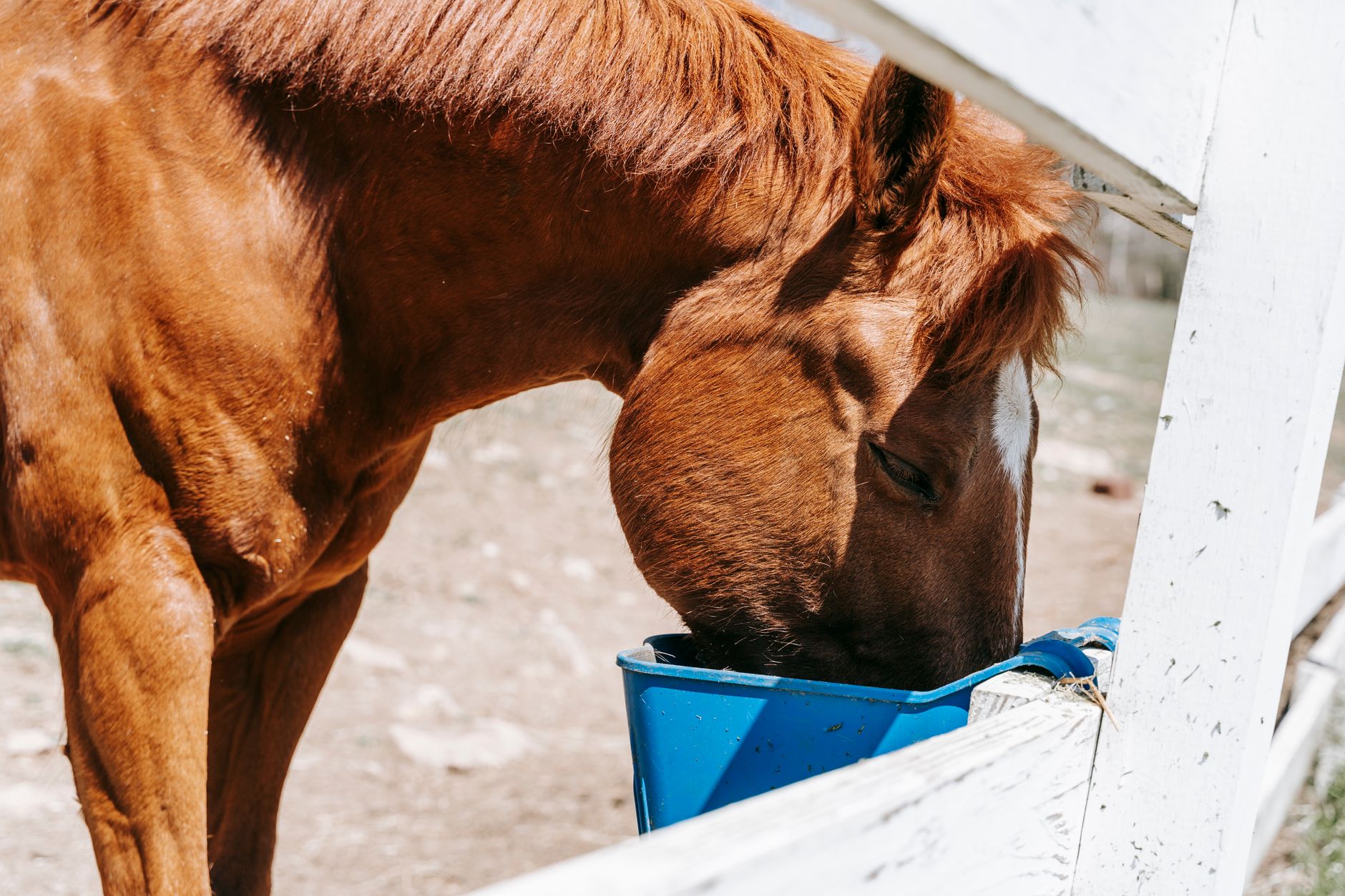
How much grain should I feed my senior horse?
How much grain should I feed my senior horse? Start with the fact almost every article on this subject skips: there are no separate published nutrient requirements for senior horses. The National Research Council does not define any, and extension guidance is blunt about it — most older horses do perfectly well on a diet formulated for a normal adult at maintenance.
So the arithmetic does not change with age. What changes is the mouth, the meal size, and how carefully you have to watch.
The amount is the same calculation as any other horse
Grain fills the gap between what the horse needs and what its forage already supplies. For an 1,100 lb horse on 20 lb of average grass hay a day, fed a senior feed: at maintenance, 0 lb (0 kg). In light work, 2.7 lb (1.2 kg). In moderate work, 5.36 lb (2.43 kg).
Age itself does not add to that. What often does is everything that arrives alongside age — worn teeth that stop the horse extracting what is in its hay, a drop in digestive efficiency, and the loss of rank in a herd that means it gets pushed off the pile.
Two of those look identical from the outside. A senior losing condition on good hay usually is not short of a bigger bucket; it is failing to get the hay it is already being given.
| Hay | No work | Light work | Moderate work |
|---|---|---|---|
| Mature, stemmy grass hay | 1.77 lb (0.8 kg) | 4.43 lb (2.01 kg) | 7.09 lb (3.22 kg) |
| Average grass hay | 0 lb (0 kg) | 2.7 lb (1.2 kg) | 5.36 lb (2.43 kg) |
| Early-bloom grass hay | 0 lb (0 kg) | 1.98 lb (0.9 kg) | 4.64 lb (2.11 kg) |
| Mixed grass and legume | 0 lb (0 kg) | 2.27 lb (1.03 kg) | 4.93 lb (2.24 kg) |
| Alfalfa, mid to full bloom | 0 lb (0 kg) | 1.41 lb (0.64 kg) | 4.06 lb (1.84 kg) |
The meal ceiling is tighter, and it is an absolute number
A single meal for a senior horse should never exceed 5 lb. Not 5 lb per something — 5 lb, full stop.
That matters because it is a flat limit rather than a percentage. The ordinary rule of 0.5% of body weight works out at 5.5 lb for an 1,100 lb horse, so on anything under about 1,000 lb the senior rule is the tighter of the two and the one you should be working to.
| Body weight | 0.5% of body weight | Senior limit | Which one binds |
|---|---|---|---|
| 500 lb | 2.5 lb | 5 lb | the percentage |
| 800 lb | 4.0 lb | 5 lb | the percentage |
| 1,000 lb | 5.0 lb | 5 lb | the 5 lb rule |
| 1,100 lb | 5.5 lb | 5 lb | the 5 lb rule |
| 1,200 lb | 6.0 lb | 5 lb | the 5 lb rule |
| 1,400 lb | 7.0 lb | 5 lb | the 5 lb rule |
Meals also need at least 4 hours between them, so a senior needing a large daily ration needs a genuinely long feeding day, not three buckets before lunch.
The real risk is choke, not calories
Senior horses are markedly more prone to choke, and the feed form is what decides it.
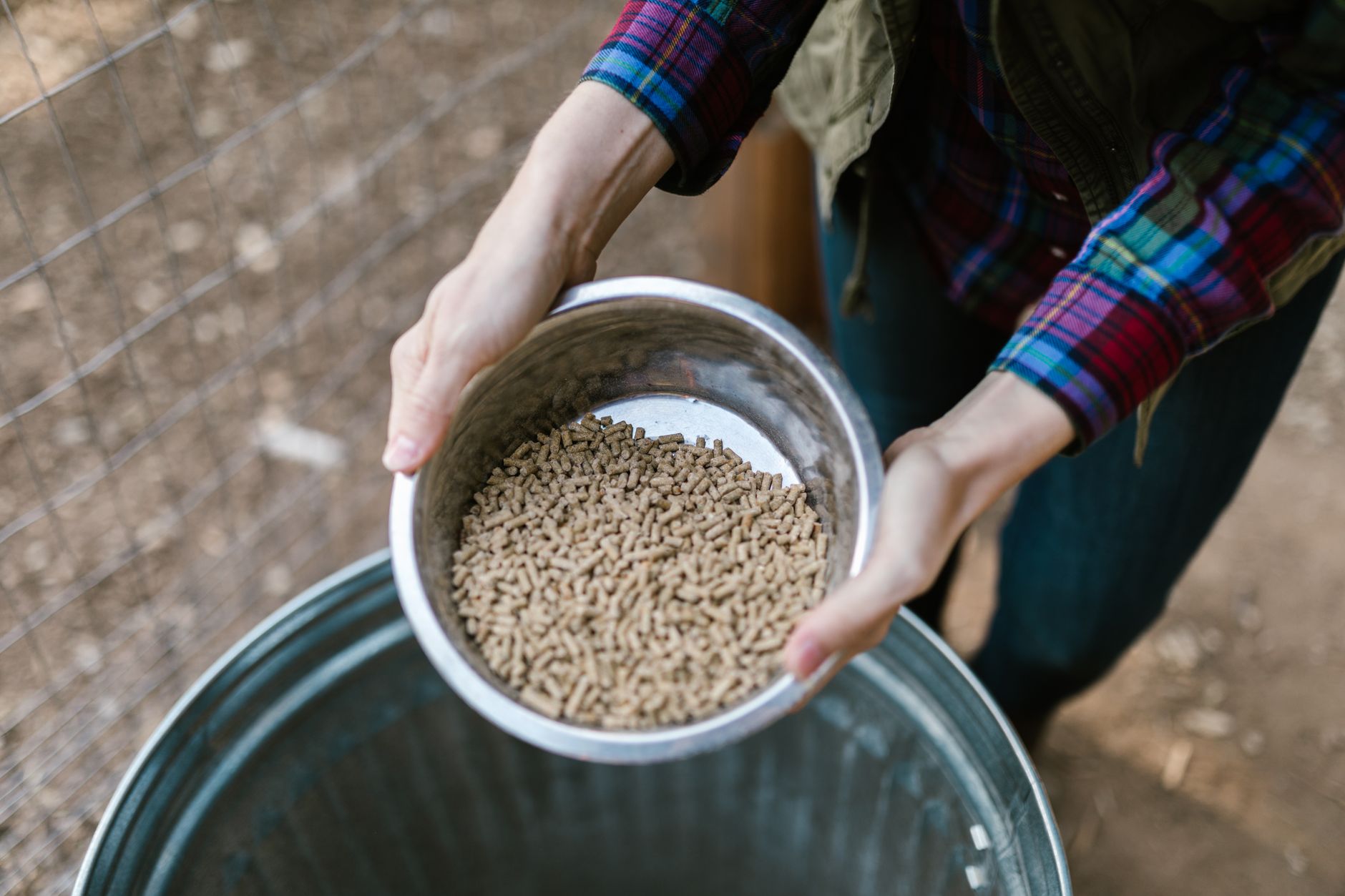
Textured mixes are the worst choice for a worn mouth. Whole grains need chewing, and a horse that bolts food it cannot properly grind is the classic choke case. Pelleted and extruded feeds are easier to chew and more digestible, and an extruded or pelleted feed has been shown to hold condition on geriatric horses better than a traditional sweet feed does.
Soaking removes the question entirely. Both pellets and extruded feeds turn into a mash with water — about half a US gal per pound of feed is the usual starting point, adjusted to a genuinely soupy consistency rather than a thick porridge. Mashes also carry water into a horse that may not be drinking enough, which matters because impaction colic is common in old horses.
When feed replaces hay
A horse that can no longer chew long-stem hay at all needs a different plan, not a bigger scoop of the same one.
Feeds labelled complete carry enough fibre to stand in for forage — that is what the word means on a bag, and it is why they are fed at quantities that look alarming next to a normal grain ration. One manufacturer’s label puts the exchange rate at 1 lb of feed for every 1.5 lb of hay it replaces, which for a horse coming off 20 lb of hay a day means something in the region of 13 lb of feed.
Two consequences follow immediately. That much feed cannot go into two buckets — at 5 lb a meal it needs three or four. And the ration has stopped being a top-up, so the forage floor of 1.5% of body weight is now being met by the bag rather than by hay, which makes getting the amount right considerably more important than it was.
Chopped forage, hay cubes, soaked hay pellets and beet pulp all do a similar job and can be mixed in. What none of them replace is the many hours a day a horse would otherwise spend chewing, so keep some long-stem forage in front of a horse that can still manage any at all.
What else changes with age
Protein. Older horses digest protein less efficiently, so their requirement runs a little higher — around 12 to 14% of the diet rather than the 10% a mature idle horse needs. This is the main reason a senior feed is not simply a softer version of an ordinary one.
Fibre. Aim for a diet above 10% crude fibre, and highly digestible fibre at that. Beet pulp and soy hulls are far more digestible than their fibre content suggests, which makes them useful here.
Alfalfa, carefully. Straight alfalfa is safe for most classes of horse but is not recommended as the sole forage for a senior, because its calcium content can aggravate failing kidneys. The same caution applies to beet pulp and wheat bran in a horse with diagnosed kidney trouble.
Condition score. Aim for 4 to 6 on the nine-point scale, and check it with your hands rather than your eyes — a long winter coat hides a great deal, and on an old horse it hides it for months.
Feed alone. A senior with arthritis is rarely the one that wins an argument over a bucket. Separating it at feeding time is often worth more than anything you put in the bucket.
Common questions about feeding the senior horse
How much grain should I feed my senior horse?
The same amount any horse of that weight and workload needs — age does not change the calculation. An 1,100 lb senior on 20 lb of average grass hay needs 0 lb (0 kg) at maintenance and 2.7 lb (1.2 kg) in light work. On poor, stemmy hay the same horse in light work needs 4.43 lb (2.01 kg), and on half the hay, 9.33 lb (4.23 kg).
What is the best senior feed for older horses?
The one the horse can actually chew. Pelleted and extruded feeds beat textured mixes for a worn mouth on both chewability and digestibility, and either can be soaked into a mash. Beyond that, look for crude fibre above 10% and protein around 12–14%.
When should a horse start on senior feed?
When its mouth or its condition says so, not when it reaches a birthday. There is no age at which a horse becomes nutritionally senior — plenty of horses in their twenties do well on ordinary adult feed. The trigger is dropped feed, quidded balls of half-chewed hay, weight loss on a ration that used to hold, or a dental exam that finds worn or missing teeth.
How much complete feed replaces hay?
Roughly 1 lb of complete feed for every 1.5 lb of hay, going by the feeding directions on a widely sold senior feed. A horse coming off 20 lb of hay a day therefore needs something like 13 lb of feed — which has to be split across three or four meals to stay under the 5 lb ceiling.
Why is my senior horse losing weight on the same feed?
Most often because it is no longer getting what you are giving it. Worn teeth stop a horse extracting the energy from long-stem hay long before they stop it eating. Check for dropped, half-chewed balls of hay, get the teeth looked at, and check whether it is being pushed off the feed by others. Dental disease, Cushing’s and kidney or liver trouble are all common enough in old horses to be worth a vet’s opinion before you simply feed more.
Can senior horses eat regular grain?
Many can, and there is nothing wrong with it while the horse chews and holds condition. The reason to switch is mechanical rather than nutritional: whole grains in a textured mix need grinding, and a mouth that cannot grind them is a choke risk.
Related calculators and guides
- Horse grain calculator — set the life stage to senior and it applies the smaller meal ceiling automatically
- How much grain can you feed a horse per day? — the three ceilings in full, and which one binds first on a smaller horse
- All horse calculators — the rest of the tools in this section
Where these figures come from
Every figure on this page is published and cited. Where sources disagree we take the more conservative one and say so. Our full approach is set out in how we source our numbers.
- Basics of Feeding Horses: Feeding Management (G1781) — University of Nebraska-Lincoln Extension
- Equine Nutrition: Concentrates — Utah State University Extension
- Equine Senior Horse Feed – feeding directions — Purina Animal Nutrition LLC
- Feeding and Nutrition for the Senior Horse (UT Horse, Vol. 2 Issue 4) — University of Tennessee Institute of Agriculture Extension
- Forage for Horses (Idaho Forage Handbook, 3rd Edition, Chapter 17) — University of Idaho Extension
- Hay Storage: Dry Matter Losses and Quality Changes — Mississippi State University Extension
- Integrity Feed Weight Chart — Star Milling Co.
- Measuring the Digestible Energy Content of Horse Feeds — Kentucky Equine Research, Inc.
- Nutrient Requirements of Horses, Sixth Revised Edition — National Research Council / National Academies Press
- Nutritional Requirements of Horses and Other Equids — Merck Veterinary Manual
- Properly curing hay is crucial for forage quality — North Dakota State University Extension
- Purina Horse Feed Quart Weights (conversion chart) — Purina Animal Nutrition LLC
- Selecting and storing horse hay — University of Minnesota Extension
- The energy requirements of performance horses in training
- Winter Feeding for Horses, Fact Sheet #1143 — Rutgers University, Department of Animal Sciences