
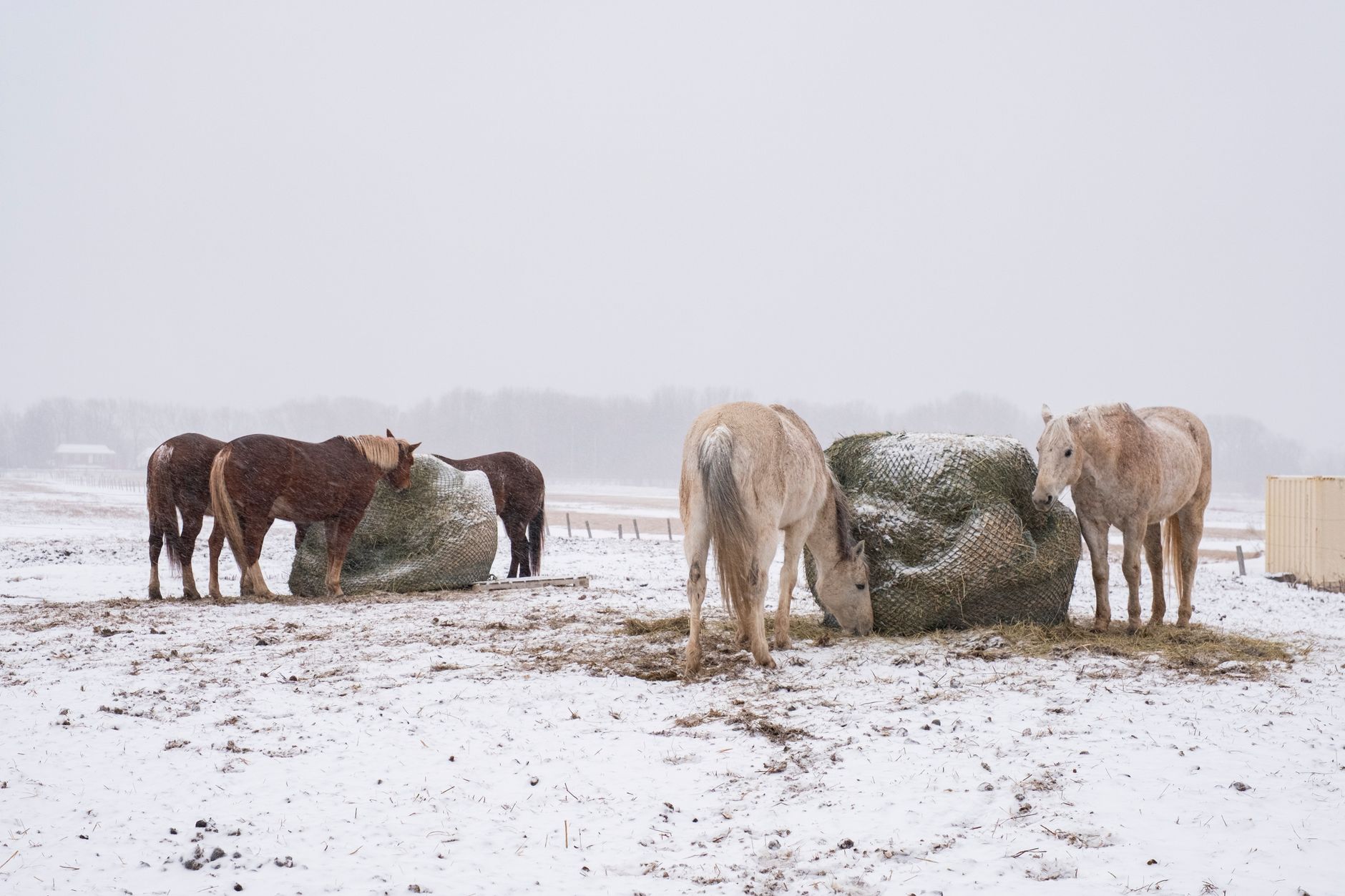
How much hay does a horse eat in the winter?
Cold weather is the single biggest thing that changes how much hay a horse eats, and it is the thing almost every feeding guide leaves out. An 1,100 lb horse that gets by on 25.7 lb (11.7 kg) in mild weather needs 36.3 lb (16.5 kg) once overnight lows sit at 20 °F — about 41% more, every day, for as long as the cold lasts.
Over a 120-day winter that difference is roughly 88 bales bales instead of the 62 bales a mild season would take. It is the difference between having enough hay in March and buying at March prices.
The figures on this page come from the same engine as our horse hay calculator, so you can put your own horse, coat and overnight low through it rather than reading off a table built for someone else’s animal.
How much hay does a horse eat in the winter per day?
For a 1,100 lb horse at maintenance with a moderate winter coat, dry and out of the wind:
| Overnight low | Per day | Per 30 days | 50 lb bales per month |
|---|---|---|---|
| Mild (above 50 °F) | 25.7 lb (11.7 kg) | 772 lb (350 kg) | 16 bales |
| 40 °F | 29.3 lb (13.3 kg) | 878 lb (398 kg) | 18 bales |
| 30 °F | 32.8 lb (14.9 kg) | 983 lb (446 kg) | 20 bales |
| 20 °F | 36.3 lb (16.5 kg) | 1,089 lb (494 kg) | 22 bales |
| 10 °F | 38.6 lb (17.5 kg) | 1,158 lb (525 kg) | 24 bales |
| 0 °F | 38.6 lb (17.5 kg) | 1,158 lb (525 kg) | 24 bales |
Two things in that table surprise people. The first is how early it starts — the requirement is already climbing at 40 °F, which most people would not call cold. The second is that it stops climbing near the bottom, and not for a good reason.
Why cold weather raises hay needs at all
Below a certain temperature a horse starts spending energy purely on staying warm. That threshold is its lower critical temperature, and it is not a fixed number — it depends almost entirely on the coat:
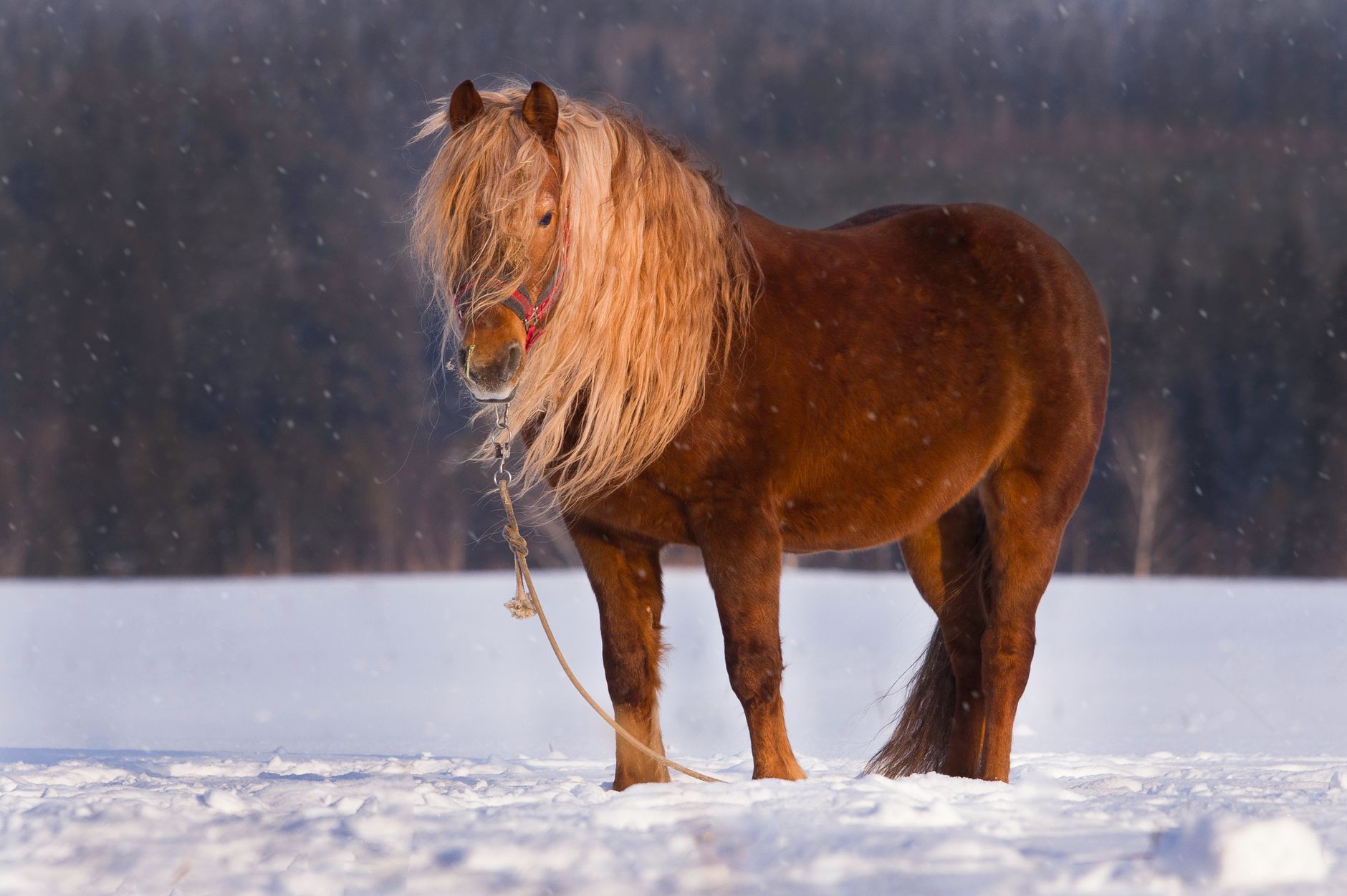
- Heavy winter coat, dry, out of the wind — about 30 °F. At 20 °F this horse needs 29.3 lb (13.3 kg).
- Moderate coat — about 50 °F. At 20 °F, 36.3 lb (16.5 kg).
- Wet, clipped or short-coated — about 60 °F. At 20 °F, 38.6 lb (17.5 kg).
Same horse, same night, and the difference between the best and worst case is larger than most people’s entire winter adjustment. Rain is what does it: a flattened wet coat has almost no insulating value left, which is why the wet threshold sits 30 degrees above the dry one.
Below the threshold the requirement climbs steadily. You will often see this quoted as 1% more feed per degree below critical temperature, a rule published by more than one extension service. It is a reasonable pocket estimate, but it rounds down. Working from the underlying figure in the NRC tables gives closer to 1.4% per degree — which at 0 °F is an energy requirement 68% above maintenance rather than the 50% the simple rule gives. (The hay figure in the table at 0 °F is lower than that implies, because it runs into the intake ceiling below — see the next section but one.)
We would rather explain that gap than quietly publish the smaller, friendlier number.
How much hay does a 1200 lb horse need per day, and other weights
Hay scales almost directly with body weight, so a bad weight guess is a bad answer no matter how careful the rest of the arithmetic is. A weight tape is close enough for feeding decisions, though it reads low on stocky, heavily muscled horses.
| Body weight | Mild | 30 °F | 20 °F | 10 °F | 0 °F |
|---|---|---|---|---|---|
| 800 lb | 18.7 lb (8.49 kg) | 23.8 lb (10.8 kg) | 26.4 lb (12 kg) | 28.1 lb (12.7 kg) | 28.1 lb (12.7 kg) |
| 1,000 lb | 23.4 lb (10.6 kg) | 29.8 lb (13.5 kg) | 33 lb (15 kg) | 35.1 lb (15.9 kg) | 35.1 lb (15.9 kg) |
| 1,100 lb | 25.7 lb (11.7 kg) | 32.8 lb (14.9 kg) | 36.3 lb (16.5 kg) | 38.6 lb (17.5 kg) | 38.6 lb (17.5 kg) |
| 1,200 lb | 28.1 lb (12.7 kg) | 35.8 lb (16.2 kg) | 39.6 lb (18 kg) | 42.1 lb (19.1 kg) | 42.1 lb (19.1 kg) |
| 1,400 lb | 32.7 lb (14.9 kg) | 41.7 lb (18.9 kg) | 46.2 lb (21 kg) | 49.1 lb (22.3 kg) | 49.1 lb (22.3 kg) |
How much hay is too much? The point where hay stops being the answer
Look along the bottom row of the first table and the number stops moving. That is not the horse getting comfortable — it is the intake ceiling.
A horse cannot eat unlimited forage. Voluntary intake tops out near 3% of body weight in dry matter. Below roughly 13 °F, our 1,100 lb moderate-coated horse needs more energy than that much hay can supply, and the honest answer becomes: hay alone will not do it. The balance has to come from concentrates, or from changing the conditions — a rug, a windbreak, a dry shed.
Nearly every hay calculator online will happily print a number well past this ceiling. It is arithmetic that has stopped describing anything real. Ours caps the figure and says so.
Turning that into bales
Weight is the answer; bales are how you buy it. The conversion is where most winter hay plans go wrong, because a bale is not a unit of weight.
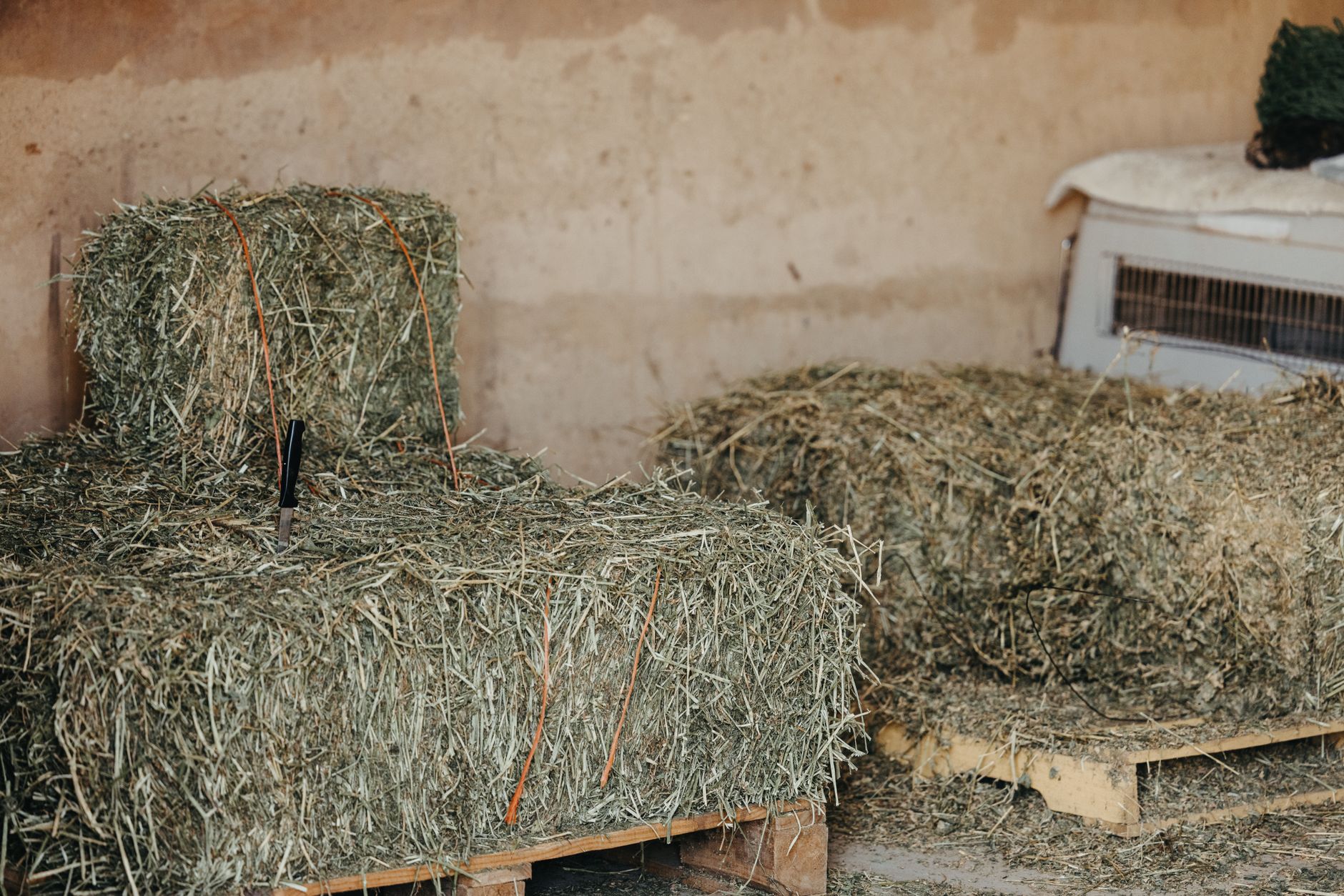
For one 1,100 lb horse over a 120-day winter at 20 °F overnight, that is 4,355 lb (1,975 kg) of hay — 88 bales of 50 lb small squares. Buy bales that actually weigh 40 lb and you are 20% short before you start.
Round bales change the sum completely, because of waste rather than intake. The same horse and the same winter on 900 lb round bales:
- No feeder, bale on the ground: 11 bales. Around 57% is trampled, bedded on or rained into.
- With a restrictive feeder: 5 bales.
That is most of a bale in every two saved by a piece of steel. In the Minnesota trials every feeder design tested paid for itself within twenty months, and most within a single winter.
How much hay do I need for winter: work it out for your own place
Four numbers, in this order:
- Weigh a bale. Stand on a bathroom scale holding one and subtract yourself. Five minutes, and every other figure scales directly off it.
- Tape the horse. Or use a girth-and-length formula, which beats a tape. Do not guess from breed.
- Use your overnight low, not the daytime high. The horse stands out in the coldest hours; that is the number that sets the requirement.
- Count the cold days, not the calendar. A 120-day winter at 20 °F is a plan. “Winter” is not.
Then add a margin. Hay runs out in the worst weather of the year, when everyone else is looking for it too and the price knows it.
What else changes the answer
Wind and wet beat cold
A dry horse in still air at 10 °F is more comfortable than a wet horse in wind at 35 °F. Shelter, a windbreak and a dry back are worth more than extra hay, and they are cheaper. Feed the extra hay as well when it is genuinely cold — but fix the wet first.
Hay is the heater
The reason hay specifically, rather than grain, is the right lever in cold weather: fermenting forage in the hindgut produces heat for hours afterwards. Grain is digested further forward and does much less of this. A late-night hay net warms a horse through the coldest part of the night in a way an extra scoop of feed does not.
Water is the limiting factor nobody counts
Horses drink less when water is near freezing, and a horse eating this much dry forage on reduced water intake is the classic winter impaction. Whatever the hay figure says, the water supply has to keep up with it.
Old horses and hard keepers sit at the top of the range
Every figure here carries a range, and the range is not decoration. An easy keeper holds condition near the bottom of it; an older horse, a hard keeper, or one with poor teeth sits at or above the top. Winter is when that difference shows, and by the time it shows in the coat it has already shown in the ribs.
Common questions about feeding hay in winter
How much hay should I feed my horse in winter?
Start from 2% of body weight a day in dry matter. Hay is only about 90% dry matter, so on the scale that is more than it sounds: 25.7 lb (11.7 kg) of actual hay for an 1,100 lb horse in mild weather. Add roughly 41% once overnight lows reach 20 °F. Then correct it by hand on the horse in front of you — feel the ribs every two weeks, and if you can see them, feed more; if you cannot feel them without pressing, feed less.
How many bales of hay does one horse eat per month?
At 50 lb a bale, about 16 bales in mild weather and 22 bales at 20 °F. That figure moves with bale weight more than with anything else, so weigh one of your own bales before you order — small squares sold as “fifty pound bales” run anywhere from 35 lb to 80 lb.
How long will a bale of hay last for one horse?
A 50 lb small square lasts roughly two days in mild weather and closer to one and a half in a 20 °F cold snap, once waste is counted. A 900 lb round bale is a different question: it holds about 25 days of hay for one horse, but fed on the ground with no feeder around 57% of it never reaches the horse, so in practice it is gone in about 11 days.
How much hay does a 1200 lb horse need per day?
28.1 lb (12.7 kg) in mild weather, and 39.6 lb (18 kg) at 20 °F with a moderate coat. Hay scales almost directly with body weight, which is why a good weight figure matters more than any other input on the page.
How many bales of hay per horse for winter?
For a 120-day winter averaging 20 °F overnight, one 1,100 lb horse needs about 4,355 lb (1,975 kg) — 88 bales of 50 lb small squares. Buy the whole winter in one go if you have the storage. Hay bought in February is bought at February’s price.
Can horses go all night without hay?
They can, but the horse is built to trickle-feed and a long empty gap is where ulcers and wood-chewing start. In cold weather it also costs you the one thing that actually warms the horse: fermenting forage in the hindgut generates heat for hours after it is eaten. A late-night hay net does more good in January than a rug does.
Do horses need to eat hay all day?
Close to it. Left to themselves, horses graze for most of a day in short bouts. Slow feeders and small-hole nets are the practical way to stretch a fixed weight of hay across more hours without feeding more of it — useful when the calculator’s answer is more than your horse should carry.
Related calculators and guides
- Horse hay calculator — run your own horse, coat, temperature and bale weight through the same engine that produced every figure on this page
- All horse calculators — the rest of the tools in this section
Where these figures come from
Every figure on this page is published and cited. Where sources disagree we take the more conservative one and say so. Our full approach is set out in how we source our numbers.
- Caring for Horses in Cold Weather — Utah State University Extension
- Feeding horses with a round-bale feeder — University of Minnesota Extension
- Hay Storage: Dry Matter Losses and Quality Changes — Mississippi State University Extension
- Nutrient Requirements of Horses, Sixth Revised Edition — National Research Council / National Academies Press
- Nutritional Requirements of Horses and Other Equids — Merck Veterinary Manual
- Properly curing hay is crucial for forage quality — North Dakota State University Extension
- Round-bale feeder design affects hay waste and economics during horse feeding — Journal of Animal Science 90(3):1047
- Selecting a small square-bale feeder — University of Minnesota Extension
- Selecting and storing horse hay — University of Minnesota Extension
- Ten ways to stretch your horse’s hay supply — University of Minnesota Extension
- The effect of small square-bale feeder design on hay waste and economics during outdoor feeding of adult horses — Journal of Equine Veterinary Science
- The energy requirements of performance horses in training
- Winter Care for Horses (G1873) — University of Nebraska-Lincoln Extension
- Winter Feeding for Horses, Fact Sheet #1143 — Rutgers University, Department of Animal Sciences